Ainu Culture in Hokkaido
The Ainu are northern Japan’s indigenous people, and once you know a little about Ainu culture, you see Hokkaido differently. Plenty of travelers arrive in Sapporo thinking about snow, crab and beer, with no idea that nearly every name on the island’s map comes from another language entirely, not from Japanese.
Their culture came close to disappearing, but today you’ll find it in museums, villages and theaters all over the island. You don’t need to be into anthropology to understand it. A bit of curiosity is enough.
Contents
Who the Ainu are
The Ainu lived in Hokkaido, southern Sakhalin and the Kuril Islands long before the Japanese pushed this far north. In their language, the word ainu simply means “human being” or “person,” and it’s how they set themselves apart from spirits and gods.
For centuries they lived by hunting, fishing and gathering, in step with the seasons: salmon swimming upriver in the fall, deer, bears, wild mountain plants. Their villages, called kotan, usually stood along rivers or near the sea, with houses of wood and reeds called chise.
Ainu culture has nothing in common with the Japanese culture you see in Kyoto or Tokyo, whether in language or traditions. The Ainu language isn’t related to Japanese, and it has no clear link to any other language in the world.
Things look different too: the clothing, the embroidery, the music, the way people pray. When you walk into an Ainu museum, it feels more like a museum of the peoples of the Far North than a Buddhist temple.
Kamuy and Ainu spirituality
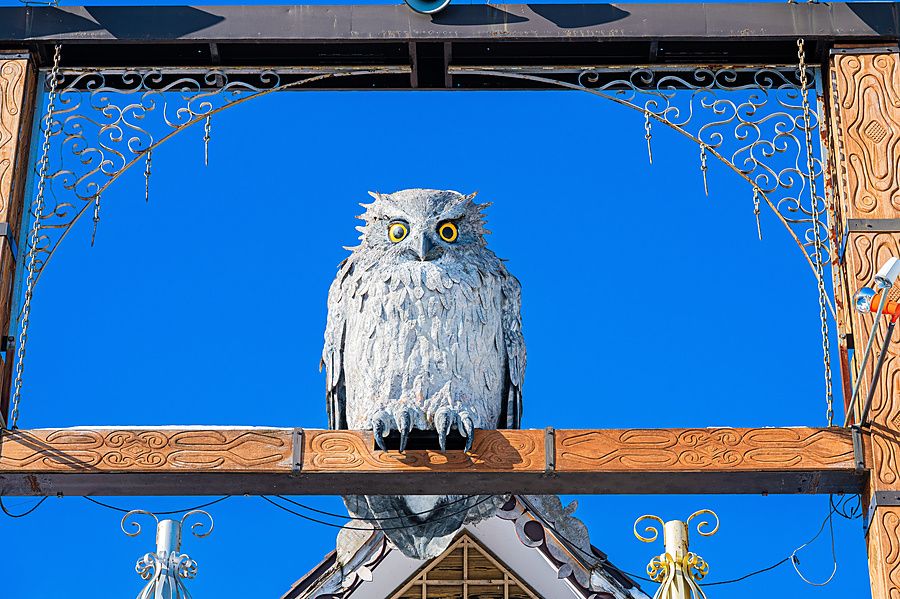
For the Ainu, anything that plays a part in daily life is a kamuy, a divine presence. The bear, the fox, the owl, the fire in the hearth, water, even a cooking pot or a boat: each has a spirit that must be respected and thanked.
The underlying idea is that kamuy come into the human world in disguise, as animals for example, and bring their meat and fur as gifts. In return, people send them back with prayers, offerings and respect, so they can come back again.
The best-known ritual is iomante, the ceremony that sent the spirit of a bear raised in the village back to the world of the gods. It’s no longer practiced in its traditional form, but the thinking behind it explains a lot about Ainu culture.
During prayers people use inaw, wooden sticks carved into very fine curls, and ikupasuy, small carved spatulas used to offer sake to the gods. When you see them on display in a museum they look decorative, but they were everyday tools, made by hand by the men in the family.
That’s exactly what I like about it: it’s a very down-to-earth spirituality. There are no grand religious buildings, just a direct relationship with the river, the forest and the fire at home.
A painful history
The story of the Ainu and Japan is one of trade, exploitation and then forced assimilation. In the Edo period the Matsumae clan in southern Hokkaido controlled trade with the Ainu, on terms that grew more and more unfavorable for them.
In 1669 an Ainu chief named Shakushain led a major uprising against the Matsumae. It ended when he was killed during peace talks, and after that defeat Japan’s grip on the island grew even tighter.
The hardest blow came in the Meiji period. In 1869 the island, until then called Ezo, was renamed Hokkaido and formally made part of the Japanese state, and thousands of settlers arrived from Honshu.
Traditional activities like salmon fishing in the rivers and deer hunting were banned or restricted for the Ainu, and they were pressured to adopt Japanese names and speak Japanese. In 1899 the Hokkaido Former Aborigines Protection Act came into force. Its name promised protection, but in practice it aimed to turn the Ainu into farmers and assimilate them.
That law stayed on the books until 1997, when a law promoting Ainu culture replaced it. In 2008 the Japanese parliament passed a resolution calling for the Ainu to be recognized as an indigenous people, and in 2019 Japan passed its first law officially recognizing them as one.
I’ll be honest with you: many people are surprised to learn that Japan, which often presents itself as a country of just one people, only recognized an indigenous people by law in the 21st century.
The Ainu language
UNESCO lists Ainu as critically endangered. Native speakers have all but disappeared, and the people who know the language today learn it as a second language, from classes, recordings and books.
A lot of the credit for saving it goes to people like Kayano Shigeru, born in Nibutani, who spent decades taping the stories of the elders and in 1994 became the first Ainu to sit in the Japanese parliament. Before him, in the 1920s, a young Ainu woman named Chiri Yukie wrote down her people’s epic songs and translated them into Japanese, in a book that’s still studied in Japan today.
While you’re in Hokkaido, pay attention to place names, because the Ainu language is still there, right in front of you. A huge number of the island’s place names come from Ainu words rendered in Japanese characters:
- Sapporo comes from an Ainu expression connected to a large dry river, though scholars don’t all agree on the exact origin.
- Shiretoko, the wild peninsula in the east, comes from sir etok, which roughly means the tip of the land.
- Many names ending in -betsu or -nai, like Noboribetsu or Wakkanai, contain the Ainu words for river or stream.
- Mount Iwaonupuri, Lake Toya and Otaru have Ainu roots too, often tied to the shape of the land or to rivers and streams.
Once you know this, you start reading road signs differently. It’s one of the easiest ways to see that Hokkaido had a history of its own long before the settlers arrived. The Ainu word you’ll hear most often is irankarapte, the welcome greeting people will say to you at the entrance to Upopoy and in the shops at Akan. It translates roughly as “let me touch your heart,” and saying it back is a small gesture people appreciate.
Embroidery, woodcarving and music
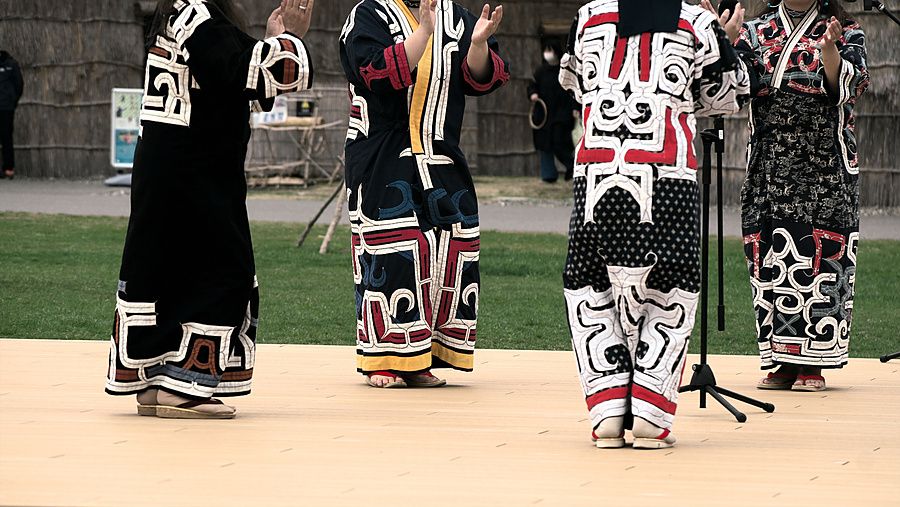
You can spot Ainu craftwork at a glance from its spiral patterns and thorn shapes, embroidered on clothing or carved into wood. The spirals are called moreu and the pointed shapes aiushi, and traditionally they were also meant to protect the wearer from evil spirits, especially at the collar, cuffs and hems.
The most traditional fabric is attus, made from the fiber of the inner bark of the elm. It’s rough, sand-colored and very tough. In Nibutani it’s still made by hand, along with carved wooden trays called ita, and both are officially recognized as traditional crafts.
You’ll almost certainly hear two instruments. The mukkuri is a bamboo mouth harp that you play by pulling a string, and it makes a vibrating sound that mimics wind or rain. The tonkori is a long, narrow string instrument typical of the Sakhalin Ainu.
Almost every Ainu craft shop sells mukkuri, and it’s one of the smartest souvenirs to bring home: it’s cheap, weighs nothing, and with a little practice you can learn to play it. The traditional dances, which are on UNESCO’s Intangible Cultural Heritage list, are often performed in a circle, with everyone clapping and singing together.
Upopoy in Shiraoi
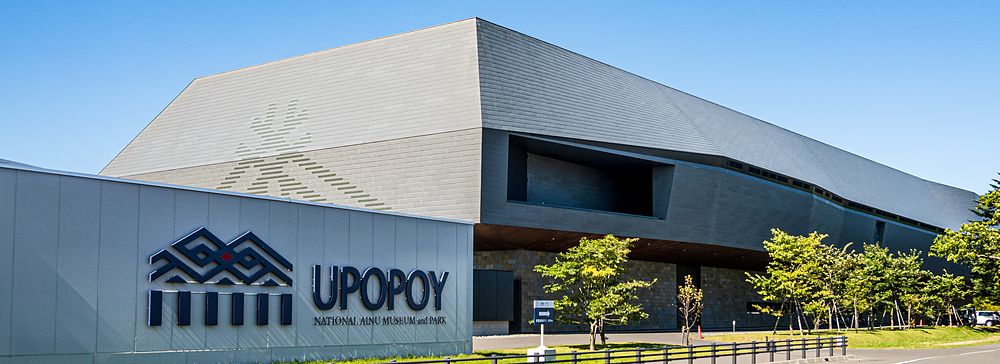
If you want to understand Ainu culture in a single day, Upopoy is the place to start. It’s the national center for the Ainu, opened in 2020 in Shiraoi, on the shore of Lake Poroto between Sapporo and Noboribetsu. In Ainu, the name means singing all together.
It’s a large open-air site with the National Ainu Museum, a reconstructed village of traditional chise houses, a hall for dance and music performances, and workshops where you can see woodcarving, embroidery and cooking up close.
I think you get the most out of it if you take your time instead of treating it as a quick stop between one onsen and the next. The museum alone is worth a couple of hours, and the exhibit text is in Ainu first, then Japanese and English. On top of that there are performances at set times and demonstrations in the village, which you’ll have to plan around.
A few practical tips for planning your visit:
- Allow at least half a day, or ideally a full day if you want to see the performances and do one of the workshops.
- Check the day’s schedule as soon as you arrive, because dances, mukkuri concerts and demonstrations only happen a few times.
- Shiraoi is on the JR line between Sapporo and Hakodate, and Upopoy is a few minutes’ walk from the station, so it’s an easy day trip even without a car.
- Admission is around 1,000–1,500 yen, and some workshops cost extra, so check the current prices before you go.
- If you’re staying in Noboribetsu or at Lake Toya, Upopoy is on your route, so you can stop there on your way to or from Sapporo.
The Ainu village at Lake Akan
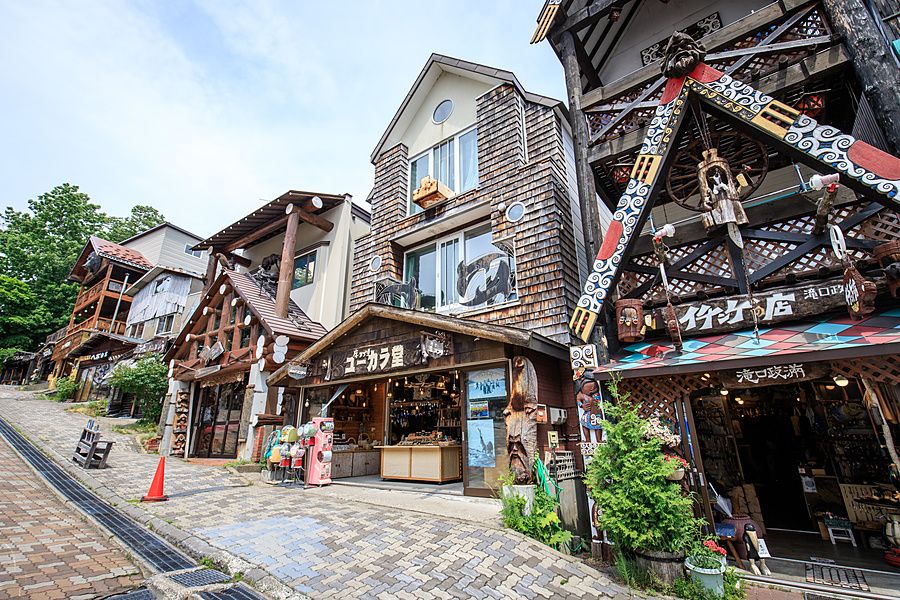
The Ainu village at Lake Akan, in eastern Hokkaido, is where Ainu culture feels most like part of everyday life. It’s the largest kotan on the island: a narrow uphill street lined with dozens of craft shops, many run by Ainu families who live there, with a theater at the top.
In the shops you’ll see craftspeople at work, sitting behind the counter carving wooden owls, bears and bowls. Small pieces go for a few hundred yen, and at the other end there are sculptures that cost as much as a piece of furniture.
The theater, Ikoro, was the first in Japan devoted entirely to Ainu culture. It has a circular stage with a real fire burning in the middle. In the evening there are traditional dances and, on a rotating schedule, more modern shows.
The best known is Lost Kamuy, which mixes Ainu dance, contemporary dance and digital projections to tell the story of the bond between the Ainu and the Hokkaido wolf, which is now extinct. Honestly, if you have two evenings, I’d see both the traditional show and the modern one. They’re very different, and together they show how this culture keeps renewing itself instead of staying shut away in a museum.
Akan works best as part of an itinerary through eastern Hokkaido, along with Akan-Mashu National Park, Lake Mashu, Lake Kussharo and maybe Kushiro. It’s a long way from Sapporo, and a day trip there doesn’t make sense.
Nibutani and Sapporo
Nibutani, in the town of Biratori, has one of the highest proportions of residents of Ainu descent in Hokkaido. It’s home to the Nibutani Ainu Culture Museum and to the private museum founded by Kayano Shigeru, which holds hundreds of objects he collected or reconstructed himself. Many of them are now designated nationally important cultural properties.
The woodcarvers and attus weavers have their workshops along the main street, and the village feels very different from Upopoy. It’s quieter, with fewer tourists, and the people you see are locals going about their work. I’d recommend it mainly if you have a car, because getting there by public transportation is slow and awkward.
If you’re in Sapporo and short on time, a couple of places are worth keeping in mind. Sapporo Pirka Kotan, in the Jozankei area south of the city, is a small cultural center with a reconstructed traditional house and a display of everyday objects.
The Hokkaido Museum, near Shin-Sapporo Station, also devotes a good part of its exhibits to Ainu history, and it lets you see that history alongside the story of the Japanese settlers. Both visits are shorter and less engaging than Upopoy, but they’re useful if your trip doesn’t take you outside the city.
Ainu food
Ainu cooking is simple and built around what nature provided: salmon, deer, potatoes, beans and lots of wild greens. The most common dish is ohaw, a savory soup with fish or meat and vegetables, which is considered a precursor to some of Hokkaido’s local soups, like sanpei-jiru.
Chitatap is meat or fish finely chopped with a knife and mixed with herbs, while ratashkep is a kind of stew of vegetables and mashed beans, seasoned with fat or oil. One plant you’ll come across a lot is pukusa, a wild garlic that gives many dishes a very strong aroma.
There aren’t many chances to try Ainu food, but there are some. Upopoy has a restaurant serving dishes inspired by traditional cooking, and in Akan village a few places serve soups and game dishes.
In Tokyo, an Ainu restaurant in Okubo, near Shinjuku, has been open for years, and for a lot of people it was their first encounter with this kind of food. Don’t expect anything elaborate. Think soups and rustic dishes, which you’ll enjoy most if you like simple rural cooking and game.
Golden Kamuy and manga
Some of the interest travelers have in the Ainu comes from Golden Kamuy, Noda Satoru’s manga set in early 20th-century Hokkaido, which was later adapted into an anime and films. The heroine, Asirpa, is an Ainu girl, and through her the story teaches you about hunting, cooking, beliefs and language.
I often recommend it to people who want a light introduction before a trip, because the cultural details were worked out with the help of a linguist who specializes in the Ainu language. Of course, it’s still a work of fiction, with plenty of action and some over-the-top moments.
Chitatap, for example, became hugely famous in Japan because of a scene in the manga. If you’ve read it, you’ll recognize a lot of things at Upopoy and Akan.
Visiting respectfully
The Ainu aren’t a tourist attraction. They’re people living in Hokkaido today who have ordinary jobs, shop at the supermarket and use smartphones like everyone else. Many don’t even know they have Ainu roots, because for generations families chose not to talk about it to avoid discrimination.
Official figures put the number at just over ten thousand people in Hokkaido, but that depends on who chooses to identify as Ainu, and the real number is probably higher.
When you visit a village or watch a performance, the same common-sense rules apply as they would with any community:
- Always ask before photographing someone up close, especially craftspeople working in their shops.
- During ceremonies and ritual dances, follow the staff’s instructions about taking photos or recording video, since that isn’t always allowed.
- Avoid questions about people’s physical features or appearance, which for many Ainu are tied to memories of discrimination.
- If you buy something, choose pieces handmade by Ainu artisans, which are usually labeled as such, over mass-produced souvenirs.
Honestly, the best way to respect a culture is to learn a bit about it before you arrive. A couple of evenings of reading or a single documentary episode is enough to make a big difference to how you experience the visit.
My advice
If you’re going to Hokkaido, set aside at least a day for Ainu culture. Upopoy is the easiest place to get to, and if your itinerary takes you to the eastern part of the island, an evening at Akan with the fire burning in the middle of the theater is worth the trip.
I’d start with Upopoy to get the big picture, then, if you have time, go on to Akan or Nibutani, where the culture feels more alive. And for the rest of your trip, try reading the names of the rivers and towns you pass. You’ll notice that Hokkaido still speaks Ainu, just quietly.