Best Places to See Autumn Leaves in Kyoto
Kyoto in autumn is worth the trip all on its own. Dark wooden temples, green moss, bright red maples: when the autumn leaves in Kyoto turn, the whole city feels like it was designed to be looked at.
The problem is that everyone knows it, and in the best weeks the most famous places get hard to enjoy. The trick is timing: the right dates, the right area for that particular week and the right time of day to visit. Get those right and you’ll see the red maples without spending the day in line behind a thousand people.
Contents
When to go
The best time to see autumn leaves in Kyoto runs roughly from mid-November into early December. October is too early, since the leaves are still green almost everywhere except for a few scattered trees.
The peak doesn’t hit everywhere at once, though. The mountain areas to the north and northwest, like Takao, Ohara and Kurama, turn first, as early as the beginning or middle of November. The city temples, from Higashiyama to Tofukuji, are at their best in the second half of the month and sometimes into early December.
That gives you a practical advantage. If you arrive in early November, head for the mountains; if you arrive at the end of the month, stay in the city. The dates also shift by a few days every year depending on how warm the autumn is, and a warm October can push everything back by a week.
I’d keep an eye on Japanese websites that track the colors temple by temple, such as weather forecast sites. They use scales along the lines of “starting,” “halfway” and “peak,” and you can follow them without any Japanese just by looking at the colors of the icons.
Tofukuji and the bridge
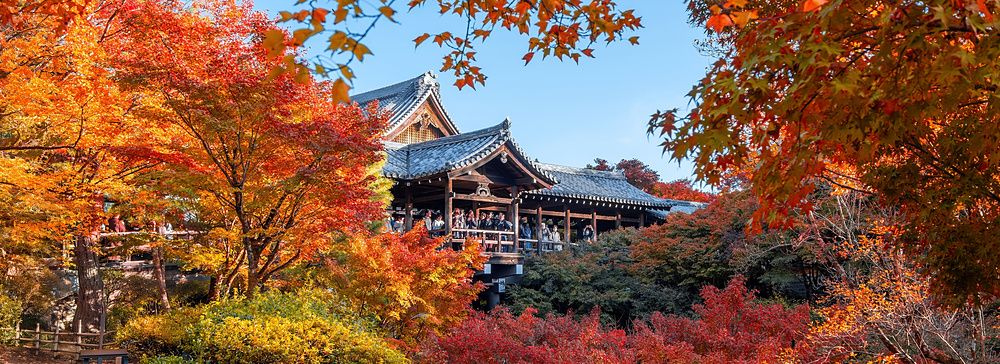
If I had to pick just one place for autumn leaves in Kyoto, it would be Tofukuji. It’s a large Zen temple south of Kyoto Station, with about two thousand maples planted in a small valley with a stream running through it.
The most famous spot is Tsutenkyo, a covered wooden bridge that crosses the valley. Looking down from it, you see a carpet of red, orange and yellow treetops, the photo that’s in half the guidebooks to Japan.
During peak weeks hundreds of thousands of people come through. On those days you’re not allowed to stop for photos on the bridge and staff keep everyone moving, which makes sense, because otherwise nobody would move at all.
Go at opening time, which is a little earlier in autumn than during the rest of the year. Before you go in, stop at Gaunkyo, the other bridge, which is outside the paid area. It looks across the same valley from the opposite side, so you get to see Tsutenkyo from the outside.
It’s an easy train ride to Tofukuji Station, on either the JR or the Keihan line, and entry to the bridge area costs around 1,000 yen.
Around Eikando
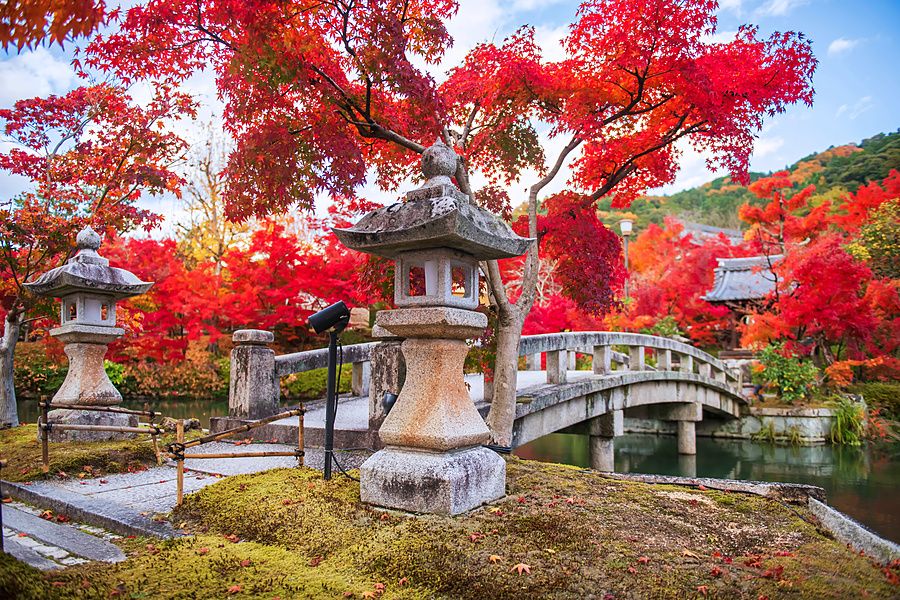
People in Kyoto just call Eikando the maple temple, and it’s no exaggeration. It’s near Nanzenji, in the northern part of Higashiyama, and has around three thousand trees, Japanese maples of several species.
Here the color isn’t concentrated in one spot. There’s the pond with the trees reflected in it, there are the wooden corridors climbing the hill, and there’s a small pagoda at the top with a view over the whole city. One of the halls also holds a statue of Amida Buddha that’s famous for its head turned back over its shoulder, as if it were turning to look at whoever is following it.
In autumn the ticket is a bit more expensive than usual, about 1,000 yen, because it also gets you into an exhibition of the temple’s treasures. I’ll be honest with you: around midday on weekends in late November, you’ll be shuffling along in line.
From Eikando, keep going on foot. Nanzenji is just around the corner and worth a stop for its red brick aqueduct, and if you head north along the Philosopher’s Path you’ll reach Shinnyodo in about twenty minutes. I’ll get to Shinnyodo further down.
Kiyomizudera at night
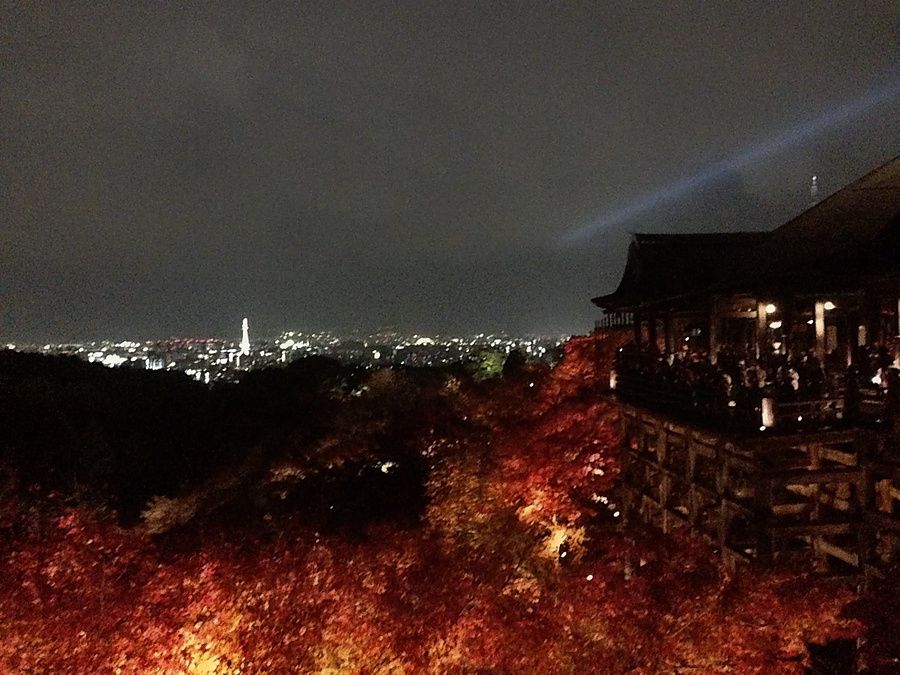
Kiyomizudera is lovely on an autumn day, but it’s also one of the most crowded places in all of Japan. My advice is to go in the evening, during the special evening hours the temple runs while the leaves are turning.
More than a thousand maples around the famous wooden terrace are lit up, and a beam of blue light shoots into the sky from the temple, representing the mercy of Kannon, the deity it’s dedicated to. Seen from across the valley, with the terrace suspended over the red trees, it’s a scene you don’t get during the day.
There are still crowds in the evening, especially right after it opens. After dinner the crowds thin out a bit on Ninenzaka and Sannenzaka, the uphill lanes leading to the temple, and walking them is easier than in the afternoon.
Keep in mind that it gets cold after sunset in late November, and colder still up on that hill. Bring a real jacket, not just a light sweater.
Evening illuminations
While the leaves are turning, many Kyoto temples stay open after sunset, with the maples lit from below. It’s a chance to see the same place twice, and often a way to skip the busiest hours of the day too.
These are my favorites:
- Eikando: the lights reflect in the pond, and the evening ticket is separate from the daytime one.
- Kiyomizudera: the blue beam of light and the view of the terrace I just mentioned.
- Hogonin in Arashiyama: a small temple that opens only in spring and autumn, and in the evening lights up a garden with the mountain behind it.
- Daigoji: southeast of the city, where the Bentendo hall is reflected almost perfectly in the pond.
- The maple garden at Kitano Tenmangu: open into the evening with the lights on.
Dates and hours for the evening openings change every season, and you almost always need a separate ticket. Check them before you go and don’t plan more than one a night, because with November traffic, getting from one temple to the next eats up a lot of time.
Arashiyama in autumn
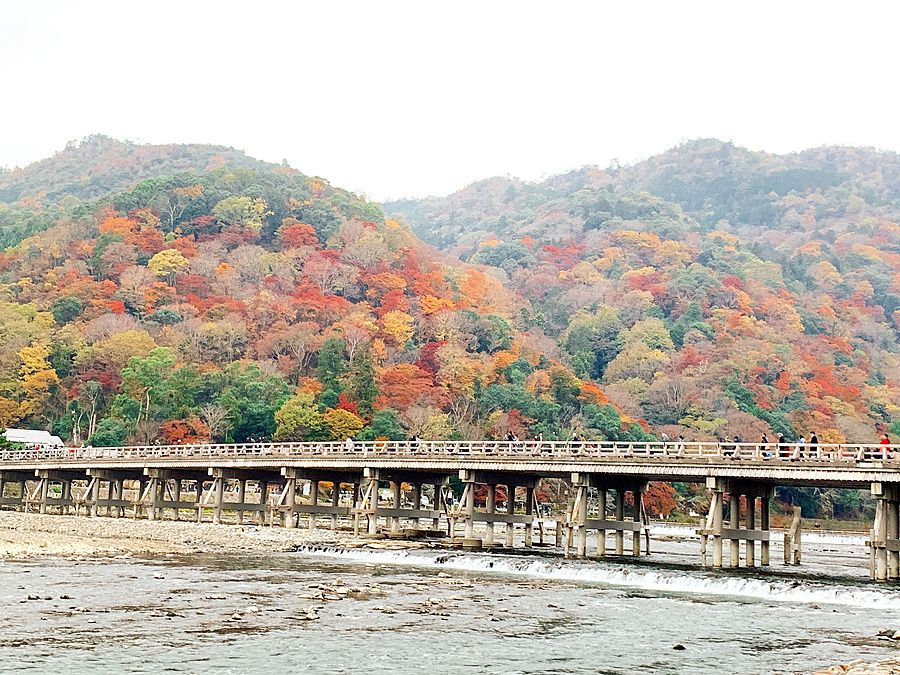
Arashiyama, on the west side of the city, has a sight in autumn you won’t get anywhere else: whole mountains changing color behind the river and Togetsukyo Bridge. The bamboo grove stays green year-round, but the area around it has lots of temples with maples.
My favorite for autumn leaves is Jojakkoji, which climbs the side of the hill. From the gate to the main hall and on up to the small pagoda at the top, you walk under a tunnel of red leaves, and from up there you can see Kyoto in the distance. Tenryuji has the most famous garden in the area, while Hogonin, part of the same complex, feels more intimate.
The problem in Arashiyama is the number of people, which gets really hard to handle on November weekends. By mid-morning the main street to the bridge is a river of people, and the buses get stuck in traffic.
What I always recommend is to get there early by train, head straight for the northern side, around Jojakkoji and the smaller temples at the foot of the hill, and save the bridge area for late afternoon.
Ohara and the north
Ohara is a small village in the countryside north of Kyoto, about an hour by bus from the center, and in autumn it’s one of the places where you can enjoy the leaves at a more relaxed pace. The main temple is Sanzenin, with green moss on the ground and red maples overhead, set around a small, very old wooden hall.
A little further on is Hosenin, which I like precisely because you sit down to look at it. You settle on the tatami in an open room, they bring you green tea with a small sweet, and the pillars frame the garden outside like a painting, with green bamboo and red maples.
Ohara turns earlier than the center, usually between mid- and late November, and it’s sometimes already at its peak while the city temples are only halfway there.
Also in the north, in the Yase area, is Rurikoin, the temple from all those photos of maples reflected in the black lacquered table on the second floor. It’s open to the public only in spring and autumn. In peak weeks entry is by reservation, and the ticket is pricey by Kyoto temple standards, around 2,000 yen, though it’s worth checking current prices before you go.
It’s worth it if you’re after that photo and that room in particular, knowing that it isn’t easy to take pictures at your own pace in there.
To get to Rurikoin, Kurama and Kibune you take the Eizan line, a small local train that leaves from Demachiyanagi Station. Between Ichihara and Ninose stations the track runs through the maples, and on autumn evenings the trains slow down and switch off their interior lights while the trees outside are lit up.
It only lasts a few minutes, but it’s one of those little things I always show anyone who comes to Kyoto in November. During those weeks Kibune also puts up lanterns and lights along the stream and around the shrine.
Takao and the mountains
Takao is where to go if you arrive in early November and find the city still green. It’s a mountain valley northwest of Kyoto, about an hour away by bus, and the leaves turn earlier here than elsewhere.
The main temple is Jingoji, which you reach by climbing a long flight of steps through the woods. You’ll sweat even when it’s cool out, so bring walking shoes. There are some very old maples, and from the edge of the temple people throw small clay disks into the valley, a good-luck custom that’s still practiced today.
There’s a lot more walking here than at the city temples, and the bus is slow, so I’d recommend Takao to people who’ve already seen the better-known spots or who want a half day out in nature.
Quieter spots
Some temples have maples just as beautiful as the famous ones, with far fewer people. They’re not empty, since nothing in Kyoto is empty in November, but you notice the difference.
- Shinnyodo: near Ginkakuji, with a long stone path lined with huge maples and a three-story pagoda rising out of the red. The outer grounds are free to visit.
- Bishamondo: in Yamashina, about a twenty-minute walk from the station, and famous for the carpet of fallen leaves on its steps, which looks best early in the morning before anyone has walked on it.
- The maple garden at Kitano Tenmangu: in the northwest of the city, it sits on a stretch of the old earthen walls built by Toyotomi Hideyoshi and has about 350 trees, some of them very old; the ticket includes tea and a sweet.
- Daigoji: in the southeast, a huge complex founded in the 9th century. By day the pond area is the part most worth seeing, especially in late November.
Shinnyodo and Bishamondo tend to peak a bit later, between the end of November and early December. That’s why I suggest them to anyone traveling closer to the start of winter who’s worried they’ve missed the best time.
Crowds and getting around
Weekends in mid and late November are the busiest time, and during the peak weeks crowds are at their worst roughly between 9:00 and 14:00. On those days some temples limit how many people they let in, and a line forms outside the gate.
In the fall, city buses are Kyoto’s weak spot. They fill up fast and sit in traffic, and often you can’t even get on. Many temples also close their parking lots during that period, so driving is a terrible idea.
My advice for surviving it is simple:
- Get around by train and subway, even if it means walking an extra ten or fifteen minutes. On those days you’ll often get there faster on foot than by bus.
- Visit the most famous place on that day’s plan right when it opens, first thing in the morning, and leave the lesser-known places for the middle of the day.
- If you can, save the best-known temples for weekdays and spend the weekend in the mountains or at quieter places.
- Leave your luggage at the hotel or have it shipped from the station. Dragging a suitcase onto packed buses in November is a nightmare for you and for everyone around you.
- Book your accommodations very early, because Kyoto is packed in late November and hotel prices go up a lot.
One last thing about tickets. In the fall almost every famous temple charges admission, usually between 500 and 1,000 yen, and special or evening openings cost extra. Over a full day it adds up to real money, so plan for it.
How I’d do it
If it were my first fall trip to Kyoto, I’d go to Tofukuji one morning right at opening and to Kiyomizudera or Eikando one evening. I’d also spend a day outside the city, around Ohara and along the Eizan line. The rest of the time I’d leave for smaller temples, and I’d pick them based on where the leaves have turned that day.
You don’t need to see twenty temples. Four or five are enough if you see them properly, at the right time, with enough time to sit on a tatami in front of a garden.
Where would you start, the city or the mountains?