Awaji Yumebutai
A complex of gardens, stairways and exposed concrete on the northern tip of Awaji Island, built into a hillside facing the open sea. Awaji Yumebutai is best known for its garden of a hundred flower beds climbing the slope and for a pool lined with shells, but it also has extremely long corridors, an open-air theater, a greenhouse and a concrete church.
Come here if you like modern architecture, if you’re driving around the island and want a stop that’s a bit different, or if you feel like walking a lot without crowds around you. Wear comfortable shoes, because you’ll be going up and down the whole time.
Contents
What you’ll see
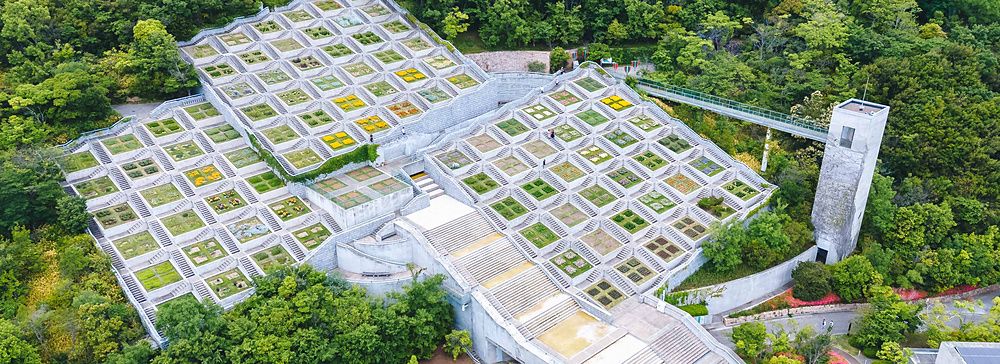
The first thing to understand is that this isn’t a building with rooms inside. It’s a stretch of hillside remade from top to bottom: ramps, pools, stairways, gray concrete walls and flowers slotted into geometric grids. The hill had been dug out to supply the soil used to build Kansai Airport out at sea, and what you see now is the result of rebuilding it from scratch. In 1995, while the project was taking shape, the great Kobe earthquake struck, with its epicenter right under the northern tip of Awaji, just a few kilometers from here. From then on the site also became a place of remembrance. The hundred beds of the terraced garden are dedicated to the earthquake’s victims, and it’s worth keeping that in mind as you climb between them.
These are the parts that really matter.
- Hyakudan-en, the garden of a hundred flower beds: a hundred square beds laid out like a checkerboard up the slope, separated by low concrete walls and linked by tiny, narrow stairs. It’s the highlight of the place, and from the top corner you can see Osaka Bay with all the beds stepping down in rows below your feet.
- Kai no Hama, the shell pool: a thin film of water over about a million scallop shells, discarded by seafood processing plants in Hokkaido, with hundreds of little fountains spurting up among them. When the sun is overhead, the water looks full of coins.
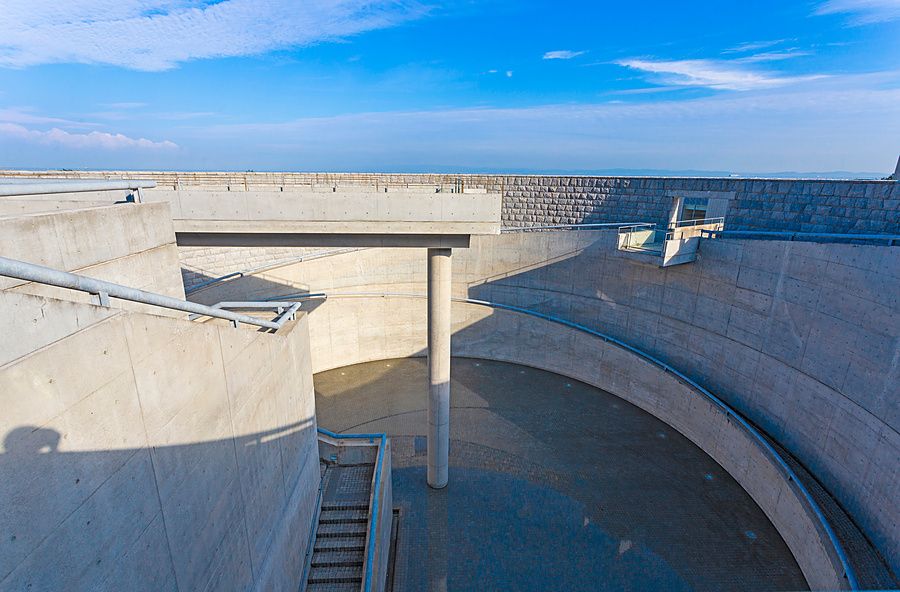
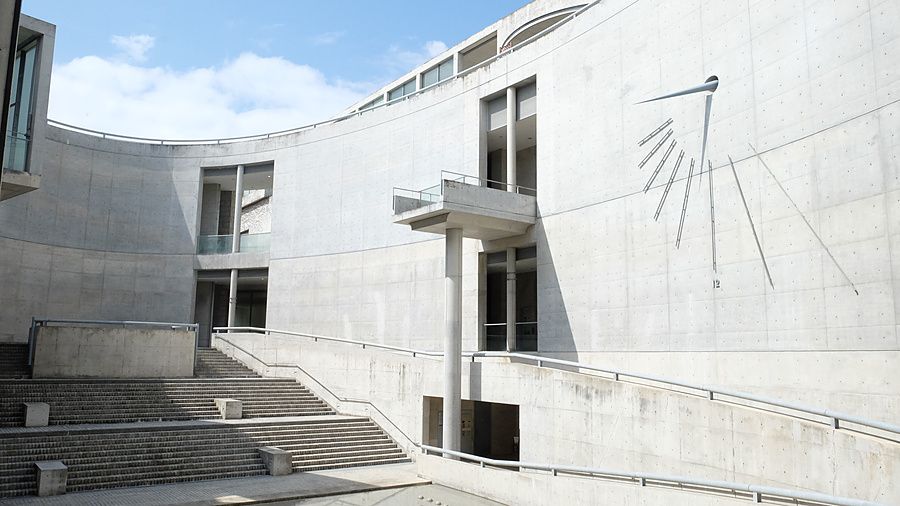
- The circular forum: a round space just over thirty meters across, with a ramp that winds along the wall and a terrace that juts out into thin air. Stand at the bottom and look up, and the curved wall wraps all the way around you.
- The two corridors, sea and mountain: one is open to the water and full of light, the other is enclosed by frosted glass and stays dim. Walking from one into the other is the best part of the whole walk, partly because the sound changes in an instant.
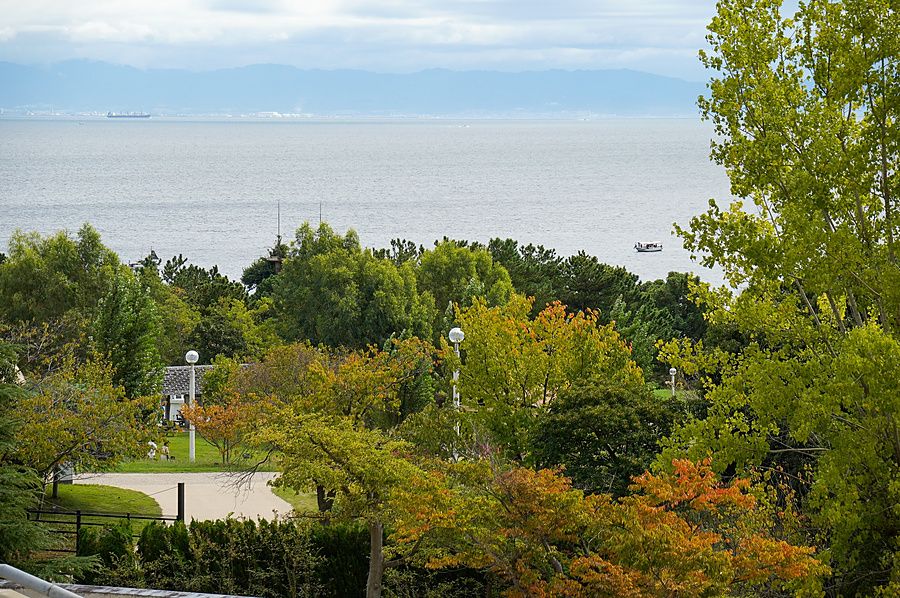
- The rooftop terrace above the oval forum: you can walk on the roof, and from up there you take in the whole bay at once, with ships going by and, on clear days, the Kobe coastline across the water.
- Awaji Green Kan, the greenhouse: a glass hall about twenty meters high with thousands of species inside, a room of succulents and cacti, a tropical room and one for very ancient plants that have barely changed since prehistoric times.
The route doesn’t run in a straight line, and the signs only get you so far. The path loops back on itself, and you’ll find yourself passing the same spot twice, convinced you’re somewhere else. The least tiring way to see the terraced garden is to take the elevator to the top and then walk down through the beds, not the other way around.
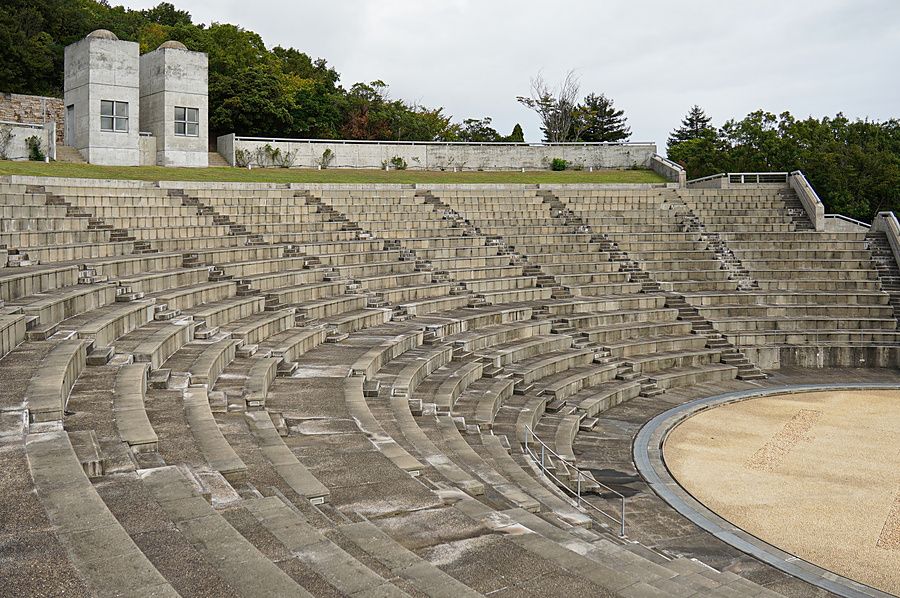
The hotel inside the complex has a bare concrete church, Umi no Kyokai, with a cross of light cut into the ceiling. You can go in when there’s no wedding going on, but most people miss it, because getting there means walking through the lobby and nobody realizes you’re allowed to. When there’s no show, the open-air theater is just concrete seating with the sea behind it: you sit for a minute and move on.
If plants don’t do much for you, the greenhouse is the one thing you can skip without regrets. Everything else is outdoors, and you can wander around freely.
If you’re expecting a Japanese garden with moss and pruned pines, you’ve come to the wrong place. Concrete is the main material here, and the flowers just fill in a grid. Still, as a place to walk, nothing else I know in Japan comes close.
I go back every time I’m on the island. It’s my favorite place to walk, among the water, stairs and flower beds, and from the top of the terraced garden the view pulls concrete, flowers and sea into a single picture you won’t find anywhere else.
When to go
The best time is early morning. The fountains in the shell pool are already running, the low light slants into the corridors, and up on the oval forum’s roof you can watch the sun rise over the bay. At that hour all you hear is the water and the occasional seagull, and the concrete hasn’t warmed up yet.
Late afternoon is the second-best option, especially for the church in the hotel, where the cross of light is clearest when the sun is low.
The season makes a big difference. From spring to early summer the hundred beds are full of flowers and color, while in fall the woods around them turn and the hill goes red and yellow behind the gray walls.
In winter, though, a good share of the beds are just bare soil. The architecture doesn’t change, but half the point of the terraced garden is gone, and if you come in January hoping for flowers you won’t get much out of it.
Midsummer has the opposite problem: almost no shade, pale surfaces throwing the heat back up at you, and exposed stairways. If you go in July or August, go while the sun is still low and bring something to drink.
Crowds aren’t an issue, which is one of the reasons I recommend it without reservation. The complex covers 28 hectares, so even on weekends people spread out and lines never form. On weekdays you might have the mountain corridor all to yourself, with your footsteps echoing.
On overcast days the bay vanishes into the gray and the view from the top won’t do much for you, but the corridors and the circular forum work just as well. In heavy rain, don’t bother: you’re outdoors ninety percent of the time and there’s no real shelter along the way.
Stairs and how tiring it gets
I’d say this is more useful than any description: you walk a lot, and nearly always uphill or downhill. The ramps are long, there are plenty of steps, and the little stairways between the flower beds are narrow, with no handrails in places.
The elevators to the top of the terraced garden are a lifesaver if your knees are tired or you’ve brought your grandparents along. There are plenty of benches and places to sit along the way, so use them instead of powering through.
With a stroller you can get around a good part of the complex using elevators and ramps, but not all of it. In some spots the only way from one level to the next is by stairs, and you’ll have to backtrack and go around. It’s the same with a wheelchair: it’s doable, but expect a few detours and be patient while you figure out which way to go.
Small kids have more fun here than you’d think, with the shallow water of the fountains and the hundred beds to clamber through like a maze, but keep an eye on them, because there are low railings and drops in several spots.
Getting the best photo
The circular forum is where most people get their cameras out. Stand in the middle and point straight up to get the concrete circle with the sky inside it, or go up the ramp and shoot the people below to give a sense of scale. There’s no line for this shot; at most you’ll wait half a minute for someone to walk past.
For the terraced garden, climb to the very top level and shoot diagonally downward, catching the beds stepping down and the sea behind them.
The other shot you’ll take home is of the shells. Get close to the edge of the pool and shoot almost at water level, with the fountains running and the light reflecting off the shells. It works best with the sun high, when the water lights up the white of the shells.
Inside the hotel church the cross of light stands out sharply against the dark concrete and comes out well without a flash. Stay at the back and shoot quietly; it’s a church, after all.
At a glance
- Highlight: the hundred flower beds laid out like a checkerboard up the hill, with Osaka Bay opening up from the top level.
- When to go: early morning; spring to early summer for the flowers, fall for the foliage; winter looks bare and midsummer is hard work.
- Best for: people who love contemporary architecture, people who want a long walk without crowds, people driving around the island who want a stop that isn’t another shrine.
- Atmosphere: gray concrete, running water everywhere, few voices around, a huge space to move through at your own pace.
Conclusion
What makes this place isn’t any single sight but the route itself. You come here to walk through an idea, among ramps, corridors and pools, and the payoff comes bit by bit as you climb. It’s worth the detour, even if you have to go out of your way to get here, and to me it’s one of the most successful places built in Japan in recent decades: no other garden brings together an entire hillside, a million shells and the open sea.
If you’re looking for temples, old wood and stone lanterns, though, you won’t find any of that here, and you’d be better off exploring another part of the island. And if you end up here in the dead of winter under gray skies, lower your expectations. The architecture still holds up, but you won’t get to enjoy the garden.