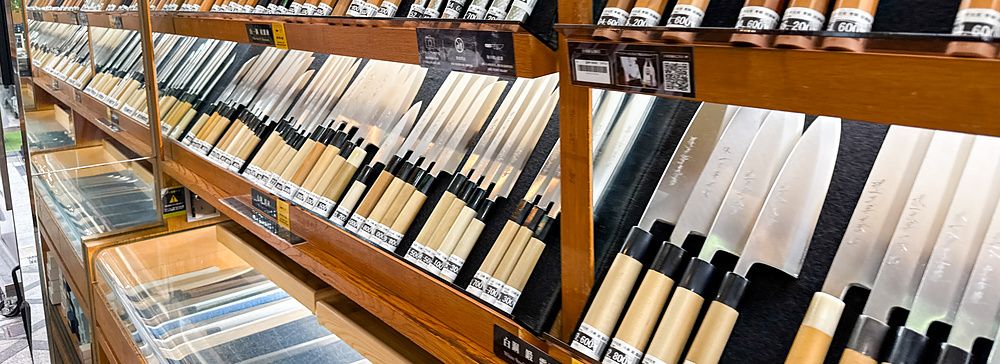
Where to Buy Japanese Knives in Osaka
Japanese knives are high on the wish list of anyone who loves to cook, and they also make a genuine souvenir you’ll actually use. If one city in Japan really deserves to be called knife heaven, it’s Osaka. The quality and the selection are part of it, but the real reason is that Osaka has a whole street given over to professional kitchen tools, with knives leading the way: Doguyasuji.
Walking down it feels like getting a look behind the scenes of Japanese cooking. You’ll find knives from the best makers, and next to them every tool a professional kitchen could need. If you’re after the knife you’ll keep for life, maybe engraved with your name in kanji, this is where you need to come.
Contents
Why buy a Japanese knife
A Japanese knife isn’t just nice to look at. It’s built to last, sharpened with obsessive care and designed for extremely precise cuts. Anyone who cooks knows that a good knife can completely change how cooking feels. And in Japan a knife is more than a cutting tool: it’s an extension of the cook’s movements, and using one is almost a ritual.
Japanese knives come in a huge number of types, each with its own job. The gyuto is the chef’s knife, the nakiri is made for vegetables, and the yanagiba is the long sushi knife that slices in a single stroke. Every shape, every balance point and every edge is there for a reason.
Many shops in Osaka sell knives forged by hand using old swordsmithing techniques. The shops are often family-run, and the people behind the counter will tell you the story of each piece with an infectious passion.
Doguyasuji, Osaka’s kitchen tool street
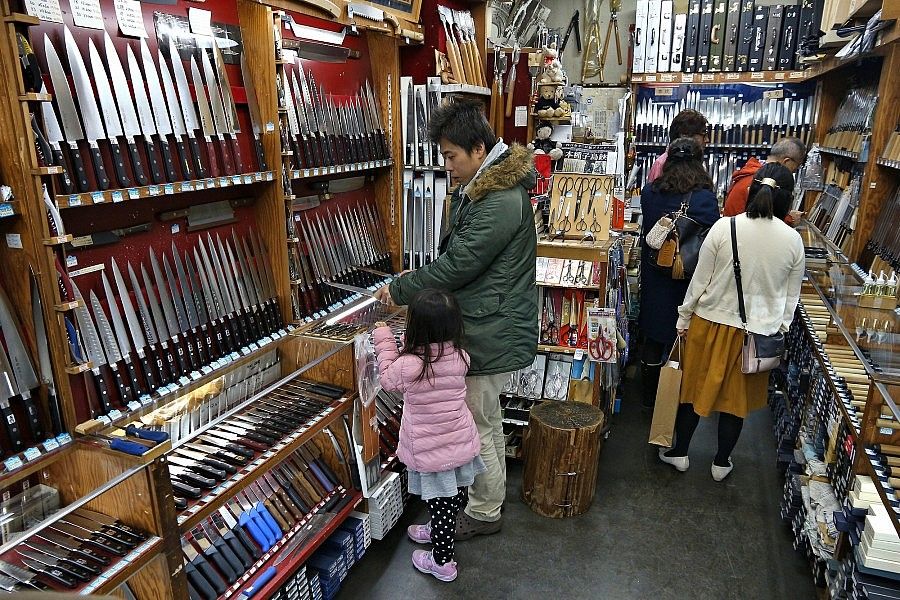
As soon as you walk in, you’re surrounded by shops that sell nothing but knives, alongside others selling chopsticks, ceramic plates, molds for Japanese sweets, sushi mats, camping stoves for nabe and even the noren curtains that hang over restaurant entrances.
The sight alone is incredible, but the fun really starts when you begin exploring. Every shop has its own character: some specialize in sushi knives, some sell only vegetable knives, some still make everything by hand, and some will engrave your knife for free on the spot. A lot of the storefronts look like they’re meant for the trade, but anyone can walk in and buy a single piece, and nobody will ask whether you cook for a living. There are about fifty shops in all, so it pays to walk around before you decide: the same type of blade can vary quite a bit in finish and price from one shop to the next.
Artisan workshops
Many of Osaka’s long-established shops still make their knives one at a time, by hand. That doesn’t just mean sharpening: they forge the blade, hammer it, harden it, polish it and fit the handle. Every piece is the result of painstaking craftsmanship passed down through generations.
Walking into one of these shops is an experience in itself. There’s the smell of iron, the sounds of the workshop, a workbench covered in marks and debris. Then the master explains the difference between a machine-made knife and a handmade one, and it’s like comparing a print with an original painting.
If you want something truly special, ask whether they have a hand-forged blade. They cost more, but they have a soul of their own.
These are the ones I especially recommend:
Tower Knives Osaka
Tower Knives Osaka isn’t on Doguyasuji. It’s in Shinsekai, at the foot of Tsutenkaku Tower, and it’s much more than just a shop: if you want to take home a real Japanese knife along with an experience you’ll remember, you almost have to stop here. They have a wide, carefully chosen selection, with blades from different parts of Japan for every kind of use, from home cooking to professional kitchens.
One of its strengths is the flawless service. The staff know their stuff and speak several languages, including excellent English, and they give advice without ever being pushy. Even if you show up with no clear idea, they’ll patiently walk you through it: you can try the blades on fresh vegetables, watch sharpening demonstrations or listen to them explain the craft behind each piece.
There’s also an open workshop at the back, where you can often watch blades being made or sharpened, or see knives being personalized with hand engraving on the spot. The engraving is free if you share your visit on Instagram, and yes, the quality of the work is impressive.
If you’re looking for an unusual gift, or simply a real keepsake that will last, they also have small pocket knives, knives for kids and more decorative pieces. On top of that, prices are clear and fair, and tourists can shop tax-free (bring your passport!).
Sakai Ichimonji Mitsuhide
Right on Osaka’s Doguyasuji, Sakai Ichimonji Mitsuhide is one of the best-known knife shops in Japan. For more than 70 years it has showcased the best of Sakai’s craft tradition, and Sakai has been famous for its blades since the days of the samurai. It’s the ideal place whether you want a professional knife for everyday use or a special, meaningful souvenir to take home.
The shop carries more than 2,000 different models, from classic Japanese blades like the yanagiba and deba to Western-style and all-purpose knives like the gyuto and santoku. What stands out most, though, is the immersive, personalized experience. Most of the staff speak English, Korean or Chinese, and they’re ready to help you choose, with clear explanations and plenty of patience. Some of them, like Brad, Chris and Lee, have become well known for how helpful and knowledgeable they are.
Some of the most popular services:
• Free engraving (by hand with hammer and chisel, in kanji or other languages)
• Gift wrapping done with great attention to detail
• A free sharpening coupon
• International shipping
In the shop you can also watch engraving and sharpening demonstrations, and upstairs you can take part in cultural activities and classes about knives. Some visitors say they bought a knife almost by chance… and walked out with a real piece of Japanese history to keep forever.
Knives range from basic models at around 8,000 yen to collector’s pieces at more than 200,000 yen. Despite the shop’s international fame, the staff are always friendly and never pushy: the goal is to help you find the right knife for your style and your needs.
It’s a place that brings together technique, beauty and tradition, and I’d recommend it even if you only want to browse and get some ideas.
Tokuzo
Tokuzo is also on Doguyasuji, and it has become a go-to shop for anyone looking for real Japanese knives. What sets it apart from the other shops in the area is the balance of quality, service and selection. The staff are known for being extremely helpful, with very good English and a patient approach, and they can guide even complete beginners to the knife that suits them best.
The selection covers all the main blade types, from Gyuto and Santoku to Kiritsuke, in both stainless and carbon steel. People especially appreciate that they never push you to buy: if anything, they help you think about what you really need, and they often recommend cheaper options that suit you better. You can also have the handle engraved in katakana, often for free, and it only takes a few minutes. What makes Tokuzo different is its focus on Tosa knives, from what is now Kochi Prefecture, where blades have been forged for more than 400 years. They’re hammer-forged, and you can spot them right away by the black finish left on the blade, which protects it from wear.
The shop buys directly from the blacksmiths, which goes a long way toward explaining its lower prices.
The shop also has a welcoming feel, with carefully arranged displays and bright lighting that lets you see every detail of the blades. Prices are competitive with those at nearby shops, and because the staff explain everything openly, from care and maintenance to the blacksmith’s story, the visit is engaging as well as useful.
Watch out for souvenir knives
Alongside all this quality, you’ll also find cheap knives made for tourists. They aren’t necessarily bad, but they aren’t handmade, and they aren’t sharpened with the same care. If you’re on a tight budget or just want a token souvenir, they’re perfectly fine. If you want a real Japanese knife, though, keep a few things in mind:
- Skip the ones sold in general souvenir shops
- Buy from specialty shops
- Check that the blade carries the blacksmith’s or the company’s signature
With a little care you can buy a beautiful Japanese knife that will last you a lifetime. Telling them apart is easier than it looks: a machine-stamped blade is perfectly uniform and has no hammer marks, while on a forged knife you can see where the metal was worked, and often a line in the steel running along the edge. Be wary of boxed sets with ten pieces that all look the same, too. In reputable shops you choose knives one at a time, based on what you need to cut.