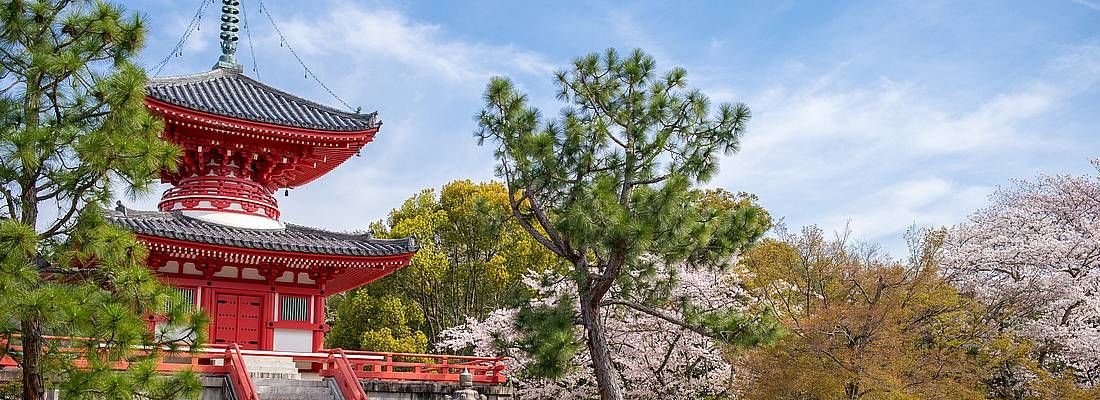
Daikaku-ji Temple
Hidden away in the northern part of Arashiyama, Daikaku-ji Temple is a place of legend and mystery, described in “The Tale of Genji,” the first novel in Japanese literature. It’s one of the few places in Japan where you can still feel the atmosphere of the old imperial court the book portrays, which is why Daikaku-ji is often chosen as a location for period films. Emperors loved it, and it’s home to one of the oldest Japanese gardens in the country. If you’re in Kyoto, it’s one I’d tell you not to miss.
Contents
A bit of history
Daikaku-ji started out in the early 800s as a detached palace of Emperor Saga, who loved this rural edge of Kyoto so much that he built a retreat here to relax and spend his vacations. Thirty years after his death, the palace was converted into a temple of Shingon Buddhism.
The temple has always played a big part in Japanese history. A number of emperors lived here after their reigns ended or after they lost power, and many of them kept ruling behind the scenes from here. In the 14th century Daikaku-ji even hosted the peace talks that, in 1392, ended nearly 60 years of civil war between two rival imperial courts. Today it isn’t one of Kyoto’s most visited temples, but a thousand years of history give it real charm and a solemn air.
Visiting the temple
Among its buildings and historical treasures are many cultural properties of enormous value, and the whole temple is surrounded by lovely natural scenery that people especially love for its fall colors. The complex is made up of several buildings linked by covered wooden corridors with an unusual nightingale floor, named for the sound it makes every time you step on it. It’s a small clue that emperors once lived here: they often used this trick as a kind of alarm.
One of the main buildings is the Shingyo Pagoda, a beautiful, colorful octagonal pagoda near Osawa Pond. It was built to mark 1,150 years since Emperor Saga wrote out the Heart Sutra, and it’s also called the “Heart Sutra Hall” because it holds Daikaku-ji’s most important treasure: a copy of the Heart Sutra that Emperor Saga wrote by hand as Kobo Daishi dictated it. The story goes that writing the sutra ended a terrible plague that swept the country in the Heian period, so it’s kept as a precious sacred object and shown to the public only once every 60 years. Next to the hall is the small Reihokan museum, which puts on special exhibitions in spring and fall featuring some of the temple’s main historical treasures and artworks.
Another building worth seeing is the Shoshinden hall, where your eyes will go straight to the gorgeous fusuma sliding doors painted by the greatest masters of Japan’s Kano school. You’ll also find other ink paintings there from various periods.
Where ikebana was born
Daikaku-ji isn’t just an imperial temple. It’s also the home of ikebana. According to tradition, Emperor Saga was so taken with some chrysanthemums picked at Osawa Pond that he arranged them in a vase, creating the first flower arrangement. That’s how the Saga Goryu school began, and it still has its headquarters right here.
So as you walk through the halls, you’ll keep coming across different arrangements, made by the school’s masters and changed with the seasons. Lots of people walk past them without noticing, but they’re part of what makes the temple what it is. If you happen to visit during one of the flower exhibitions held here, you’ll find the historic buildings turned into a gallery of flower arrangements.
Osawa Pond
Before you leave, take a walk through the Japanese-style gardens around Osawa Pond, a man-made pond created a good 1,200 years ago. The pond and the garden around it were built for Emperor Saga’s palace as a place to throw parties, go boating and fishing, and host informal receptions. It’s the oldest example of a Heian-style garden in Japan, and the only one left in the country, too. Small Buddhist statues, a shrine and other structures dot the grounds, linked by paths that wind through the greenery and open onto beautiful views. From late March to early April, don’t miss the cherry blossoms at the temple; in late November, the warm fall colors give the place a melancholy, romantic feel.
The pond is at its best under a full moon, though. It was designed specifically to reflect the sky, and Osawa is still considered one of the best places in Japan for tsukimi, moon viewing. In the fall the temple puts its court boats back on the water, their bows decorated with a dragon’s head and a phoenix, and you can climb aboard to watch the moon from the middle of the pond while traditional music drifts over from the shore.
Getting There
The temple sits in the quietest corner of Saga, away from central Arashiyama. From JR Saga-Arashiyama Station it's about a 20-minute walk north, all on flat ground past houses and farm fields. If you're short on time, buses 28 and 91 leave from the station square and drop you right at the entrance in a few minutes.
If you're already out exploring Arashiyama, allow about 25 minutes on foot heading north from the Randen tram station. The walk takes you through the Sagano countryside, which is much less crowded than the area around the bamboo grove.
Useful Info
- JR Saga-Arashiyama Station (JR Sagano Line): about 20 minutes on foot
- Daikakuji stop (city buses 28 and 91): right outside the entrance
- Randen Arashiyama Station (Keifuku tram): about 25 minutes on foot
Map
This place is on MarcoMaps
Daikaku-ji Temple
My map of Japan: over 4,000 places I've tried myself, each with photos, rating, and hours. Filter by category and rating, find veg-friendly spots and places near you with GPS. No sign-up, right from your phone.
- 4,000+ places
- Rating, photos, and hours
- Veg friendly
- Near me (GPS)
- Favorites without login
- Works offline


Copying the Heart Sutra
The Heart Sutra is Daikaku-ji’s great treasure, and here you can try writing it out yourself. The temple is one of Japan’s leading centers for shakyo, hand-copying sutras, a practice that traces straight back to Emperor Saga.
In the copying hall you’re handed writing materials and a sheet with the characters already drawn for you to trace over, so you don’t need to read Japanese. You just follow the lines slowly, sitting in front of the garden. When you’re done, you can leave your copy at the temple, where it’s kept along with those of other visitors. It’s an unexpected chance to slow down on a Kyoto day spent racing from one temple to the next.