Dewa Sanzan
Dewa Sanzan literally means “the Three Mountains of Dewa“: Haguro, Gassan and Yudono, the three sacred mountains of the old Dewa Province, now Yamagata Prefecture, in northern Honshu.
They’re the heart of Shugendo, a tradition that blends mountain worship, Buddhism and Shinto, and people have practiced it here for more than 1,400 years. Each mountain stands for a stage of life: birth (Haguro-san), death (Gassan) and rebirth (Yudono-san). That’s also the order people usually visit them in.
Dewa Sanzan is still a living pilgrimage site, visited by worshippers, ascetics and the yamabushi, the hermit monks of the mountains.
Contents
Dewa Sanzan is still a fairly hard place to get to, which only adds to its appeal. That’s especially true in winter, when Haguro is the only one of the three mountains you can reach.
The best time to visit Dewa Sanzan is between July and mid-September, when all three shrines are open to pilgrims and tourists.
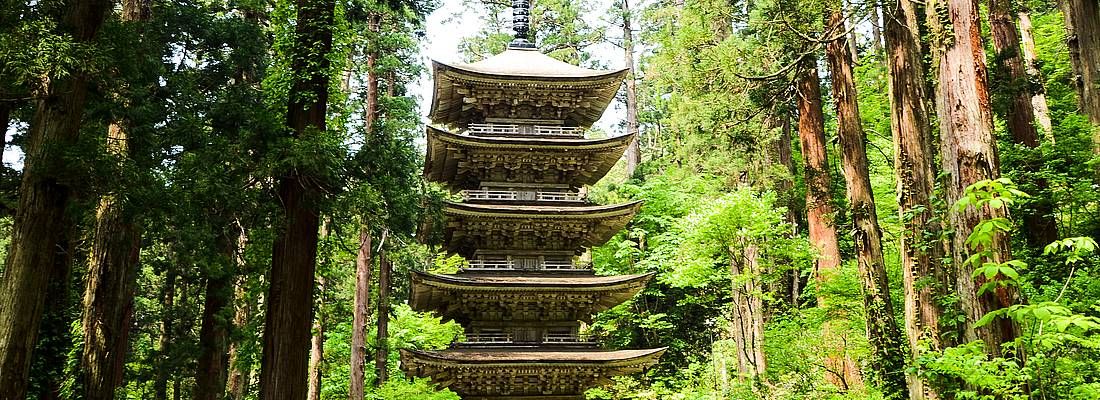
Mount Haguro is probably the best known of the three, since it’s home to one of Japan’s national treasures, a beautiful five-story pagoda.
Mount Gassan is the tallest, and it’s known mostly for its natural scenery and its wide variety of rare alpine plants.
Mount Yudono is seen as the heart of the three sacred mountains, and it’s the one many ascetics choose. The mountain is also known for its goshintai, a sacred object believed to be directly connected to a deity. The Yudono shrine is revered as holy ground that has to be kept secret, and to this day photos and videos are banned there.
Trails
Most people who come to Dewa Sanzan hike the trails on all three mountains, although some prefer to take the shuttle buses from one to the next, since Haguro and Gassan are a long way apart.
Of the three, Haguro is the easiest to reach, and it’s the only one you can visit without an exhausting trek. The well-marked trail winds through the forest and passes the beautiful five-story wooden pagoda called Goju-no-to. After that comes a climb of 2,446 stone steps, which isn’t especially steep. Along the way you can also see the spot where the Japanese poet Basho wrote one of his many famous poems. Eventually the trail levels out again, and soon you’re on the grounds of the Gosaiden shrine, where the spirits of all three mountains are worshipped.
The hike to the top of Mount Gassan takes a full day. Bring a map and check the weather before you go, because if it rains, the rocks get slippery and the trail can become hard going and, in places, dangerous.
Once you’ve reached the summit of Gassan and its shrine, you can carry on along a trail to the third mountain, Yudono. This climb is much harder and steep in places, but your reward is the shrine itself, considered the most sacred of the three.
Dainichibo Temple
Shugendo is rooted in mountain worship and folk religion, but it has absorbed elements of Shinto, Buddhism and Taoism.
Traditionally, the priests of this sect began their journey across the three peaks in Toge, a small village on the slopes of Mount Haguro, and went on from there to Gassan and Yudono. Women, however, weren’t allowed to go to the Yudono shrine, the final stop of the pilgrimage. They could only go as far as Dainichibo Temple, at the foot of Mount Yudono.
The temple is said to have been built by Kobodaishi, the founder of the Shingon sect of Buddhism and one of Japan’s most famous saints. According to legend, he found the exact spot by throwing a ritual object, which landed right where the temple stands today.
The cedar at Dainichibo Temple is estimated to be over 1,800 years old. It was planted on the grave of Prince Mimurowake, son of Emperor Keiko, the 12th emperor of Japan.
The temple was a Kigan-ji (“prayer temple”) for the Tokugawa shoguns’ family, charged with watching over the clan’s well-being.
According to legend, the monk Daijuku Bosatsu Shinnyokai Shonin was drawn to Buddhism at a young age and made Dainichibo Temple his base. He wanted to become a “living Buddha,” and to get there he took up harsh religious practices, eating nothing but nuts, seeds and bark. His diet got even stricter when he started living on just water and salt, and finally on a poisonous drink made from bark. After that he devoted himself to meditation until he died.
His tomb stayed sealed for 1,000 days. When it was reopened, his body was found mummified and untouched by worms because of the poisonous drink he’d taken before he died, and so he was given the sacred status of “sokushin-Butsu,” or “living Buddha.” You can now see his body at Dainichibo Temple. Shinnyokai isn’t the only one, though. Not far away, Churenji Temple holds the sokushinbutsu of Tetsumonkai Shonin, another ascetic tied to the worship of Yudonosan, who’s famous for mutilating one of his own eyes as an act of devotion. They’re two of the very few living Buddhas you can see in Japan, and it’s no coincidence that several others are in this same part of Yamagata.
Where to stay
Most pilgrims stay in Haguro-machi, at the foot of the mountain, where there are several places to spend the night, known as shukubo. Many of them have been run by yamabushi families for generations, and sleeping in one is an experience in itself, nothing like a hotel. Dinner is shojin ryori, the monks’ vegetarian cooking, made entirely of mountain herbs, mushrooms and vegetables gathered on the three mountains.
In the morning, guests are invited to join the daily prayer in the house’s altar room before they set off up the mountain.
History
The history of the Dewa Sanzan mountains is bound up with the earliest days of mountain worship in Japan. They became a religious center more than 1,400 years ago, when Prince Hachiko, the eldest son of Emperor Sushun, came to Dewa Province in 593. He devoted the rest of his life to religious practice, putting himself through harsh austerities and penance, and these practices grew into the worship of Haguro Gongen, the mountain’s deity. The prince then set about building shrines on the summits of the area’s three mountains.
Once Dewa Sanzan became a place for ascetic practice, many people started making pilgrimages there. Several prominent figures came here, including En no Gyoja, the founder of the shugendo sect, and Kukai, the founder of the Shingon sect.
After the Meiji Restoration in 1868, the Japanese government decided to break up the fusion of Shinto and Buddhism. As a result, the shugendo sect lost its purpose, and many priests went back to a more worldly life.
Religion and mountain worship
The link between religious belief and mountain worship has always played a key role in Japanese folk culture. It’s been pointed out that almost every mountain peak has had its own shrine at some point.
The Dewa Sanzan mountains are sacred in both Shinto and Buddhism.
Every year, hundreds of worshippers known as yamabushi, the lay practitioners of shugendo, make the pilgrimage to Dewa Sanzan. Mount Haguro is especially important because it’s the gateway to Mount Gassan and Mount Yudono.
Shoreisai, the yamabushi New Year
The most intense moment of the year at Dewa Sanzan comes on the night of December 31, when Shoreisai is held on Mount Haguro. At the center of it are two yamabushi chosen from the village of Toge, who arrive after a hundred days of retreat and fasting. All night long they compete in a series of ritual trials meant to decide which of the two has won the favor of the gods.
The most spectacular moment comes when two huge torches of woven straw are dragged out into the courtyard and set on fire. They stand for the demon that, according to legend, brought misfortune to the villages until Prince Hachiko drove it away with fire. It’s one of the few nights when the snowbound shrine stays lively until dawn, and the festival is listed as one of Japan’s Important Intangible Folk Cultural Properties.
Haguro
The three mountains have formed a single sacred landscape since the 17th century, but people were worshipping them long before that. Haguro is the closest of the three to the Sea of Japan, which makes it a kind of spiritual base when heavy winter snow cuts off the other peaks. That’s also why it’s the most visited of the three.
The road up to the shrine passes under a huge bright red gate and then through a second one. An arched bridge crosses the Haraigawa River, where pilgrims used to purify themselves before taking on the upper part of the mountain. A little farther on, to the left, stands a national treasure and Dewa’s oldest structure, the five-story pagoda Goju-no-to. First built in 937 and rebuilt around 1372 on the orders of Daihoji Masauji, lord of Mount Haguro, the pagoda is almost thirty meters tall and a beautiful example of the Muromachi style. It survived the Meiji religious crackdown that devastated the shrine complex.
This is where the famous 2,446 steps up to the summit begin. They say thirty-three images of lotus flowers, gourds and sake cups are carved into the steps as good-luck symbols. The whole route takes about an hour, through an old forest of pines and cedars, one of which is believed to be over a thousand years old.
The shrine has about fifteen buildings, and the main one is the Gosaiden, said to be the largest thatched-roof shrine in Japan. It’s lacquered red inside and out, and it was rebuilt after a fire in 1818. In front of it is a pond called Kagami. Another important building is the bell tower, built in 1618, the second-oldest structure at the shrine. It holds a bronze bell from 1275 that’s 1.68 meters in diameter at the base and almost 3 meters tall overall.
Gassan
You can head up Mount Gassan on foot or by bus. Most of the trail climbs gradually, with marshy ground in some stretches, and the rest runs mostly along stone paths through fields of tall grass dotted with alpine plants. There are no large buildings, only a “purification hut” you have to pass through to reach the small shrine at the summit. From the eighth station it takes two and a half hours to walk to the top, but the view makes it worth the effort.
Yudono
Mount Yudono is much lower than Gassan. The trail alternates gentle slopes with sheer drops, including one called Gakko Zaka that’s over seven hundred meters high. There are steel ladders and chains to hold on to.
You can also skip the trail and take the bus to the shrine. As at Gassan, there’s no real religious complex here, just a place for prayer and reflection: in this case a large rock with hot water flowing out of it (“Yudono” means “place of hot water”). Before you enter the shrine you have to take off your shoes and socks. The proper way to visit is to walk clockwise around the rock with your hands pressed together in prayer.
Getting There
Everything starts from Tsuruoka. From Tokyo you take the Shinkansen to Niigata and then the limited express along the coast, about four hours in total. In front of the station you'll find the bus stops for the three mountains and an information desk where you can pick up a map of the area.
For Mount Haguro, get off at Zuishinmon, the gate where the walk up through the cedars begins, or stay on the bus all the way to the top if you'd rather skip the 2,446 steps.
In summer the same line continues to Gassan's eighth station, the starting point for the summit, and a seasonal bus runs from Tsuruoka to the Yudonosan shrine.
Useful Info
- Tsuruoka Station (JR Uetsu Line, Inaho limited express from Niigata): base for all three mountains
- Shonai Kotsu bus to Hagurosan: Zuishinmon stop (about 35 minutes) and the top of Haguro (about 50 minutes)
- In summer the same line continues to Gassan's eighth station
Map
This place is on MarcoMaps
Dewa Sanzan
My map of Japan: over 4,000 places I've tried myself, each with photos, rating, and hours. Filter by category and rating, find veg-friendly spots and places near you with GPS. No sign-up, right from your phone.
- 4,000+ places
- Rating, photos, and hours
- Veg friendly
- Near me (GPS)
- Favorites without login
- Works offline

