50 m
Japanese Nursing Association50 m
Building.
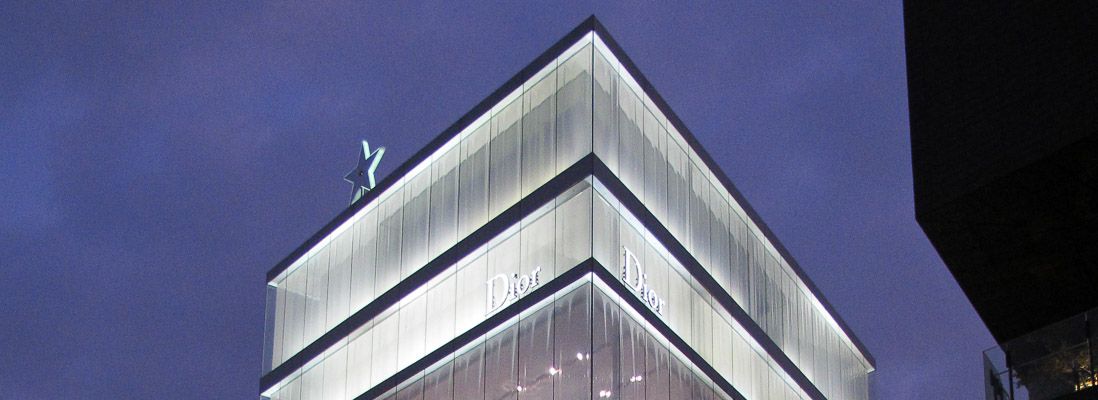
A glass lantern lighting up on Tokyo’s most elegant avenue. That’s what comes to mind every time I walk past Dior Omotesando. Designed by SANAA (Kazuyo Sejima and Ryue Nishizawa) and opened in late 2003, this boutique doesn’t go for an aggressive, theatrical effect. It works with layers and transparency. One look and you can tell that the architecture here speaks the language of fashion, with subtle overlaps, planes that slip into one another, and light that shifts with the sky and with the reflections of the trees along the avenue. Here on Omotesando the flagships compete with landmark facades, and Dior goes for grace instead. My advice is to walk up to it slowly, because every step shows you another detail, an edge, an architectural seam that makes all the difference.
It all starts with layering. In couture, different fabrics build volume and depth; here the glass panes are paired and spaced apart to create weightless planes. The building doesn’t impose a single sculptural shape. Instead it offers a changing skin, and the facade works more as a filter than a barrier. SANAA uses controlled transparency: some levels are milky and others clear, some reflect the street and others absorb it. The idea is for the store to feel like a body of light in constant dialogue with the avenue, shimmering by day and glowing softly at night, never glaring. Nothing here is trying to be monumental. There’s just lightness and a composure that works precisely because it never raises its voice.
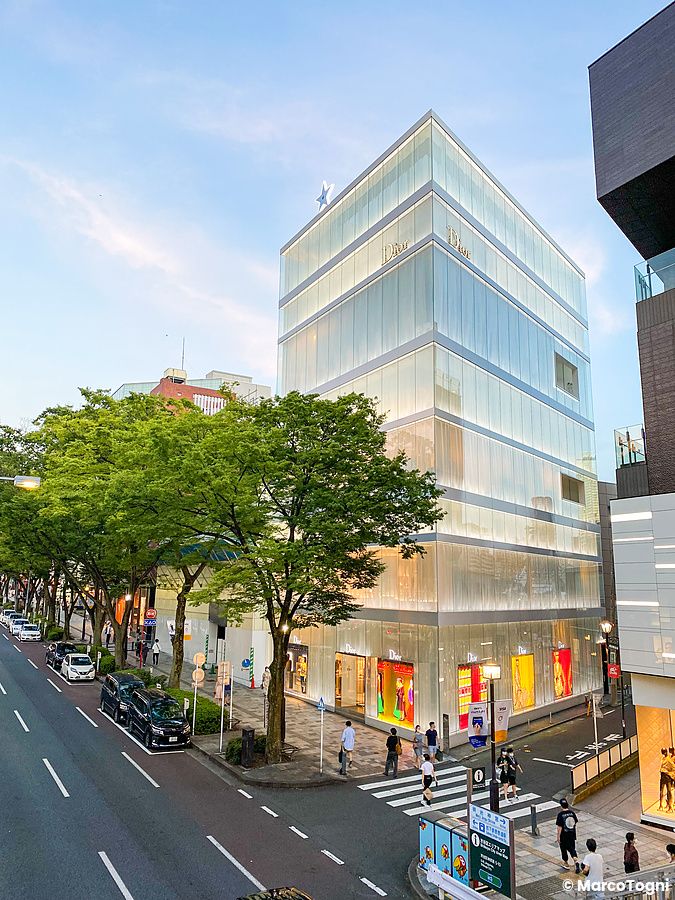
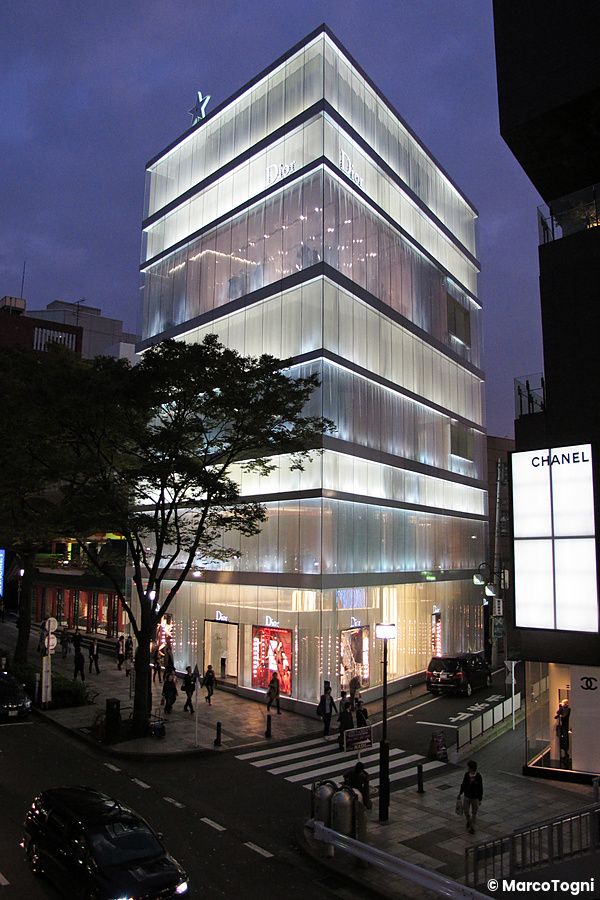
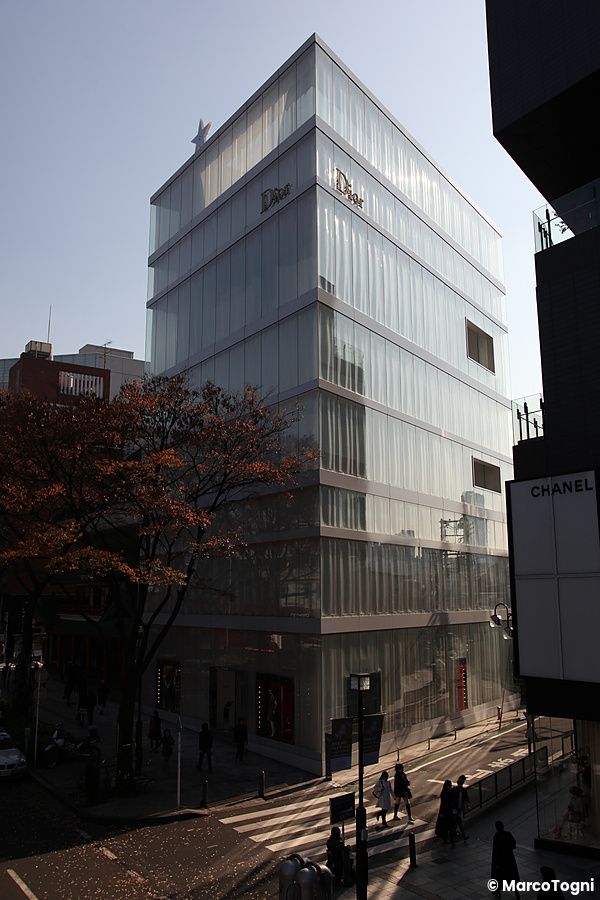
The facade is a vertical prism that layers clear outer glass over white, translucent acrylic screens, curved like a fold of fabric. The joints are thin, almost like exposed seams that show off the precision of the cut. The lines are clean, with no fussy framing, so Omotesando’s trees are reflected in the glass like a natural pattern in motion. When the sun beats down, the surface answers with soft reflections; on humid days the glass turns milkier and the boutique looks wrapped in a veil. White, Dior’s visual signature, isn’t a flat white here. It’s a white that breathes, created by taking light away, with films and treatments that temper it. The result is an elegant presence that fits in with the rhythm of the avenue without ever disappearing. The secret is the double layer: clear glass in front and, behind it, semi-transparent acrylic screens molded into curves and printed with thin white stripes. These panels work like doors and swing open, both for maintenance and to keep the building from becoming a sealed box.
Notice, too, what’s missing: you can’t see the floor slabs. There’s no horizontal band giving away each floor, the way there usually is on a building. That’s why from the street the boutique reads as a single volume and not as a stack of levels.
Inside, light is still the main material. The stairs and mezzanines are laid out like floating platforms, with railings made of glass and thin steel. This isn’t a cold white box: the transparency is warmed up by textured surfaces, upholstery and discreet metal details. The products aren’t just on display; they’re framed by warm backdrops and shafts of light that make them stand out without any theatrics. The layout is easy to read, almost fluid. You go up and down naturally, and the views between floors turn the space into a kind of small indoor lookout. Stop on the landings, because they’re the best spots to see how the volumes talk to each other, with views that overlap without ever getting confusing. The color palette sticks to white and beige, with inlaid Versailles parquet and the Cannage motif recurring on the walls like a discreet signature. These are the same codes Dior uses at its home on Avenue Montaigne in Paris, reworked here in a contemporary way. Upstairs you’ll find the women’s collections, high jewelry and home goods from the Dior Maison line. Overall it feels less cold than the facade would lead you to expect.
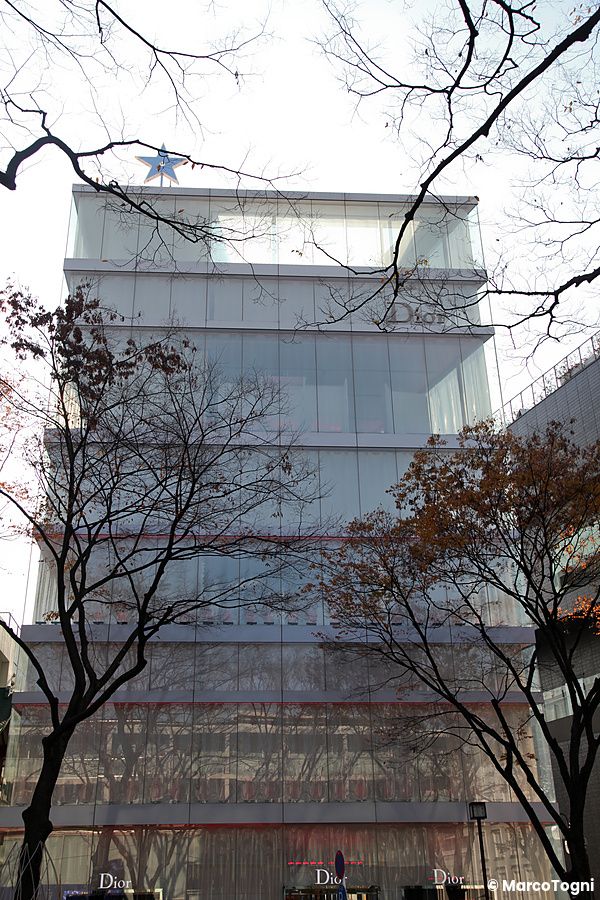
This is a building you take in as you walk. Outside, your gaze slides across the layers of the facade; inside, it moves among veils and reflections, and things look soft and hazy at times, crystal clear at others. It feels like slipping into a well-cut dress, with nothing excessive and everything in its place. If you like architecture that doesn’t demand the spotlight, you’ll find restraint and delicacy here. For me the most interesting time is dusk. The daylight fades, the floors inside light up, and the boutique really does become a contemporary lantern. Watch the shadows of the trees falling on the glass like embroidery: they don’t last, but they show you why this architecture works.
For years SANAA has been exploring transparency and thinness, in buildings where the material seems to vanish to make room for light. Here on Omotesando you see their signature: geometric purity, structural lightness and a search for the thin line between inside and outside. The relationship with the neighborhood is key. Omotesando is an open-air museum of designer flagships, and Dior chooses subtraction. The influences certainly include the Japanese tradition of light-filtering screens (shoji) and the quieter side of modernism, the kind that works with rhythm and planes rather than sculptural gestures. It’s a project that ages well because it doesn’t rely on a passing wow effect. It relies on proportions and details.
From the avenue it looks much more imposing than it is. The lot measures just 315 square meters, and the building rises to the 30-meter height limit set by Omotesando’s zoning rules, for a total of about 1,500 square meters spread across a basement and the upper floors.
It’s all down to the proportions. The facade isn’t broken into horizontal bands and the volume stays compact, so your eye has nothing to measure it against. That’s why, despite its tiny footprint, the boutique holds its own next to much wider and much louder neighbors.
It’s on Omotesando, among the avenue’s contemporary buildings, and it makes an ideal stop on a walk to see them. You can walk right into the boutique, and if you’re into photography, I recommend three times of day:
A few practical tips: bring a wide-angle lens to capture both the prism and the avenue, and a 50 mm lens to pick out details of the layers. Inside, always follow the store’s rules and ask before taking pictures. If it’s crowded, move over by half a bay; often one step to the side is enough to clear the background and bring out the pattern of the joints. Avoid the middle of the day in summer, when the light can go flat and the reflections get too harsh.
It isn’t a landmark because it shouts. It’s one because it whispers, with rare clarity. On an avenue where every brand tries to wow you, Dior wins through restraint, with fine materials, transparent planes set side by side, and light used as a design material. It’s a lesson in controlled elegance, where the facade isn’t a gratuitous shop window but a fabric that breathes with the street. If you love architecture that reveals itself slowly, this building rewards taking your time. I suggest pairing your visit with other flagships on the avenue, because comparing them will help you see how smart this design choice is.
Look at the edges of the panes against the light and you’ll immediately see how precisely they’re paired. Notice how the railings inside never interrupt the way you read the floors; they follow it. Pay attention to the shifts in transparency across the facades. They aren’t random: they create a rhythm that hints at the interior without fully revealing it. Stop for a minute at the corner by the side street. That’s where the depth of the layers is most obvious and the boutique feels like a porous object rather than a sealed block.
Omotesando is an urban catwalk where architecture does the branding. Dior and SANAA prove that brand and architecture can be one and the same without turning into a stage set. Surrounded by projects aiming to become instant landmarks, this one goes for staying power. It’s a building you don’t tire of, because it doesn’t live off a single effect. It lives off tiny variations, small differences you discover by coming back at different times of day or in different seasons. In autumn, when the trees turn yellow, the facade takes on an unexpected warmth; in winter, with the dry air, the glass turns clearer and the lines look even sharper.
If you want to shoot, here are some pointers I use a lot:
If you’re into contemporary architecture, it’ll end up on your Tokyo map. If you like projects built on transparency and detail, it’ll speak to you. If you want to be surprised right away, other facades on the avenue may impress you more, but give it time. This is architecture you come to love on a second look.
Dior Omotesando is elegance without the muscle-flexing, a building that shows you can do branding with silence, light and proportions. I often go back to see it, because it changes every time with the air and with the trees along the avenue. I recommend putting it on your itinerary together with other Omotesando addresses and, if you have time, coming back twice on the same day: daylight and blue hour tell two different stories about the same lantern. If small architectural details move you, you’ll find plenty of reasons here to stop and look.
At Meiji-Jingumae Station, take exit 4 and you'll come out right at the Omotesando intersection. From there it's a two-minute walk uphill until the glass prism appears along the avenue.
If you're coming by train to Harajuku, take the Omotesando exit and head onto the avenue. It's just under five minutes, past some of the most photographed flagships in the city.
If you get off at Omotesando Station instead, take exit A1 and walk down the avenue toward Harajuku, past Omotesando Hills: about seven minutes. The easiest option is still to fit it into the walk between Harajuku and Aoyama, so you see all the avenue's buildings one after another.
This place is on MarcoMaps
Dior Omotesando
My map of Japan: over 4,000 places I've tried myself, each with photos, rating, and hours. Filter by category and rating, find veg-friendly spots and places near you with GPS. No sign-up, right from your phone.



Dior Omotesando - nearby you will find: