Dogo Onsen
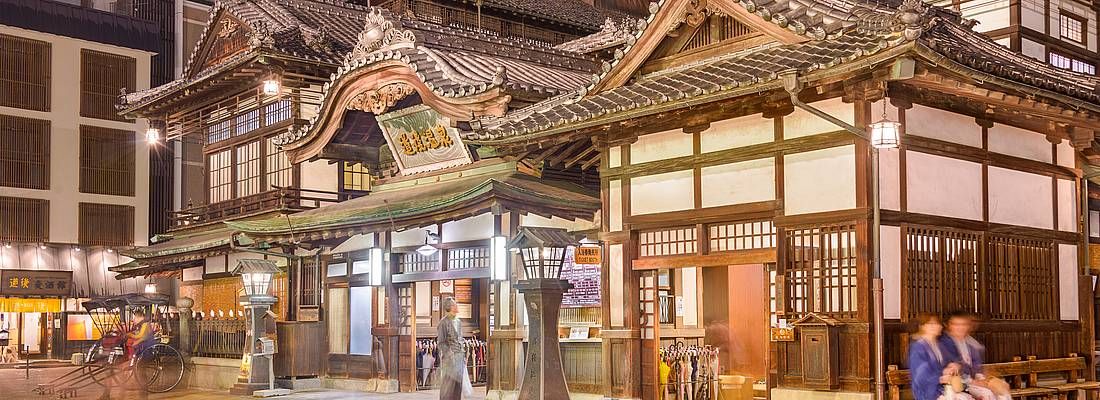
Dogo Onsen has a nostalgic, laid-back atmosphere that’s easy to fall for. This hot spring town east of Matsuyama has about 3,000 years of history behind it, and a visit here feels completely timeless. For centuries it was a favorite of emperors, nobles and samurai, and its lanes have a charm few places can match, with small inns and wooden houses, shops selling crafts and local products, museums and traditional bathhouses.
In the evening the narrow streets are dimly lit by lanterns and by the bathhouses that are still open. You hear the clack of wooden sandals as tourists and locals head home or back to their hotels in their yukata, and that’s when Dogo Onsen feels magical.
Contents
The white heron legend
The herons on the Honkan’s roof aren’t just decoration. They tell the legend of how Dogo Onsen began. The story goes that a white heron with an injured leg came down every day to soak it in the hot water bubbling up between the rocks, until the wound healed completely and the bird flew away. Curious, the locals tried the water themselves and discovered its healing properties.
The story is commemorated by the heron stone, now kept in Hojoen garden in front of the station. Everything after that is documented history. Dogo already appears in the Man’yoshu, the oldest collection of Japanese poetry, and it’s listed among the hot springs that Prince Shotoku visited.
Dogo Onsen Honkan
Dogo Onsen’s main attraction is the Dogo Onsen Honkan, a public bathhouse dating from 1894. Its wooden facade catches your eye with all its traditional details. It’s topped by a turret with red glass windows, and statues of herons, the onsen’s symbol, dot the roof. Inside it’s even more incredible: a maze of staircases, passageways and rooms that are said to have inspired the settings and atmosphere of Miyazaki’s famous animated film Spirited Away.
The Honkan has two bath areas inside. Kami no Yu has the bigger public bath, which is often crowded, while Tama no Yu is smaller and quieter. There are several admission packages that give you access to different floors of the building, and some include a small snack with green tea. For an extra fee you can also tour the room with the private bath reserved for the imperial family.
It’s called the Yushinden, and it’s the only bath built for the imperial family that survives in Japan. It dates from 1899 and was used until the mid-20th century. The tour is guided and takes you through rooms built of fine wood and decorated in gold, ending at the granite tub, which was always kept dry and only filled when it was going to be used.
More places to bathe
Of course, the Dogo Onsen Honkan isn’t the only place to bathe. The town has two more bathhouses, plus a wide range of ryokan that let even day visitors use their communal baths.
The second best-known bathhouse is Asuka no Yu, just a few meters from the Honkan. It opened in 2017 and is the most modern one in town. A lot of care went into the design details, and the spaces are contemporary but keep a touch of tradition. Here too you can choose between several admission packages, with access to public or private baths and to the tatami lounge, where you can sip a cup of tea.
Tsubaki no Yu is another traditional-style bathhouse. It first opened in 1953 and was rebuilt in the 1980s. It’s right next to Asuka no Yu and has simple interiors and indoor baths with mineral-rich water.
Dogo Onsen’s water
Dogo’s real secret is the water itself. It’s alkaline, with a pH of around 9, and it has none of the sulfur smell of many mountain onsen. It also leaves your skin feeling smooth and silky, which in Japan is what earns a spring its reputation as a beauty bath. The water reaches the baths without being heated or diluted. There are dozens of springs under the town at different temperatures, and their water is blended to get the temperature just right.
The water is gentle, so even people who aren’t used to very hot baths can handle it. And since all three public bathhouses use the same water, what sets the Honkan, Asuka no Yu and Tsubaki no Yu apart is the atmosphere and the spaces, not the quality of the bath.
Local food
After a good soak you’ll probably be a little hungry, and there’s nothing better than a stroll through the center of town to try the local food. One local specialty is taimeshi, a tasty, hearty rice dish served with sea bream, either cooked or raw. For a sweet, refreshing snack, try the mikan orange ice cream. Mikan are grown in the region and also go into excellent juices and beer. If you like sweets, I recommend the taruto cake and the rice-based botchan dango, sold in plenty of small shops and in the shopping arcades. Taruto has nothing to do with a tart. It’s a sponge cake roll filled with yuzu-scented bean paste, created when a lord of Matsuyama brought back the recipe for a Portuguese cake from Nagasaki and had it adapted to local tastes. Botchan dango are named after Soseki’s novel. They’re skewers of three balls in different colors, flavored with green tea, egg yolk and red beans.
Shopping
Dogo Onsen’s shopping arcades are the place to pick up souvenirs and local products. The busiest one runs for 250 meters from the Dogo Onsen Honkan to the station, lined with small shops selling gifts, snacks, sweets and crafts. You’ll find lacquerware, ceramics, Imabari bath towels and pearls, all specialties the region is known for. For Studio Ghibli fans, there’s also a shop selling the studio’s merchandise.
Most of the shops stay open until late in the evening, and with ryokan guests in yukata window-shopping, the atmosphere is especially pleasant and lively.
Botchan comes to life
At the end of the shopping arcade, next to the train station, stands the Botchan Karakuri clock, which comes to life every hour on the hour from 8:00 to 22:00. The fun little show stars characters from a famous Japanese novel, Natsume Soseki’s Botchan. The figures dance to traditional music, and while you watch you can rest your legs in the free hot spring foot bath near the clock. While you’re there, take a closer look at Dogo Onsen station itself. Built in 1895, it’s a lovely example of the architecture of that period. It’s the terminus of the three tram lines that stop here, and in front of the building you can see a replica of the historic Botchan steam locomotive.
Local culture
One museum in town that stands out is the Masaoka Shiki Museum, a short walk from Dogo Park. The museum and memorial is dedicated to Masaoka Shiki, one of Matsuyama’s best-known locals and the father of modern haiku. The exhibits cover the poems and paintings of this multitalented artist, along with plenty of material on his life.
Cherry blossoms in Dogo Park
The site of the old Yuzuki Castle is now a beautiful green space, and on weekends it’s a lovely place to be, with locals strolling around the pond full of carp and turtles and sitting on the lawns for a picnic. In spring it’s one of the best places in the city to see the cherry blossoms. The castle itself is gone, but a small museum about it stands right next to the park entrance.
Temples and shrines
If you still have time, you can explore the area’s best-known shrines and temples.
Ishiteji Temple is in Matsuyama, about a 20-minute walk from central Dogo Onsen or a short bus ride away. It’s a large complex with several buildings, a three-story pagoda and an entrance gate designated a National Treasure. One unusual thing about Ishiteji Temple is its cave, which leads to a second, rather bizarre sacred complex.
Isaniwa Shrine is 200 meters from Dogo Onsen station. A flight of steps leads up to the heart of the shrine, which is made up of two large halls with connected roofs. Covered corridors, vermilion columns and walls decorated with paintings are some of the beautiful details that set this shrine apart.
Getting There
You get to Dogo Onsen by tram, and the last stop is right in the middle of town. From JR Matsuyama Station take line 5, and from Matsuyama-shi Station take line 3. Either way it takes about 20 minutes.
When you get off the tram you're facing the entrance to the shopping arcade, and the Honkan is a 5-minute walk away. You can easily get around the rest of the area on foot.
On weekends and holidays you can ride the Botchan Ressha, a replica of the old steam train. It's slower and runs less often than the regular trams, but the ride is part of the experience.
Useful Info
Name: Dogo Onsen
Cost per person: Honkan, Kami no Yu bath only: adults 700 yen, children 350 yen - Honkan with lounge: 1,300 to 2,500 yen depending on the package - Asuka no Yu: adults 610 yen, children 300 yen - Tsubaki no Yu: adults 500 yen, children 200 yen
Time needed: About 2 hours for a bath (bath access is limited to one hour) and a stroll through the shopping arcade. Plan on half a day if you want to try more than one bathhouse and walk around Dogo Park.
Closed: Closed one day in December for the big year-end cleaning. The closure applies to all three bathhouses, and the date is announced on the official website.
Booking: You don't need to book for the bath, since you buy your ticket at the entrance. The exceptions are the private rooms on the Honkan's third floor and the special rooms. There are only a few of them and they're in high demand, so book them on the official website by 22:00 the day before.
Tips: Don't stop at the ground-floor bath. Go up to the second floor, where they lend you a yukata and serve tea and a sweet in the tatami room, and add the tour of the Yushinden, the bath built for the imperial family. In the evening, walk around in yukata and geta like the ryokan guests do. It's the best time to be in town.
Getting there:
- Dogo Onsen stop (Iyotetsu tram, lines 3, 5 and 6): last stop, in front of the shopping arcade
- JR Matsuyama Station: tram line 5, about 20 minutes
- The limousine bus from Matsuyama Airport also stops at Dogo Onsen
Map
MarcoMaps100% free
This place is on MarcoMaps
Dogo Onsen
My map of Japan: over 4,000 places I've tried myself, each with photos, rating, and hours. Filter by category and rating, find veg-friendly spots and places near you with GPS. No sign-up, right from your phone.
- 4,000+ places
- Rating, photos, and hours
- Veg friendly
- Near me (GPS)
- Favorites without login
- Works offline

