
Enoshima
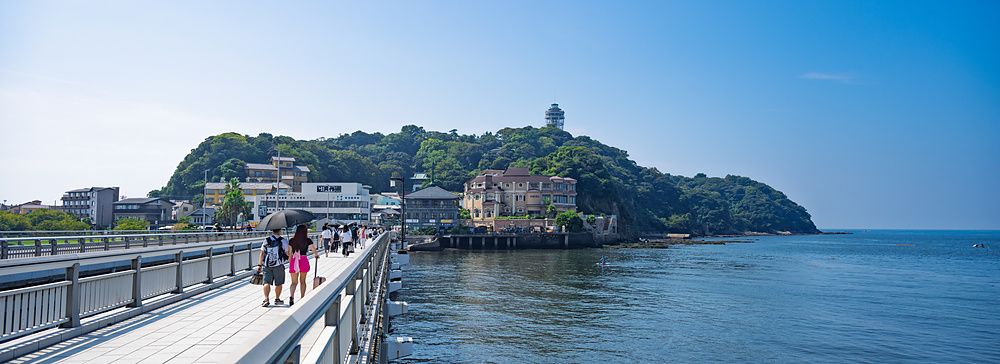
Enoshima is a small island at the mouth of the Katase River, where the river empties into Sagami Bay. It’s linked to the mainland by a bridge, the Enoshima-Ohashi, which is 600 meters long.
The island has shops, restaurants and plenty of cultural and sightseeing spots, among them Enoshima Shrine, home to three deities who protect land travel, sea travel and fishing. On especially clear days you can even make out the top of Mount Fuji.
Don’t miss the tropical botanical garden, the Enoshima lighthouse, the marina and the Iwaya caves, which the sea carved out of the rock about 6,000 years ago.
Lots of local anglers fish the Katase River because it has so many good spots, and in July and August the island’s beaches draw big crowds.
The marina is easy to get to in several ways. Most of the sights, though, are up on the island’s wooded hill, and that part you can only explore on foot.
Contents
Nearby neighborhoods


Machida
Shin-Yokohama
Enoshima Shrine
Enoshima Shrine is actually three separate shrines spread out across the island. The main complex has an octagonal hall housing one of the three most revered statues in Japan, the statue of the goddess Benten. She’s Enoshima’s protector and one of the best-known deities in all of Japan, the goddess of luck, wealth and knowledge. Legend says she created the island and then defeated a five-headed dragon that was terrorizing the area. Today huge numbers of tourists, visitors and even celebrities come here specifically to ask her for good fortune. To bring luck and wealth, visitors traditionally wash their coins in the shrine’s pond.
As you climb along the island’s ridge you reach the three shrines one after another. First comes the Hetsunomiya, the main complex with the octagonal hall, then the Nakatsunomiya halfway along, and finally the Okutsunomiya, the farthest one, almost directly above the Iwaya caves.
Each one is home to one of the three sister goddesses that tradition eventually came to identify with Benten. That’s why the shrine isn’t all in one spot: you walk through it from one end of the island to the other.
The Iwaya caves
The caves are an easy walk away, on the island’s south coast. One holds a number of Buddhist statues, and the other is dedicated to the legendary dragon said to have terrorized the area until the goddess Benten defeated it. The first cave runs more than 150 meters into the rock and the last stretch is dark, so you’re handed a small candle to find your way past stone altars and statues worn down by the damp. The story goes that the far end reaches all the way to the caves of Mount Fuji.
The second cave is much shorter and ends at the dragon statue, lit up in purple at the end of the passage. When the sea is rough, the caves may stay closed, because the walkway runs right at water level.
The lighthouse
The 60-meter lighthouse stands in a lovely park and doubles as an observation tower. It was built where the house of Samuel Cocking once stood. Cocking was a British merchant who bought a sizable part of the island in the late 19th century and also laid out a botanical garden there.
Winter illuminations
From late November to late February the island looks completely different. This is the season of Shonan no Hoseki, the big light display that lights up the botanical garden, the observation tower and the slope running down to the sea.
The view from the top of the tower is the reason a lot of people go up at this time of year: the winter air is clearer, and you can take in the entire Shonan coast.
These are also the evenings when the island is at its most crowded, especially on weekends, and it’s the only time of year the garden stays open after sunset.
Daishi temple
This Buddhist temple belongs to the Shingon sect and houses a six-meter statue of Fudomyo, one of the protectors of Buddhism.
The south coast
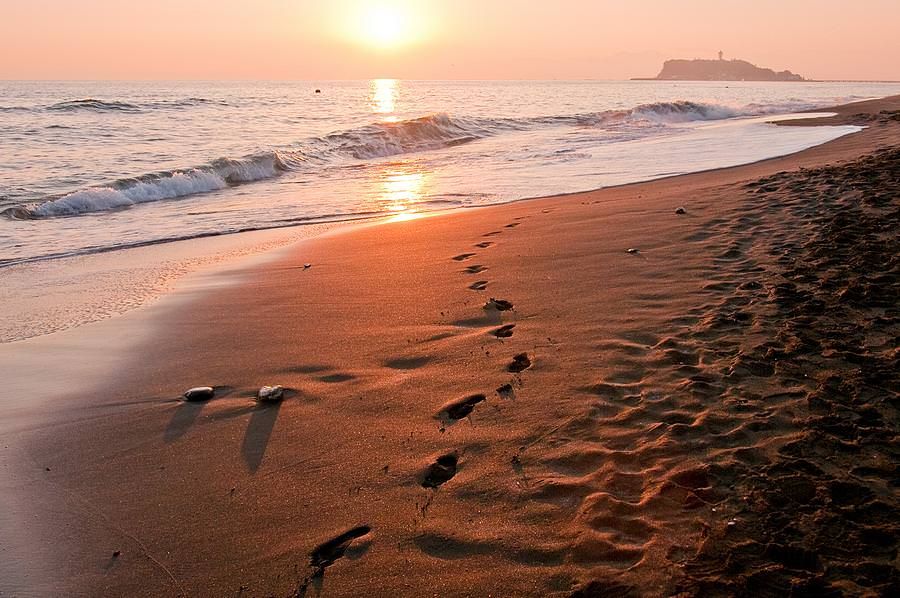
Enoshima’s south coast is all jagged cliffs dropping steeply into the ocean, ending in wide rock shelves where people sit at low tide to soak up the sun or fish. The small Bentenmaru boats that link this side of the island to the mainland also dock here. Those rock shelves weren’t always there. They used to be seabed, lifted by the 1923 Great Kanto earthquake, which raised this whole strip of coastline in one go. This is also the west-facing side of the island, where on clear days the sun sets into the sea with the outline of Mount Fuji behind it, and around sunset the rocks fill up with people sitting and waiting for it.
Enoshima Island Spa
If you’re looking for some rest and relaxation, Enoshima Island Spa makes a nice stop. It’s a spa resort built along Enoshima’s rocky shoreline, a perfect place for hot spring baths and for lounging in its various pools, some of them set inside artificial caves.
Ryukoji temple
This temple stands on the spot where Nichiren, founder of the Buddhist sect that bears his name, came close to being executed. According to legend, a flash of light and a clap of thunder convinced the executioner to stop. You can see a handsome five-story pagoda from the Meiji period and the cave where Nichiren was held prisoner.
Enoshima Aquarium
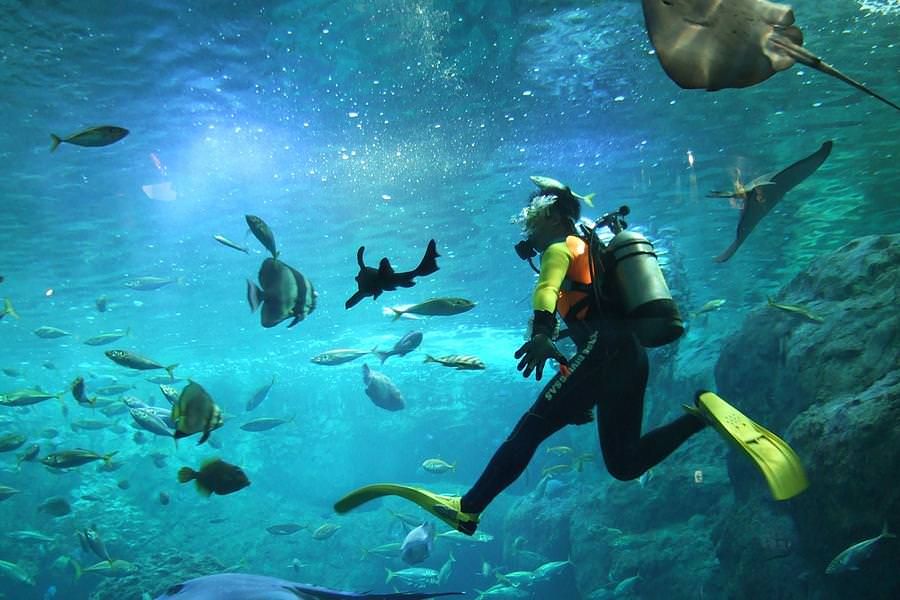
Enoshima Aquarium is a large, modern aquarium on the beach near the Enoshima bridge. Inside you can see the sea life of Sagami Bay, and there are several penguin and seal shows too. The biggest tank recreates the bay’s seabed, with a school of 8,000 sardines circling under artificial lights and waves.
Next to it is the jellyfish room, kept dark, with a spherical tank in the middle and around ten species raised here by the aquarium.
Shirasu, Enoshima’s local dish
If there’s one thing people eat more of in Enoshima than anywhere else, it’s shirasu, the tiny sardine fry that boats land every morning at Katase port, right by the bridge. You’ll find it practically everywhere along the uphill street to the shrine: raw over rice in the classic shirasu-don, or boiled, fried as tempura or cooked into fritters.
The catch is that raw shirasu isn’t available year-round, which can change your plans for the day. Fishing is closed from January to mid-March, and even during the rest of the year a single day of rough seas is enough to leave restaurants with nothing but boiled shirasu.
The other local specialty is tako senbei, an octopus cracker pressed flat to order in a red-hot press. It comes out as big as a plate and super crunchy, and lining up at the stalls that make it is part of the experience.
Getting There
From Tokyo the easiest way is the Odakyu Line to the end of the line at Katase-Enoshima. From there it's a ten-minute walk: you cross the bridge and you're on the island.
If you're coming from Kamakura, take the Enoden to Enoshima Station, then walk down toward the sea along a street lined with shops, again about ten minutes.
From Ofuna there's the Shonan Monorail, which hangs from its track high above the houses and runs to Shonan-Enoshima, a short walk from the other two stations. Once you're on the island, you get around only on foot.
Useful Info
Name: Enoshima Island
Cost per person: Island: free - Escar (uphill escalators): 500 yen, children 250 yen - Sea Candle: 800 yen, children 400 yen - Combo ticket Escar + Sea Candle: 1,100 yen, children 550 yen - Iwaya caves: 500 yen, children 200 yen - Samuel Cocking Garden: free during the day, 500 yen after 17:00 during the illumination season, children 250 yen
Time needed: I'd allow 3 hours for the main shrines. Plan on a full day if you want to explore the Iwaya caves, the botanical garden and the Sea Candle tower.
Closed: The Iwaya caves close when the sea is rough or the weather is bad, and on those same days the Bentenmaru boat to the south coast doesn't run either.
Tips: Put the Iwaya caves at the top of your list: they close in the late afternoon, well before the island's other attractions. Halfway through the first cave they hand you a lit candle, and that's what you use to get through the last stretch in the dark.
Getting there:
- Katase-Enoshima Station (Odakyu Enoshima Line): about 10 minutes on foot
- Enoshima Station (Enoden): about 10 minutes on foot
- Shonan-Enoshima Station (Shonan Monorail from Ofuna): about 10 minutes on foot
Address: Enoshima Island, 1 Chome-9 Enoshima, Fujisawa, Kanagawa 251-0036, Japan
Open in Google MapsMap
MarcoMaps100% free
This place is on MarcoMaps
Enoshima Island
My map of Japan: over 4,000 places I've tried myself, each with photos, rating, and hours. Filter by category and rating, find veg-friendly spots and places near you with GPS. No sign-up, right from your phone.
- 4,000+ places
- Rating, photos, and hours
- Veg friendly
- Near me (GPS)
- Favorites without login
- Works offline



Creative Commons inoc
Creative Commons chaojikazu
Creative Commons inoc