Expo ’70 Commemorative Park
About 30 minutes north of central Osaka, Expo ’70 Commemorative Park is a huge green space that in 1970 hosted the Japan World Exposition, the first of its kind anywhere in Asia.
Back then the grounds were filled with pavilions that let visitors explore the wonders of the world. Today the site is a fantastic public park that locals love, and people come here to walk among the trees, play sports, visit museums and enjoy the seasonal flowers and colors.
If you’re in Osaka and want a break from shopping malls and busy streets, I recommend taking a walk in Expo ’70 Commemorative Park. It has enough to keep you busy for a whole day, and gardens, lakes, museums and shopping are only part of what’s there.
Contents
Walking around the park
Once you’re inside, you’ll find a patchwork of colors and landscapes. Where the Expo pavilions used to stand there are now woods, gardens, picnic and barbecue areas, play areas for kids, wide lawns and small squares framed by flowers and trees. Some people stop for a picnic on the benches, others relax with a book in the shade, and others just stroll slowly and take in the scenery, which is magical in every season but especially moving in spring and fall. With around 5,000 cherry trees, the park is one of the most popular places in the city to see the blossoms, and the best time for hanami is usually early April. In fall the leaves turn every shade of red and yellow, and the whole landscape takes on a melancholy look that’s beautiful to photograph.
What’s left of the Expo
Not everything built for the 1970 Expo is gone, though. Some of the structures and installations survived and were repurposed, so they got a new life. One of the Expo pavilions is now a museum about the event itself, where you can get a feel for it through photos, film clips and objects.
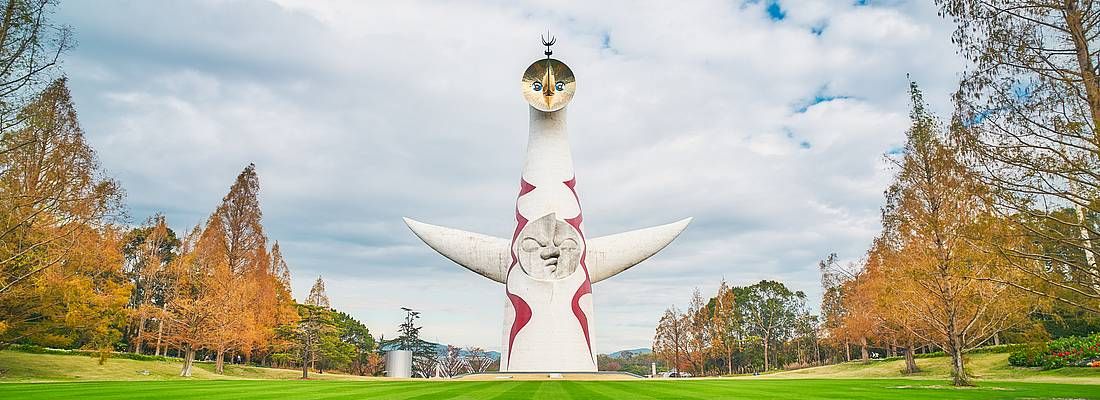
One of the best-known sights is the Tower of the Sun. Standing 70 meters tall above the park’s main entrance, it has become the symbol of the place. It isn’t the only sculpture you’ll see in the park, but it’s certainly the most famous. The artist Taro Okamoto created it, and it stands out for its 3 faces, which represent the future, the present and the past. The tower originally housed an Expo exhibition space. It stayed closed for decades, but now you can go inside again and climb up around the Tree of Life, a 41-meter sculpture covered in creatures that tell the story of evolution, from the simplest organisms to dinosaurs. At the entrance there’s also a reconstruction of the Sun of the Underground, the tower’s fourth face, which was lost after the Expo.
The Dream Pond is a beautiful lake that’s part of the original design, dotted with sculptures rising out of the water. Today couples and tourists weave between them in pedal boats, and a romantic ride around the lake has become one of the most popular things to do in the warmer months. Of course, there’s also a Japanese-style garden, created to welcome the Expo’s foreign visitors and give them a taste of the country’s traditions and landscapes, with stone lanterns, bonsai, carp ponds and teahouses. The garden is laid out around a central lake that, seen from above, is shaped like the kanji for “heart.”
Museums
Besides the Expo museum, the park has other places that are perfect if you’re into Japanese history, culture and traditions. The National Museum of Ethnology will surprise you with its extensive collection of artifacts from all over the world, while the Japan Folk Crafts Museum focuses on Japanese arts and crafts: ceramics, textiles, paintings and lots of other handmade pieces make up its permanent collection. The Museum of Ethnology, which Japanese people call Minpaku, is one of the largest ethnographic museums in the world. The building was designed by the architect Kisho Kurokawa, and walking through the galleries is like a trip around the world, continent by continent, past masks, clothing, musical instruments and everyday objects.
Shopping and entertainment
Right next to the park is the Expocity shopping complex, directly across from the main entrance. It has about 300 stores from Japanese and international brands selling a bit of everything: high fashion and luxury goods, cosmetics, home goods, sporting goods and much more. The mall spans three floors and includes a food court with lots of restaurants and fast-food places, so you can grab a bite in between shopping.
The complex also has other attractions that are perfect for families, including a multiplex movie theater, the largest Ferris wheel in Japan and Nifrel, an ultra-modern aquarium that reinvents the whole idea of an aquarium by breaking down the barriers between visitors and sea creatures.
Expocity also includes VS Park, with lots of sports challenges to take on together, and Redee, where kids can get hands-on with drones, virtual reality and programming.
Getting There
From central Osaka, take the Midosuji subway line from Namba, Umeda or Shin-Osaka. The trains run straight through without a transfer onto the Kita-Osaka Kyuko line to Senri-Chuo, where you switch to the Osaka Monorail and get off a few minutes later at Banpaku-kinen-koen. The whole trip takes about 30 minutes.
From Kyoto, your best option is the Hankyu line to Minami-Ibaraki, where you change to the monorail.
When you exit the station, Expocity is right in front of you, and the park's central entrance is a 5-minute walk away.
Useful Info
- Banpaku-kinen-koen Station (Osaka Monorail): central entrance and Expocity
- Koen-higashiguchi Station (Osaka Monorail, Saito line): convenient for the east entrance
Map
This place is on MarcoMaps
Expo '70 Commemorative Park
My map of Japan: over 4,000 places I've tried myself, each with photos, rating, and hours. Filter by category and rating, find veg-friendly spots and places near you with GPS. No sign-up, right from your phone.
- 4,000+ places
- Rating, photos, and hours
- Veg friendly
- Near me (GPS)
- Favorites without login
- Works offline

