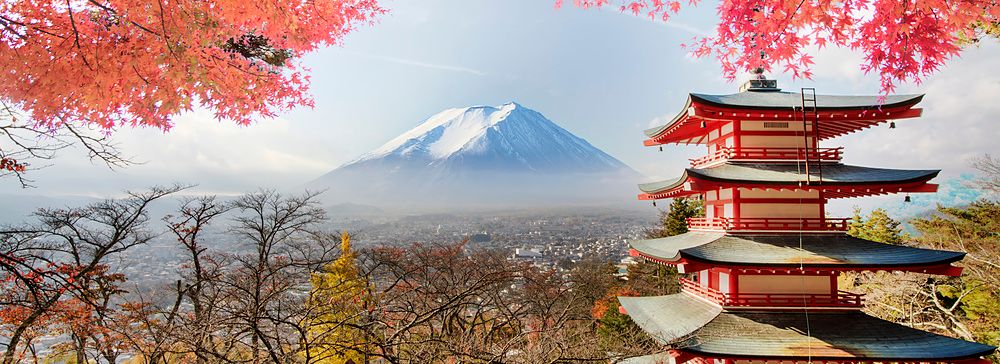
Fujiyoshida
Fujiyoshida is the place to go if you want Mount Fuji right in front of you, and you can get there without much hassle. It’s a small town at the foot of the mountain, on the Fuji Five Lakes side, with a street that points straight at the summit and a shrine where pilgrims used to set off for the climb to the top.
Don’t come expecting big-city pace. People come here for the mountain, the air up on the plateau and a bowl of udon unlike any you’ll find elsewhere. I’ll explain how to get around, when it’s worth coming and what you’ll find as soon as you step off the train, because it’s easy to show up, take the photo and leave without ever figuring out where you were.
Contents
The street with the Fuji view
The photo you’ve seen everywhere is taken on Honcho-dori, a straight street lined with streetlights, power lines and small low-rise shops, with Fuji planted at the far end as if it were there to cap the view. You’ll recognize the spot right away, because there’s always someone holding up a phone in the middle of the road.
That’s exactly the problem. It’s an ordinary street, with cars going by and people living on it, and standing in the road for a photo annoys both the residents and the drivers.
My advice is to go early in the morning. There’s less traffic, the light catches the snow on the peak nicely and you don’t have to wait your turn. Stay on the sidewalk, take your shot and move along. Fuji isn’t going anywhere.
Udon and the shrine
If there’s one thing I’d tell you to try in Fujiyoshida, it’s Yoshida udon, the local specialty. These are thick, firm noodles served in a miso and soy sauce broth, and you’ll find them only here. The soil up on the plateau is full of lava rock and was no good for rice, so people went all in on wheat.
It’s simple, cheap food, the typical lunch around here, and not special-occasion dining. Don’t expect tempura in the bowl. On top you’ll get boiled cabbage, aburaage and, at the more traditional places, horse meat stewed in a sweet sauce, which people in this area have always eaten and which doesn’t cost much. The noodles are so firm because the dough is kneaded by foot. Many of the shops are just rooms in private homes, with a small curtain over the entrance and only three tables.
Sengen Shrine is close by, shaded by huge trees. For centuries this was where people set off on foot to climb Fuji along the old Yoshida Trail. Once you know that, you see the town differently, because that straight street running toward the mountain wasn’t built for photos. It was the pilgrims’ road.
Half a day is enough for a visit like this, and it makes sense to pair it with Lake Kawaguchi or the Chureito Pagoda, which are both right nearby.
The late-August fire festival
If you’re here at the end of August, on the 26th and 27th, the quiet town I’ve been describing is gone. That’s Yoshida no Himatsuri, the fire festival that officially closes the Fuji climbing season. Around seventy wooden torches, each three meters tall, are set up along the road to the shrine, and in the evening they’re all lit at once while two mikoshi parade through the old pilgrim-lodging district.
You can feel the heat from far away, and the street turns into a corridor of flames, with families lighting their own torches in front of their homes too. It’s considered one of the strangest festivals in Japan, and if your dates fall anywhere near it, it’s worth rearranging your trip to be there.
The weaving town
Long before it was known for the Fuji photo, Fujiyoshida was, and still is, a weaving town. People have been weaving here for over a thousand years. The very fine Gunnai silks were already famous in the Edo period: the soil on the plateau couldn’t feed people, so they made their living from thread instead.
The streets behind the center still have a couple of hundred small weaving mills, low sheds that now weave for fabric, tie and umbrella brands. Some have opened a factory store, and in October the town holds a festival around them, the Hataorimachi Fes, with looms out in the street.
Getting There
From Shinjuku the easiest option is the Fuji Excursion direct train. It gets you to Fujisan Station in under two hours with no changes, and Fujisan is the center of Fujiyoshida and the starting point for Sengen Shrine.
For Honcho-dori and the Chureito Pagoda you're better off at Shimoyoshida, two stops earlier coming from Otsuki and served by Fujikyu local trains. From there it's a ten-minute walk toward the mountain.
The alternative is the JR Chuo Line to Otsuki and then the Fujikyu, which is a private line and isn't covered by the Japan Rail Pass. You can also take the bus from Shinjuku, which costs less than the train and stops a short walk from Fujisan Station.
Useful Info
- Fujisan Station (Fujikyuko; the Fuji Excursion from Shinjuku stops here)
- Shimoyoshida Station (Fujikyuko, local trains), for Honcho-dori and the Chureito Pagoda
- Direct buses to Fujisan also run from the Shinjuku bus terminal
Map
This place is on MarcoMaps
Fujiyoshida
My map of Japan: over 4,000 places I've tried myself, each with photos, rating, and hours. Filter by category and rating, find veg-friendly spots and places near you with GPS. No sign-up, right from your phone.
- 4,000+ places
- Rating, photos, and hours
- Veg friendly
- Near me (GPS)
- Favorites without login
- Works offline

