Genko-an Temple
From the main hall of Genko-an you see the two windows the temple is known for. The round one is the “Window of Enlightenment,” while the square one is called the “Window of Confusion.” The temple dates back to 1346, when Tetsuo founded it for the Rinzai sect, a branch of Zen Buddhism.
Picture a square and its four sharp corners, which can hurt anyone or anything they touch. That’s what the square window stands for: all of life’s problems, with corners that cut into people’s hearts like knives.
The round window, on the other hand, represents the perfection of the universe.
Contents
Getting There
The easiest way is to go to Kitaoji Station on the Karasuma subway line and take city bus Kita 1 from there. In about 15 minutes you'll get to the Takagamine Genkoan-mae stop, pretty much right in front of the temple.
From Kyoto Station, or from the Shijo Omiya area, bus 6 goes to the same stop, but it's a long ride, around 45 minutes from the station.
In November, during fall foliage season, the temple asks visitors not to come by car, because the parking lot can't be used at that time.
Useful Info
- Takagamine Genkoan-mae bus stop: city buses Kita 1 and 6
- Kitaoji Station (Karasuma subway line): the Kita 1 bus leaves from here
Map
This place is on MarcoMaps
Genko-an Temple
My map of Japan: over 4,000 places I've tried myself, each with photos, rating, and hours. Filter by category and rating, find veg-friendly spots and places near you with GPS. No sign-up, right from your phone.
- 4,000+ places
- Rating, photos, and hours
- Veg friendly
- Near me (GPS)
- Favorites without login
- Works offline


Genko-an’s blood ceiling
When you visit, you’ll notice every visitor pointing up at the ceiling. At first you won’t see why, since it just looks like a ceiling made of wooden boards. That wood, though, came from the floor of Momoyama Castle in Fushimi, which was destroyed and later rebuilt in concrete.
People also call it the “blood ceiling,” even though you can’t see much on it apart from a few footprints and handprints. The story goes that during a war more than 400 years ago, many soldiers stayed behind to defend the castle and died there, taking their own lives rather than surrender to the enemy.
The war was fought between Ieyasu (the first Tokugawa shogun) and Mitsunari (a loyal vassal of the late Toyotomi Hideyoshi), and it was decided at the famous Battle of Sekigahara. The warlord Mototada Torii had to stay at the castle and hold it against Mitsunari. Ieyasu offered to leave him more fighters, but he turned them down, saying those men would be more useful in the decisive battle (he knew full well his time had come).
With a small group of samurai, he held out for 10 days against more than 40,000 soldiers. At the very end they committed seppuku, and their bodies lay on the floor for a long time.
So these boards are soaked in the blood of warriors who fought to the very end to defend the place.
Many Kyoto temples, Hosen-in among them, received boards from the castle floor, and they’re said to have been built into the temples to honor those samurai and put their souls to rest.
From hermitage to Soto temple
Before it became the temple of the windows, Genko-an was a hermitage where its founder retired. He was the second abbot of the great Daitoku-ji, and he built it to spend the last years of his life there.
Over time the hermitage fell into decline, until in 1694 the monk Manzan Dohaku brought it back to life and moved it over to the Soto school, the other major branch of Japanese Zen. That’s why Genko-an is a Soto temple today, even though it started out in the Rinzai tradition.
The main hall you visit, with the windows and the blood ceiling, was rebuilt in those years with donations from a wealthy merchant. It houses statues of Shakyamuni Buddha and of the bodhisattva Reishi Kannon.
The temple garden
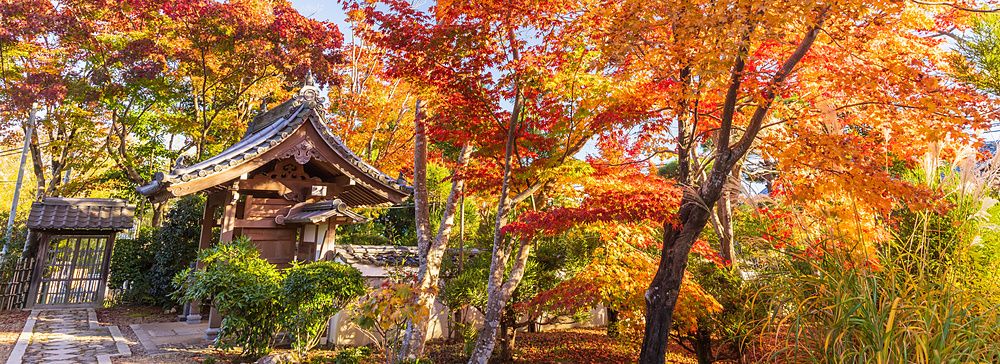
It’s a classic Japanese garden, meticulously kept, and from it you get a spectacular view. It’s the first thing you notice when you step onto the grounds, and its colors and light blend beautifully. Lots of maple trees grow here, and in the fall they turn red, yellow, and orange, usually between mid and late November. If you come to Genko-an Temple in those weeks, you’ll see this amazing garden at its best.
Satori no mado and Mayoi no mado
At the temple you’ll hear the two windows called by their Japanese names: Satori no mado, the round Window of Enlightenment, and Mayoi no mado, the square Window of Confusion.
According to the temple, the square’s four corners stand for the four sufferings of existence that Buddhism talks about: birth, old age, sickness, and death. The circle is the symbol of Zen, a line with no beginning and no end, like the truth you work toward through meditation.
What’s curious is that both windows look out onto the same garden. Only the frame changes, and that’s exactly the lesson. The world stays the same, and it’s the way we look at it that makes it a place of suffering or of peace.