Getting Around Kyoto
I’ve been to Kyoto about twenty times, both on my own and leading group tours, and whenever I talk to people who’ve traveled there, I notice that many of them had a hard time getting around Kyoto.
The sights are far apart, and you can’t rely on just one type of transportation, so you have to switch between the subway, buses and taxis depending on the area.
I want to give you a few solid tips so you don’t run into any trouble and don’t waste time getting from place to place.
Contents
How Kyoto differs from Tokyo
Kyoto is very spread out, and its sights are scattered far from one another. Right from the start, you need to understand how it differs from Tokyo. In Tokyo, you don’t really need to know the neighborhoods before you go. You can show up in Shibuya knowing nothing about it and still have a great time, because it’s like Disneyland, with something to do and see everywhere you turn.
In Kyoto, though, you need to plan your itinerary ahead of time and then stick to it, so you don’t waste time and keep the trip interesting. Most temples don’t have much else around them, so plan your days carefully rather than wandering around at random.
I strongly recommend reading my Japan itineraries to figure out how to organize your days.
The subway
The subway is my top recommendation, wherever you can use it. Kyoto has two lines, and they cover a large part of the city, but they don’t reach everywhere. Take the subway as much as you can, then switch to the other options below.
It has two advantages over the bus: it isn’t as crowded, so it wears you out less, and it’s fast.
Buses
Buses cover the whole city, but with all the tourists Kyoto gets, they’re always crowded, and standing for 30–40 minutes on a packed bus can be unpleasant and tiring.
You can’t avoid them, but I really recommend planning carefully and following my 3–4 days in Kyoto itinerary, where I keep bus rides to a minimum. Also factor in traffic: at rush hour and on weekends, buses get stuck along Shijo and on the main roads through Higashiyama, and a ride that looks short on the map can take twice as long.
At the busiest tourist stops, you’ll often have to let a bus go by because it’s already full, so if you need to be somewhere at a set time, leave early.
Taxis
A lot of people assume taxis are a luxury for the well-off few. In Kyoto, that’s not true at all. I’m obviously not suggesting you get around the whole city by taxi, but on some routes a taxi is the best option, and if there are 2, 3 or 4 of you, it costs about the same as all of you taking the bus, or a little more (sometimes even less on short trips!).
For example, consider a taxi from the Golden Pavilion to Ryoanji and back, or from Nishiki Market to the Kiyomizudera area. Buses on those routes are always very crowded, and since the trips are short, a taxi is definitely a good, cheap alternative. In the evening, a taxi becomes almost essential, because buses run less often and areas like Gion or Pontocho are still awkward to reach by public transportation.
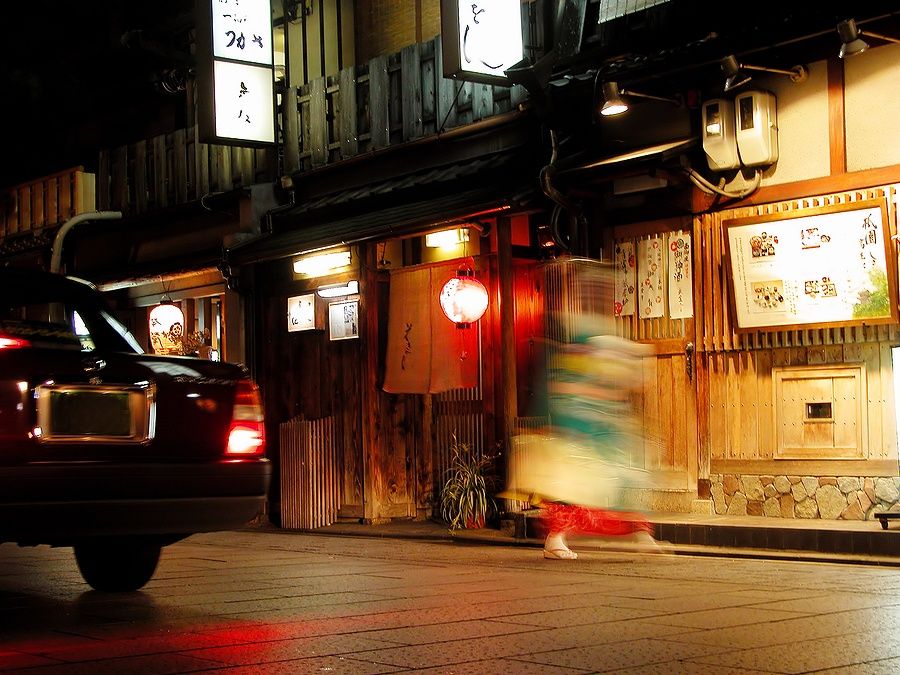
Finding one is very easy. Taxis line up in front of Kyoto Station and along the main streets, and you can hail one on the street when it shows the red sign on the windshield, which means it’s available.
Other train lines
Besides the subway, Kyoto has other rail lines. To get to the bamboo forest (Arashiyama) or Fushimi Inari, for example, you can take a JR train from Kyoto Station. Then there are the private lines, which in many cases are even more convenient. The Keihan runs along the Kamo River and is perfect for Gion and Fushimi Inari, while the Hankyu drops you off right downtown at Kawaramachi and also goes to Arashiyama, with a transfer at Katsura.
For Arashiyama there’s also the Randen tram, which is slow but very scenic, and for the mountains to the north, toward Kurama and Kibune, you take the Eizan line.
Walking
People tend to picture Kyoto as a small, traditional town where life moves slowly, but nothing could be further from the truth: it’s a huge city of 1.5 million people. Some areas are perfect for lovely walks, but don’t think for a second that you can walk everywhere. To give you an idea, it takes 2 hours to walk from the main station to the Golden Pavilion, and from there it’s another hour and a half on foot to the bamboo forest. So, clearly, you can’t walk everywhere.
There are some fantastic walks, though, like the one from Heian Jingu to Kiyomizudera, the walk along the river, or the streets around Gion.
Biking
What I just said about walking goes for biking too. Even if you’re in good shape, biking isn’t worth it for many routes, because the roads have heavy traffic and aren’t pleasant at all, or they’re too crowded with people. I only recommend a bike for exploring Arashiyama and the downtown area between Nishiki Market and Gion, plus the streets around it.
Paying for transit
The easiest option is an IC card (Suica, Icoca and Pasmo all work). You tap it on the reader and it works on the subway, buses and trains, private lines included, so you don’t have to figure out the right fare at the ticket machine every time.
On city buses, you get on through the back door and pay when you get off, by tapping your card on the reader next to the driver. On some routes outside downtown you also tap it when you get on, while on certain express tourist buses you board through the front door and pay right away. If you pay cash, you need the exact fare, but there’s a change machine on board that takes coins and 1,000-yen bills.
Finally, watch out for outdated information about day passes. The bus-only pass is no longer sold. The combined subway and bus pass is still available, but it only pays off if you make a lot of trips in one day.