Haneda Airport to Tokyo
Every way to get there.
Public transportation in Japan, especially in big cities like Tokyo, is fairly expensive and above all takes time. So when you’re getting around Tokyo, try to plan your day so you’re not constantly crisscrossing between neighborhoods.
It’ll all seem very hard at first, but after a few days you’ll get the hang of it and moving around will start to feel easy.
While you’re in Tokyo, the Japan Rail Pass isn’t worth it. It only pays off if you make plenty of long-distance trips between Japanese cities, and even then you have to run the numbers route by route.
Most flights land at Narita International Airport, about 60 km from Tokyo. The easiest way to get downtown is the Narita Express, which costs about 3,000 yen. Here’s a trick: buy the round-trip ticket between Narita and central Tokyo. You get it by showing your foreign passport. It costs 5,200 yen and it’s valid for 14 days, so you save a lot compared to two one-way tickets.
You can also take a Limousine Bus, which drops you off wherever you need to go for about 3,000 yen. It’s especially handy if you’re staying at one of Tokyo’s best-known hotels, and you’ll find many of them on my page of Tokyo hotels.
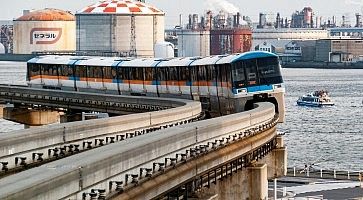
Haneda Airport is closer to Tokyo. Just take the monorail to Hamamatsucho Station, where you can change to the Yamanote Line and easily get anywhere in Tokyo.
Whatever you do, don’t take a taxi unless you can afford to spend a lot of money, somewhere between 20,000 and 30,000 yen. And if your budget really is that big, you might even consider the Heli Express helicopter, which gets you to central Tokyo in no time for 260,000 yen.
Every way to get there.
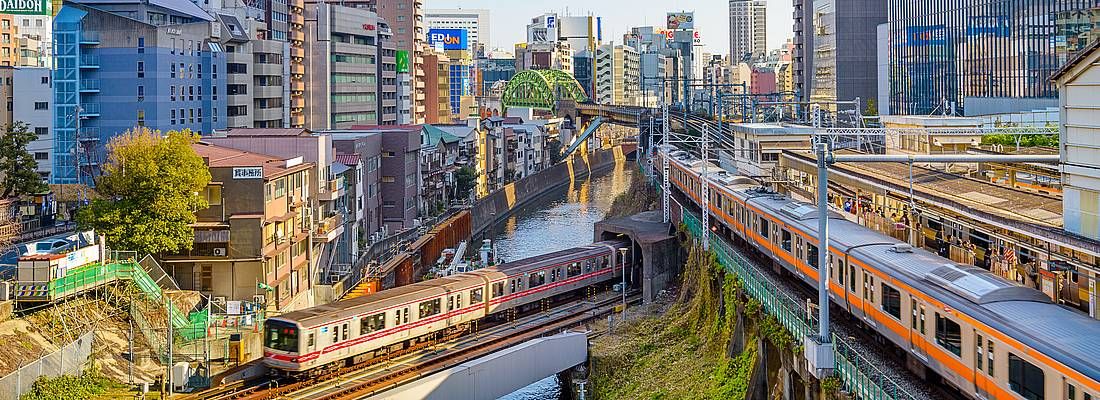
The first thing to understand is that there are lots of railway companies, each running several lines, and each with its own entrances and ticket offices. The most important thing to understand about getting around Tokyo is that if you’re a typical visitor and don’t want to complicate your life, you’ll almost always ride trains run by two companies: JR and Tokyo Metro. I’ve put together a page where you can download a Tokyo subway map showing all the lines you’re likely to need: the nine Tokyo Metro lines, the four Toei lines and one JR line, the Yamanote Line.
JR runs plenty of other lines too, but I’m only mentioning them for the record. You won’t need them, unless you know Tokyo so well that you can try the kind of little-known route only a born-and-bred local would take.
Always plan your trips very carefully, because a ticket for the Yamanote Line is NOT valid on Tokyo Metro, and vice versa. So every time you go somewhere, decide which company you’re going to use. To skip the hassle of buying tickets and move around faster, I obviously recommend a Suica or Pasmo card.
Besides Tokyo Metro there’s also Toei, the subway run by the Tokyo Metropolitan Government. It has four lines, and the most useful one for you is the Oedo Line, which runs in a sort of loop and takes you to areas the other lines don’t reach.
They’re two different companies, so if you switch from Toei to Tokyo Metro you pay for two rides. When you can, stay on the same network and keep things simple.
Then there are the private railways, which run out of the major stations and are mostly for getting out of Tokyo: Odakyu and Keio from Shinjuku, Tobu from Asakusa, Tokyu from Shibuya. You won’t need them to get around the city, but you’ll run into them the day you decide to take a day trip.
With a Suica, though, you don’t have to think about any of this: it works on all of them, JR, Toei, Tokyo Metro and the private lines.
These are two reloadable prepaid cards for riding trains in Japan. They have nothing to do with the Japan Rail Pass: they just save you from buying a ticket every time you go somewhere. They’re very convenient, and I suggest getting your Suica right at the airport as soon as you land. Don’t buy it online, because websites charge way too much for it, while in Japan you can get one in under 30 seconds.
A lot of people ask me how much to put on it at the start. Load at least 5,000 yen, then top it up as you go whenever it runs out. You’ll find all the details in my article on Suica and Pasmo cards. If you have an iPhone, you can skip the plastic card altogether and keep your Suica on your phone, topping it up with a credit card without going to the machines. On Android phones bought outside Japan, on the other hand, Suica almost never works because they don’t have the right chip, so don’t think twice and go for the physical card.

The rechargeable cards you use on trains, and more.
If you can, stay off the trains between 8:00 and 9:00 in the morning. On the busiest lines the crowd pushes you onto the train, and you stay squeezed in until your stop. In the evening, between 18:00 and 20:00, the biggest stations turn into a river of people where you can only walk with the flow.
If you really have to travel at those times, wear your backpack on your front, put your phone on silent and don’t take calls. Nobody wrote these rules down, but everyone follows them.
Also watch out for the pink cars, which are for women only at rush hour. You’ll see where they stop marked on the platform floor.
But the most useful tip is this: if you have luggage, travel at a different time, because you won’t get anywhere with a rolling suitcase at rush hour.
Maps without much detail, like the one below, only give you a rough idea of where you are; they won’t help you find anything. If you’re looking for a specific place, you can check the various maps on my site, for example, or open Google Maps, take a screenshot of the detailed map and check it later in your camera roll. If all you have is the address, go to the right neighborhood and ask at a police box. If you’d rather find it on your own, first learn how to read addresses in Japan, then go to the right neighborhood and take a photo of one of the countless maps posted in every station and on almost every street. You’ll need it to find your way among the blocks of buildings that Japanese addresses are based on.
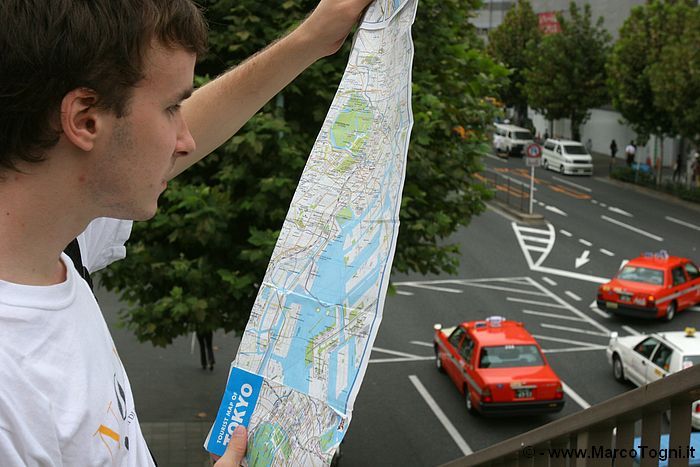
Me studying a useless map of Tokyo: at first glance it makes no sense at all…
You can get around Tokyo on foot. If you’re only here for a few days I’d stick to trains and the subway to save time, but if you want to try something different and skip the usual spots tourists flock to, you can go for a few walks. You won’t see anything spectacular, but it can be a nice experience.
Over the years I’ve become one of the few people who’ve walked through practically every neighborhood in Tokyo.
Every route is good for one reason or another. The best views are probably on the walk from Tokyo Station to Ginza along the elevated railway tracks, where there are some pretty nice little alleys. There are several videos of my walks on my YouTube channel.
Everyone says taxis in Japan are really expensive, but does that even need saying? I can’t think of anywhere in the world where taking a taxi is particularly cheap…
Tokyo has tons of taxis, both outside stations and in other busy areas, and you can flag one down on the street with a simple wave: it’ll stop if it’s free. The fare is 500 yen for the first kilometer, then 100 yen for every 255 meters, with extra charges if there’s traffic. Rates go up at night.
Only take a taxi in an emergency, for example if you miss the last train around midnight and absolutely have to get back to your “base,” as long as it’s not too far.
Remember that taxi doors usually open and close on their own. If one doesn’t, wait for the driver to signal before you try it yourself and risk breaking it.
Trains and the subway are always your best bet, and sometimes the bus isn’t such a bad option, but only take it if a Japanese person suggests it. On one of my first trips, for example, I had to go to an office in Waseda. Instead of taking the subway and then looking for the office, I was told to take the bus and get off at a certain stop, and the office was right there. In that case it made sense, because otherwise it would have taken me much longer, but in every other case the bus isn’t a good way to get around Tokyo. The night buses, on the other hand, are excellent: they leave from Tokyo Station’s Yaesu exit and go to every other city in Japan.
Buying a bike is cheap, and I know there are places that rent them out, but I couldn’t tell you where. Either way, I don’t recommend cycling if you’re only here for a few days: people usually ride on the sidewalks, it gets pretty chaotic and you’d end up causing trouble. If you’re staying in Tokyo longer and often make the same trip, though, a bike is the ideal way to get around. And if you just want to try one for a few hours, there’s bike sharing, with docks of electric bikes scattered all over the central neighborhoods, so you’re rarely far from one. You unlock the bike with the app and drop it off at another dock, not necessarily the one you started from, and all you need to sign up is a credit card, even a foreign one.
As a bit of trivia, owning two bikes is fairly common in Japan: people ride one from home to the station, take the train, then ride the other one to work.
There are some free bike parking areas, but near the stations in residential areas you’ll find huge lots with thousands of bikes, where parking costs 100–150 yen a day.
If you park your bike somewhere you’re not allowed to, the police will impound it, and you’ll have to pay a fine to get it back.

