Hagi
Hagi is a small town on the Sea of Japan coast in Yamaguchi Prefecture. It played a major role in the history and culture of Japan, and it changed the country’s course.
Mass tourism has barely found it, yet this is where the end of an era played out, the era of the samurai and the shoguns, and where a new one began with the industrialization of Japan. Hagi has cultural sights, craft traditions and whole neighborhoods of historic residences that are well worth exploring.
Contents
Castles and samurai residences
Hagi is hundreds of kilometers from Tokyo, but it still played a key part in the country’s history. For about 250 years it was ruled by the Mori clan, one of the most powerful clans of the feudal era. The Mori were among the main forces behind the fall of the shogunate, which opened the way to the Meiji Restoration and the country’s modernization.
That prosperous period left behind Hagi Castle and the old town. Walk its lanes, scented with orange trees and lined with traditional samurai residences, and you can still feel the past. Some of the residences are open to the public as museums. Everything here has stayed the way it was, so much so that you can even find your way around with an Edo-period map!
The scent of natsumikan
The citrus fruit hanging over the old town’s earthen walls isn’t there for decoration. These are natsumikan, summer oranges that quite literally saved Hagi. After the shogunate fell, samurai who no longer had a stipend started growing them in the gardens of abandoned residences, and that’s how natsumikan became the symbol of the town.
In spring the white blossoms fill the lanes with an intensely sweet scent, and the yellow fruit stays on the trees above the walls for much of the year. In the shops downtown you’ll find them turned into jams, sweets and drinks, and stopping for a natsumikan ice cream is the perfect break halfway through your walk.
The beach
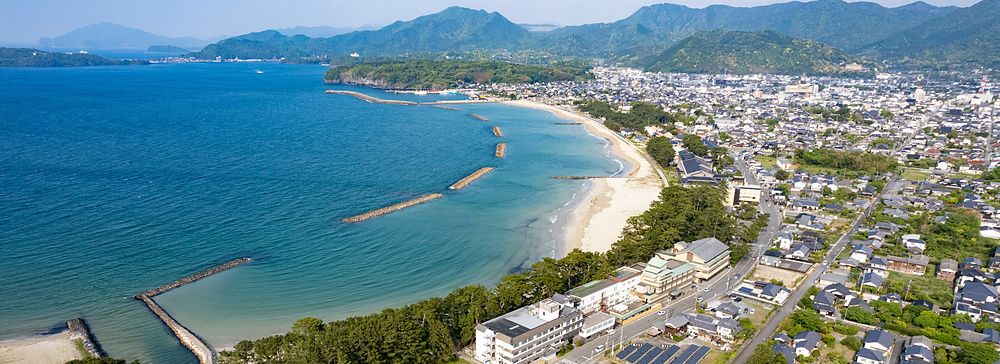
Just a short walk from the Hagi Castle ruins, the town beach, Kikugahama, is a stretch of white sand edged by green pine woods. In summer it’s perfect for swimming and lying in the sun. Once you’re out of the water you can take a walk through the old port area of Hamasaki and see the historic houses of the merchants who used to live here.
Getting to know Hagi ware
Use your visit as a chance to get to know the local craft traditions, especially Hagi ware, which the town is very proud of. Since the Edo period (1603-1867), Hagi tea sets and utensils have been used in the traditional tea ceremony and closely tied to it. In town there’s a museum devoted to it, along with plenty of workshops and shops where you can learn how it’s made and buy pieces and souvenirs of excellent quality. What makes Hagi ware special is that it changes as you use it. The glaze develops a fine web of tiny cracks, and the tea slowly seeps into them and changes the color of the cup year after year. The Japanese call this hagi no nanabake, the seven transformations, and it’s why the tea world has a saying: first Raku, then Hagi. Buy a cup and you’re taking it home still unfinished.
The story of the five Choshu samurai
The story of the five samurai from the Choshu clan has become a legend and one of Hagi’s best-loved tales. In the second half of the 1800s these young men traveled all the way to London to study. They wanted to gain new knowledge and push their country toward a more technological future. One of them, Ito Hirobumi, went on to become Japan’s first Prime Minister. At the Bakumatsu Museum you can learn more about the five samurai’s story, along with some interesting details about them.
Temples and shrines
Hagi has many shrines and temples. The best known is Shoin Shrine, dedicated to Yoshida Shoin, the famous teacher who inspired a great many students and is remembered in several places around town. Next to the train station you’ll find Daishoin Temple, which along with Tokoji is one of the two temples that house the Mori clan tombs. Both stand out for their hundreds of stone lanterns, donated by members of the powerful family.
World Heritage sites
Five places in Hagi are part of the UNESCO World Heritage listing for the sites of Japan’s industrial revolution. The most moving is the Shokasonjuku school, a few tatami rooms within the grounds of Shoin Shrine. Many of the men who went on to lead modern Japan studied there.
The other four tell the story of a country learning to build ships and cannons. They are the reverberatory furnace with its stone chimney, the remains of the Ebisugahana shipyard, the Ohitayama ironworks, where iron was made with the tatara method, and the old town itself. They’re spread out across town, so allow some time to get from one to the next.
Local food
Hagi sits on the Sea of Japan coast and is especially known for its fresh fish dishes. Make sure you try Hagi gozen, a set meal of local specialties served in Hagi ware bowls and plates. It looks as good as it tastes!
Cherry blossoms and a volcano
Hagi also has a few green spaces where you can unwind with a walk. Shizuki Park, right in town, is great for a picnic under the cherry blossoms in spring or for a cup of tea in the afternoon at Hanano-e, a traditional teahouse. A few kilometers north of the center stands Mount Kasayama, a small volcano with a lookout and a pretty little lake that’s lovely to walk around. Tucked away on its slopes is a forest of wild camellias, 25,000 plants that carpet the ground with red flowers between December and March. From a raised walkway you can look down on them, with the Sea of Japan beyond. Myojin Pond, at the foot of the mountain, is connected to the sea, and saltwater fish swim in it. Not far away, icy air blows out of a few cracks in the rock even in the middle of summer.
Around the Aiba Canal
The Aiba Canal runs southeast of the historic center, and its history is a bit unusual. It was built in the mid-1700s for the residents’ everyday needs. Small boats carried firewood and rice along it, and people also used its water for the vegetable gardens and fields nearby. Today everything has changed, and colorful carp have taken the place of the boats, but it’s still a romantic, quiet spot and a pleasant place for a walk. The streets are lined with traditional houses, and a couple of them are residences open to the public. At the beautiful Yukawa Residence you can see the house’s direct access to the canal and the way its rooms connect to the water, which was used to fill the bath, water the garden and much more. The other historic home is the one where Katsura Taro grew up. He went on to serve three terms as Prime Minister of Japan. The house has elegant tatami rooms and a garden with a small stream fed by the canal.
Getting around
If you like walking you can explore Hagi on foot, but one of the most practical and fun ways is by bike. You’ll find bike rentals next to the town’s two stations, Hagi Station and Higashi-Hagi Station.
If you’re traveling in winter or would rather take it easy, you can use the Maru Bus tourist bus, which covers the main sights on two lines. The West Loop and the East Loop follow two different routes, through the western and the eastern parts of town. Buses run about every 45 minutes, and an unlimited-ride day pass costs 500 yen.
Getting There
The easiest way is the bus from Shin-Yamaguchi, the station where shinkansen from Osaka, Kyoto and Hiroshima stop. The Super Hagi Go takes about an hour to central Hagi and costs 1,600 yen. You don't need to book, but if the bus is full you'll be left behind.
From Yamaguchi Station, JR Bus runs buses that take just over an hour and are covered by the Japan Rail Pass and the main regional passes for the area.
You can get there by train, but that's really for train lovers. The JR Sanin Line runs along the coast from Masuda, Izumo and Matsue, while from Shimonoseki it takes about 3 hours with transfers.
Useful Info
- Higashi-Hagi Station (JR Sanin Line): the most convenient, close to the Hamasaki area and Shoin Shrine
- Hagi Bus Center: last stop for buses from Shin-Yamaguchi and Yamaguchi, right in the center
- Hagi Station (JR Sanin Line): out of the way to the south, mainly useful for Daishoin Temple
Map
This place is on MarcoMaps
Hagi
My map of Japan: over 4,000 places I've tried myself, each with photos, rating, and hours. Filter by category and rating, find veg-friendly spots and places near you with GPS. No sign-up, right from your phone.
- 4,000+ places
- Rating, photos, and hours
- Veg friendly
- Near me (GPS)
- Favorites without login
- Works offline

