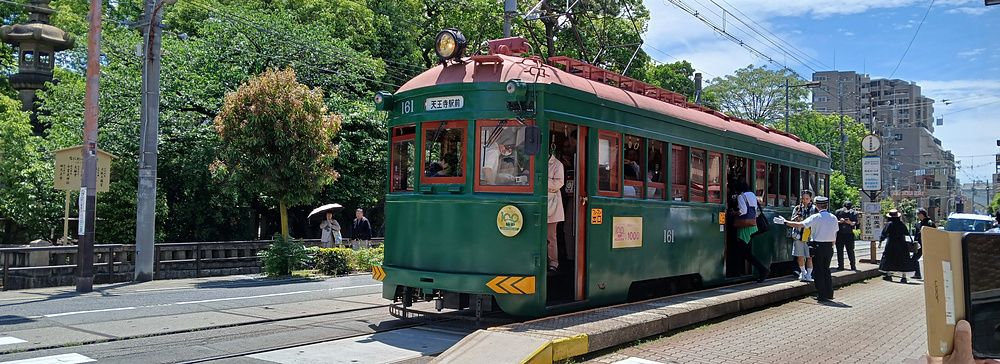
Hankai Tramway in Osaka
One of the things I most often tell people spending a few days in Osaka is to take the tram at least once. There are only two lines, both run by Hankai, and they go from the south side of Osaka down to Sakai, the next city to the south.
It won’t get you anywhere faster, since that’s what the subway is for. But it’s the easiest way to see a low-rise Osaka of small neighborhood shops and shrines, without spending much and with almost no planning.
Contents
What Hankai is
The company that runs the tram is called Hankai Denki Kido, but in Osaka almost everyone just calls it Hankai Densha, or affectionately chin chin densha, after the bell the driver rings before pulling away. It’s part of the Nankai group, the railway company that links Namba with Kansai Airport, and it has been a separate company since 1980.
Its roots go back much further. The first stretch opened in 1900, on a route that used to be served by horse-drawn carriages. Today it’s the only tramway left in Osaka, because all the other city lines were torn up during the 20th century to make way for cars and the subway.
The two lines meet halfway, at Sumiyoshi:
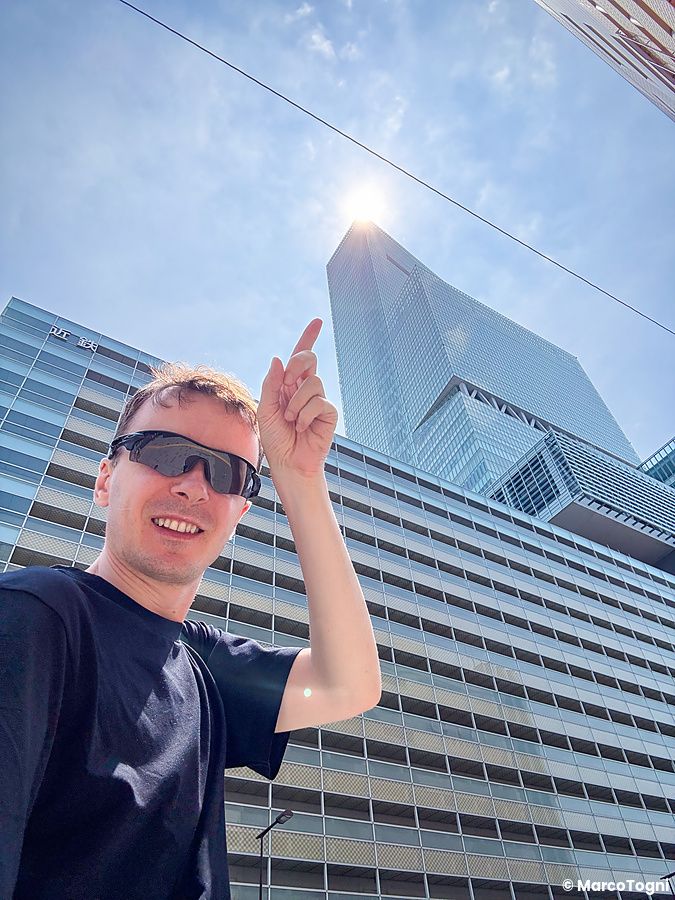
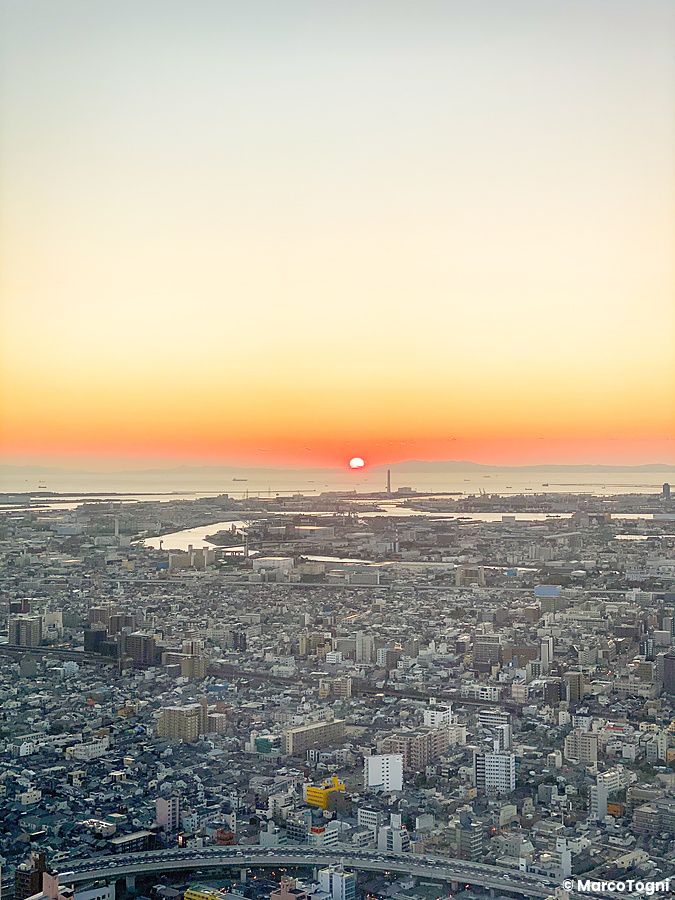
- The Uemachi line starts at Tennoji-ekimae, right in front of Tennoji Station and below Abeno Harukas, the tallest skyscraper in the city, and heads south for just over 4 kilometers.
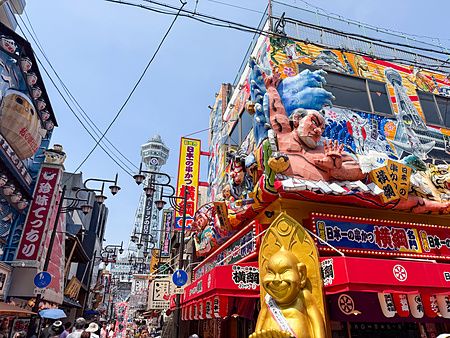
- The Hankai line starts at Ebisucho, the stop a short walk from Shinsekai and Tsutenkaku, and runs about 14 kilometers to Hamadera, in southern Sakai.
- Many Uemachi line trams continue past Sumiyoshi on the Hankai line tracks, so you can ride from Tennoji to Sakai without changing trams.
Riding end to end, from Tennoji to Hamadera, takes about fifty minutes. The stops are very close together, and the tram often shares the road with cars and has to wait at traffic lights.
How to ride
There’s just one rule: you get on through the back door and off through the front one, next to the driver. You pay when you get off, not when you board, and that’s what trips up people used to European trams the most.
There’s a single flat fare across the whole network, a little over 200 yen for adults, no matter how many stops you ride. Kids pay about half. Still, check the current fare before you go, because it changes every so often.
There are only two ways to pay:
- With an IC card like Icoca, Suica, Pasmo and the like. You tap it on the reader by the door when you get on, then again on the one next to the driver when you get off.
- In cash, dropping your coins in the fare box next to the driver as you get off, ideally with exact change.
- Nothing else is accepted: no credit cards, QR code payments or e-wallets. Don’t count on your phone unless you’ve added an IC card to it.
Have your coins in hand before you reach your stop. The older people from the neighborhood get off with their fare already counted out, and if you start digging for change in front of the driver, a line builds up behind you.
The one-day pass
If you plan to hop on and off a few times, there’s a one-day ticket called Tekuteku Kippu that covers both lines for a full day. It costs around 700 yen for adults and pays for itself by the fourth ride.
I think it’s almost always worth getting, because this tram is at its best when you get off wherever something catches your eye, without doing the math every time. Do Tennoji, Sumiyoshi Taisha, Sakai and back, and you’re already at four rides without even noticing.
There’s also a tourist pass that bundles the tram with admission to Tsutenkaku, the tower in Shinsekai. It makes sense if you’re starting from Ebisucho and were going to visit the tower anyway. Every now and then the company also sells collector’s tickets and themed passes, which train fans buy to keep rather than to use.
The oldest tram
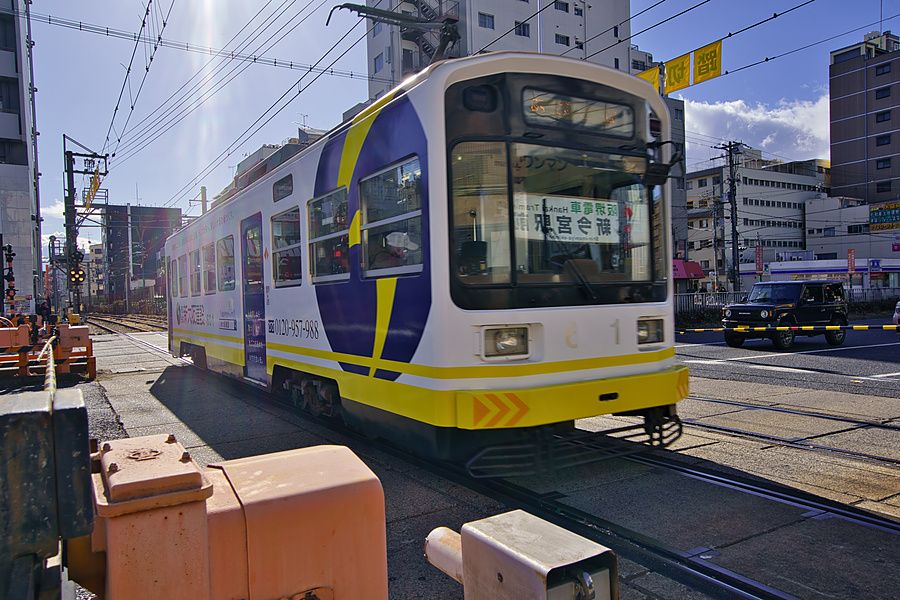
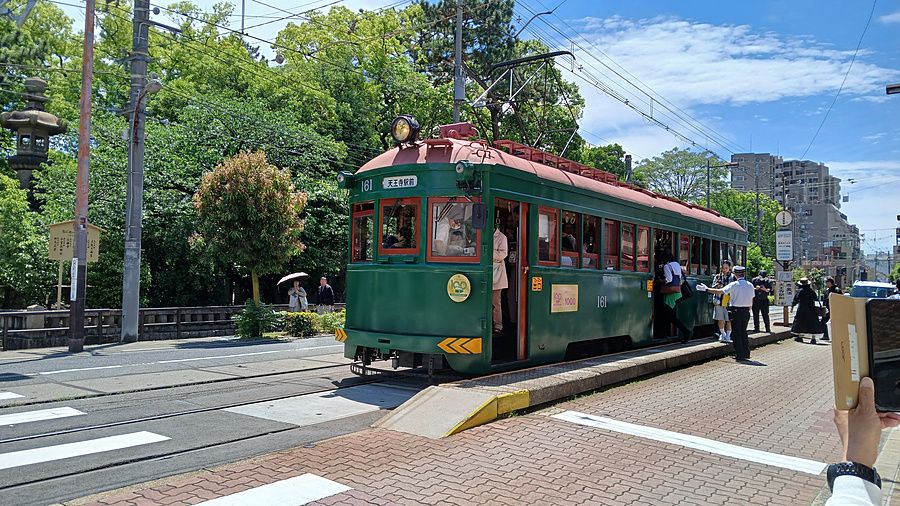
Hankai runs a real mix of trams, and that’s one of the reasons train fans come all the way from Tokyo. Alongside the modern low-floor trams, the rounded-front ones that Sakai calls the Sakai Tram, you’ll find older, boxy cars with long velvet seats and windows that open.
The most famous is the Mo161 series, which went into service in 1928. The Mo161 cars are the oldest trams in Japan still able to carry passengers, with wooden floors and no air conditioning.
Don’t expect to find one waiting at a stop by chance, though. The Mo161 cars no longer run in regular service and are mostly used for private charters or special runs during festivals and events, so if you have your heart set on one, check the Hankai website for when the next run is scheduled.
With the regular cars, it’s a bit of a lottery. Depending on the run, you’ll get either the quiet new tram or the 1960s one that jolts at every switch. Honestly, I’m always hoping for the old one.
The view from the window
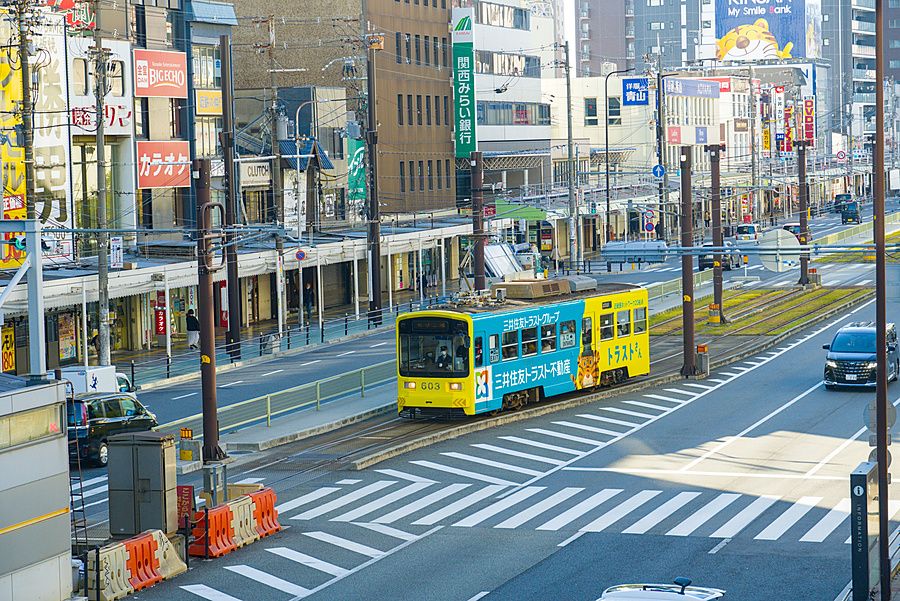
The stretch I like best is on the Uemachi line just past Tennoji. The tram runs down the middle of the street with the cars and stops at traffic lights like a bus. Then at some point it squeezes in between the houses, so close to the walls that you feel like you’re riding through other people’s backyards.
Farther south it goes back to the street and runs through quiet residential areas, where some stops are little more than a strip of concrete between lanes of traffic. Check for cars before you get off, because at many stops you have to cross a lane to reach the sidewalk.
The Hankai line from Ebisucho has a different feel. It passes warehouses, old shops with their shutters half down and houses with plants on the windowsills, and the people on board are mostly locals going grocery shopping or coming home from school.
Once you reach Sakai, the tram runs down the middle of a very wide avenue, in its own lane between the two directions of traffic. From there the scenery opens up, with more trees and less traffic.
After Abikomichi, where the tram depot is, trams come less often. If you’re riding all the way to the end, check the schedule before getting off at stops with less frequent service.
Sumiyoshi Taisha
The stop most people take the tram for is Sumiyoshi Toriimae, right in front of the entrance to Sumiyoshi Taisha. It’s one of the oldest Shinto shrines in Japan and one of the most important, and it’s the head shrine of all the Sumiyoshi shrines in the country.
A few steps from the stop is the Sorihashi, the tall red arched bridge that’s the symbol of the shrine. Climbing it is harder than it looks, because it’s steep and the steps are narrow.
The main buildings are in a very old architectural style, with bark roofs and red walls, unlike almost any other shrine you’ll see in Japan.
I especially recommend it if you’ve already seen Osaka’s best-known sights and want somewhere less crowded. On a normal day there are far fewer people than in Kyoto. In the first few days of the new year, though, it’s one of the most mobbed shrines in the region, and the trams are packed all the way to the doors.
If you head back north on foot along the tracks, you’ll pass through an area of old houses and small shops that’s worth a half-hour walk before you get back on at one of the next stops.
Sakai by tram
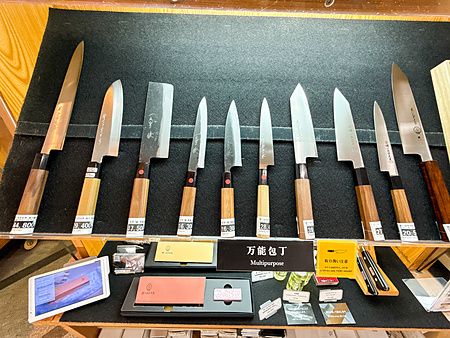
Sakai is the reason I recommend the one-day pass. For centuries it was one of Japan’s wealthiest merchant cities, and it’s still famous for its knives, which many professional chefs come here to buy.
There are only a few stops worth noting, and they’re all on the Hankai line:
- Shukuin: a minute from the stop is Sakai Risho no Mori, a cultural center dedicated to Sen no Rikyu, the tea ceremony master who came from Sakai, and to the poet Yosano Akiko. You can also watch a tea ceremony inside.
- Myokokuji-mae: the stop for Myokokuji Temple, known for its huge garden of century-old cycads.
- Hamadera-ekimae: the end of the line. From here you can walk to Hamadera Park and its long pine grove by the sea, a good place for a stroll and a break before heading back.
Along the avenue between stops there are several knife shops and traditional sweet shops. It’s easy to hop off when one catches your eye, since another tram will be along soon.
When to go
The tram is at its best on a sunny day, mid-morning or early afternoon, when light pours in through the windows and the cars aren’t full of students and commuters. During the morning and evening rush hours you’ll be standing, packed in tight, and with a backpack it gets uncomfortable.
In summer, watch out for the older cars, which have little or no air conditioning, and Osaka’s heat in July and August is hard to ignore. In spring and fall, on the other hand, it’s the nicest way to get around the city.
A few practical tips before you go:
- Reload your IC card before you get on, because you can’t do it on board and there are no ticket offices at the stops.
- Sit up front, next to the driver, if you want to see the road the way the driver sees it. It’s the favorite spot for train fans and kids.
- If you’re starting from Tennoji, take a tram that goes past Sumiyoshi. The final destination is shown on the sign on the front of the tram.
- Don’t plan tight connections, because the tram stops at traffic lights and running a few minutes late is normal.
Is it worth it?
If you only have a few days in Osaka and want to see the famous sights, the tram isn’t essential, and for getting around fast the subway is still far more practical. I see it more as a half-day change of pace, maybe on your second or third day, once you’ve already done Dotonbori, the castle and Kuromon Market.
It’s also a good choice if you’re traveling with kids, who usually love watching the driver ring the bell, and for anyone who likes photographing cities as they are, without skyscrapers or giant signs.
I go back every time I have a free afternoon in Osaka and no particular plans. If I were you, I’d start from Tennoji, stop at Sumiyoshi Taisha and carry on to Sakai for some knives and a cup of tea, then ride back to Ebisucho for dinner in Shinsekai.
A whole day on a single ticket, a handful of stops and no rush at all. Which end would you start from?