Heian Jingu
In terms of architecture, Heian Jingu is considered one of the finest Shinto shrines in Kyoto. Its history is fairly recent, but it’s still a key part of Japan’s cultural heritage.
Thousands of tourists visit every year, but it’s also a major religious site for Japanese people, especially those with strong patriotic feelings, because the shrine is dedicated to two emperors who changed the face of Kyoto and of Japan as a whole. Over time, Heian Jingu has become a symbol of change and rebirth for a city and a country where old traditions live alongside modern life, with an eye on economic growth and on promoting education and culture.
Contents
Getting There
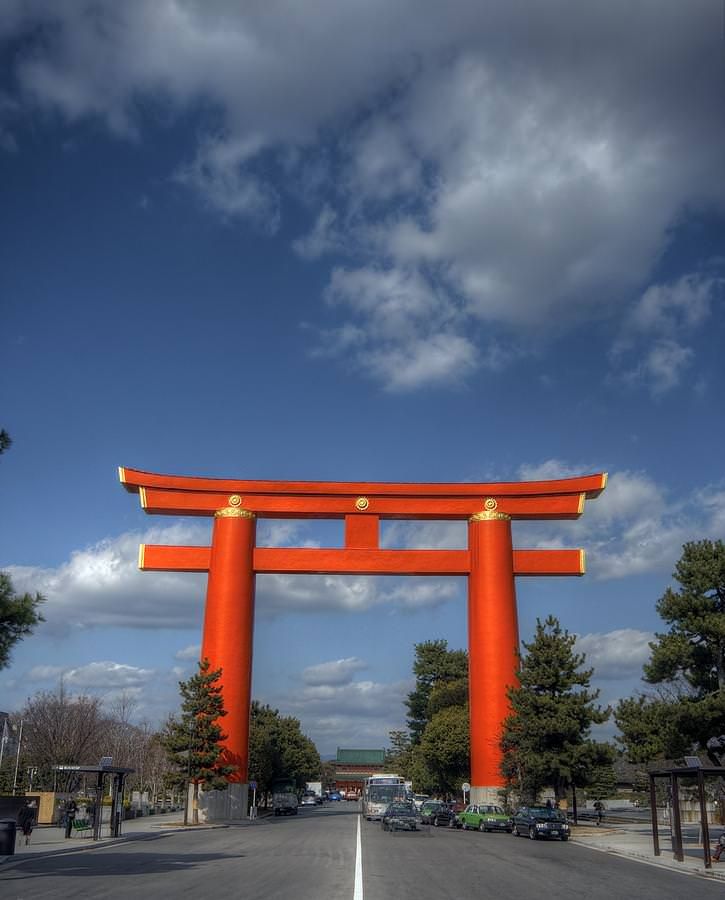
The easiest way is the subway. At Higashiyama Station on the Tozai line, take exit 1 and walk north for about ten minutes, using the giant red torii as your landmark.
If you're on the Keihan line, you can get off at Sanjo or Jingu-Marutamachi and allow 15 minutes on foot.
From Kyoto Station, your best option is the bus. It drops you in Okazaki Park, a two-minute walk from the shrine's entrance avenue.
Useful Info
- Higashiyama Station (Tozai subway line): exit 1, then a 10-minute walk
- Okazaki-koen, Bijutsukan/Heian Jingu-mae bus stop: buses 5, 100 and 110 from Kyoto Station
- From Gion and Kiyomizu, buses 201, 203 and 206 also stop nearby (Higashiyama-Nijo stop)
Map
This place is on MarcoMaps
Heian Jingu
My map of Japan: over 4,000 places I've tried myself, each with photos, rating, and hours. Filter by category and rating, find veg-friendly spots and places near you with GPS. No sign-up, right from your phone.
- 4,000+ places
- Rating, photos, and hours
- Veg friendly
- Near me (GPS)
- Favorites without login
- Works offline


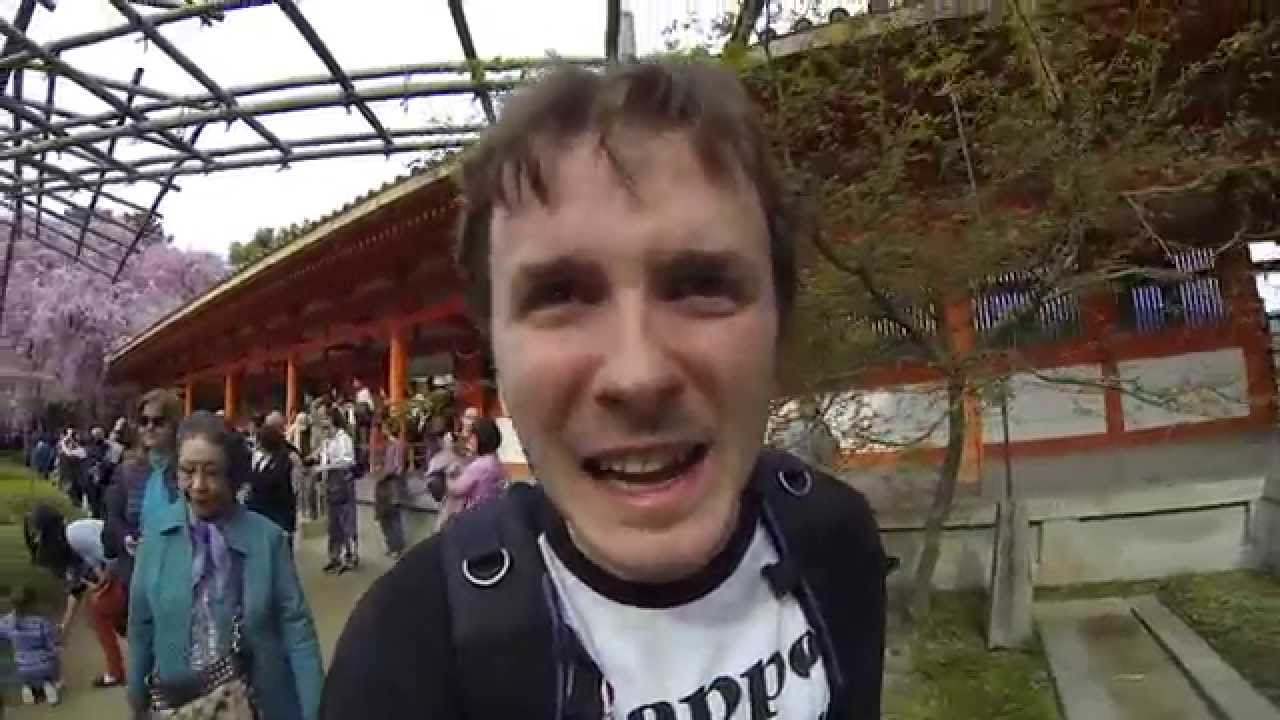
Video: Kyoto's Heian-Jingu Shrine in bloom
A short history
Heian Jingu was built in 1895 for the 1,100th anniversary of Kyoto’s founding, as a partial, scaled-down replica of the Heian imperial palace. For the anniversary it hosted an exhibition on Japanese culture, and once the event was over, the building lived on as a shrine dedicated to the first emperor to reign from Japan’s former capital, Emperor Kammu.
In 1938, people gathered in front of the shrine to honor Emperor Komei, the last emperor to reign from Kyoto, who pushed the city and the country toward modernity and progress. That led to a project to renovate and alter the shrine, and since 1940 it has also been dedicated to Emperor Komei.
The story doesn’t end there. In 1976, an arson attack destroyed nine of the shrine’s buildings, including the honden, the hall that houses the spirits of the two emperors. It took only three years to rebuild them, thanks to donations that poured in from all over Japan, so part of what you see today was rebuilt from scratch.
Kyoto’s first and last emperors
As you walk around the shrine, you might wonder why these two emperors matter so much to Japanese people, and above all to the people of Kyoto.
Kammu took the throne in 781 as Japan’s fiftieth emperor, and his first goal was to build a new capital worthy of the great Japanese empire. He decided to put up a grand new imperial palace, and the new capital, Heian, would grow up around it. Kyoto’s story began in 794. Under Kammu, the capital continued to develop and modernize, thanks to the measures he introduced: he promoted education, opened up to foreign trade, and brought in new laws and a better-organized, more modern administration. The whole country benefited, and Japan became one of the world’s major powers.
Kyoto’s last emperor, Komei, finished the job. He laid the groundwork for Japan to become an advanced country, ahead of a period of huge change known as the Meiji Restoration.
A walk around the shrine
In front of the shrine stands a massive torii gate that marks the way in and is one of the largest in Japan. Once you’re through it, you can admire the front of the main building, built in the classic style of Heian-period imperial palaces. Behind it you’ll find a wonderful garden, where you can wander among all kinds of fragrant plants, surrounded by beautiful cherry trees that add a splash of color in spring.
The shrine and garden cover a very large area, and the garden alone takes up half of it. It was a long, elaborate project, entrusted to the famous garden designer Jihei Ogawa, who spent more than 20 years completing it. Along the way you’ll also find a few traditional-style buildings and many ponds that make the landscape even more picturesque and atmospheric. Many kinds of fish live in the ponds, along with a few species that are uncommon in Japan, like the yellow-bellied slider turtle. If you’d like to feed the fish or the turtles, you can buy food at stands near the ponds.
If you have time, take a look around the neighborhood too. There’s Okazaki Park, Kyoto City Zoo and the public library, and if you love art, don’t miss the Kyoto City Museum of Art and the National Museum of Modern Art.
The Shin-en garden through the seasons
The Shin-en isn’t one garden but four gardens arranged in a ring around the shrine buildings, and you walk through them in one direction only, going in on one side and coming out once you’ve done the whole loop. There are two places along the way where it’s worth slowing down. In the middle garden, you cross the pond on the Garyu-kyo, a row of stepping stones made from the old pillars of the Sanjo and Gojo bridges over the Kamo River, so you’re literally walking on pieces of Kyoto.
The loop then ends at the pond in the east garden, where the Taihei-kaku, a covered bridge brought here from the Imperial Palace, spans the water and frames the Higashiyama hills.
Each season has its moment. In April the red weeping cherry trees bloom in the south garden. Tanizaki put these same trees in “The Makioka Sisters,” and this is the busiest time of the year.
In early June it’s the west garden’s turn, with Japanese irises along the water and water lilies on the ponds, and in July the lotus flowers open. In November the fall leaves are reflected in the big pond in the east garden. In winter the Shin-en empties out: there are hardly any people, and you can see the garden’s layout more clearly.
Special events
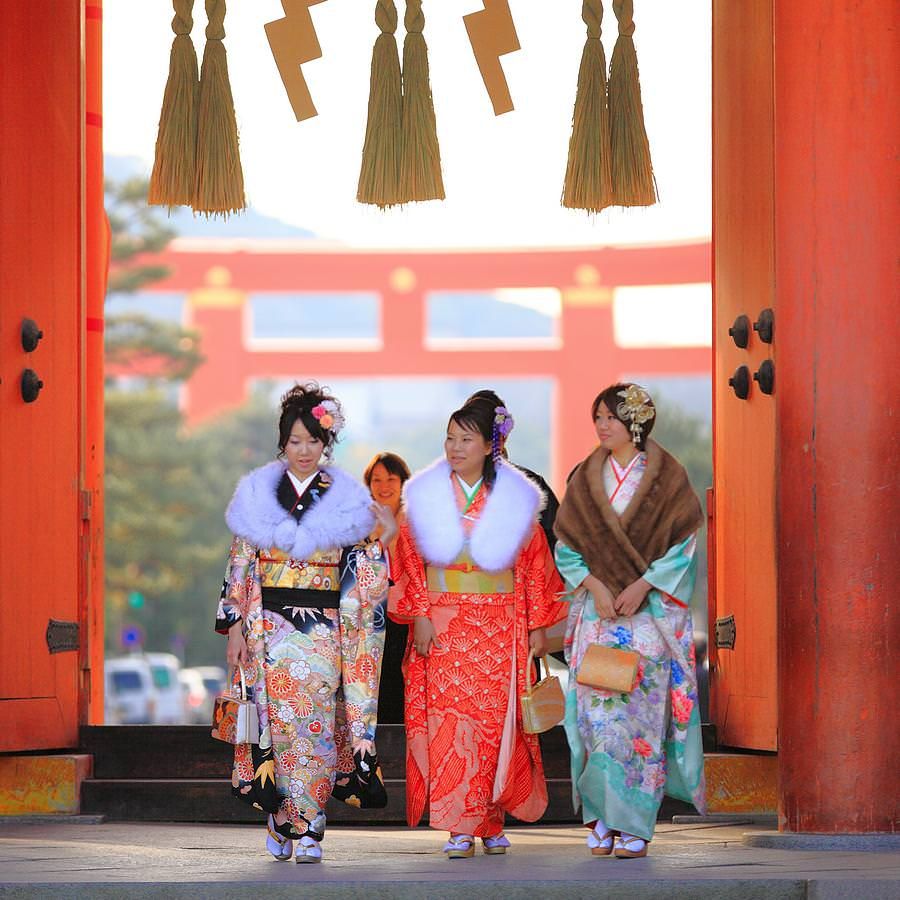
Heian Jingu is also the perfect setting for all kinds of special occasions, from traditional weddings to concerts, and this mix of modern and traditional is what most sets Heian Jingu apart from Kyoto’s other historic and cultural sites. The biggest event is the Jidai Matsuri, when people come together to celebrate the birth of Kyoto. It’s held every year on October 22, and if you’re in Kyoto around then, it’s definitely not one to miss! You can also catch the famous parade from the Kyoto Imperial Palace to Heian Jingu, with rich, colorful costumes and traditional clothing from different periods of Japanese history.
The periods don’t appear in random order, though. The procession moves backward in time, opening with figures from the Meiji Restoration and closing with Kammu’s era, when Kyoto had just been founded. There are about two thousand people in costume, and it takes a good two hours for all of them to pass by.
At the very end come the two mikoshi carrying the spirits of Kammu and Komei back to the shrine, and this is the religious heart of the whole festival.
A scaled-down imperial palace
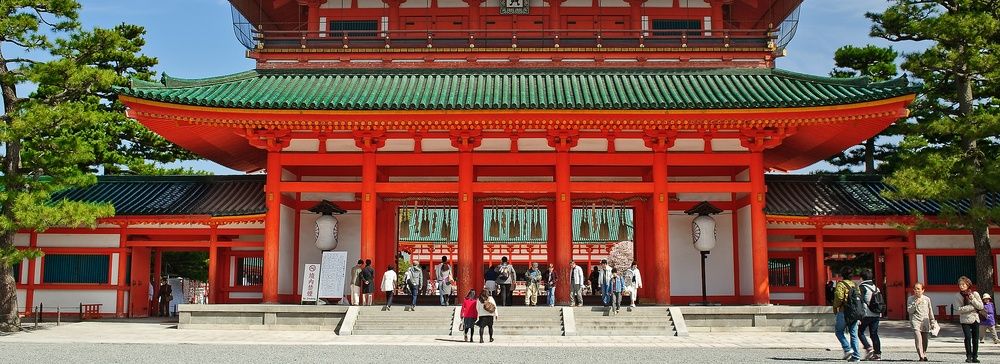
This isn’t just another shrine. The main buildings reproduce the Chodoin, the official heart of the imperial palace in Heian-kyo, at five-eighths scale. You walk through the Otenmon gate and come out into a huge courtyard of white gravel, with the Daigokuden at the far end. This outer worship hall is a copy of the ancient throne hall.
On either side rise twin towers: the Soryu-ro, for the blue dragon, to the east, and the Byakko-ro, for the white tiger, to the west. In Chinese tradition, these two animals guard the cardinal directions. The buildings were designed by Ito Chuta, one of the big names in modern Japanese architecture, and the national government has designated them Important Cultural Properties. When Japanese people picture Kyoto in its earliest days, this is what they see: that contrast between vermilion and green roof tiles.
© meenaghd
© Kiyo Photography