Hidden Tokyo Neighborhoods
Tokyo is an amazing city because every neighborhood feels completely different from the next. Still, after a few days you might want a change, something that makes your trip different from what thousands of other tourists do. The city has hundreds of smaller neighborhoods, and most of them are honestly pretty forgettable, but a few are real finds. Here are my picks for hidden Tokyo neighborhoods, for anyone who wants to see a less obvious side of the city.
Keep in mind that they’re fairly unusual places: you’ll either love them or they’ll leave you cold.
Contents
Koenji
Koenji is full of secondhand clothing stores, little restaurants, small bookstores and vintage toy shops. In the evening, several venues host live music by little-known bands.
It’s a great place for a rainy day, since quite a few of the streets are covered. If you’re around at the end of August, Koenji hosts the Awa Odori, one of Tokyo’s biggest traditional dance festivals, with thousands of dancers parading through the neighborhood.
It’s on the Chuo Line.
Daikanyama
For the most part this is an elegant residential neighborhood, and its stores have a refined style to match. You’ll find trendy boutiques, little cafés and small art galleries.
It’s about a 20-minute walk from Shibuya, or a couple of minutes by train.
Shimokitazawa
Shimokitazawa is a small, lively neighborhood with secondhand clothing stores and, in the evening, live indie music in tiny venues.
The atmosphere is all its own, with a hippie vibe.
It’s a 6-minute train ride from Shibuya.
Shin Okubo
Just a short walk from Shinjuku, Shin Okubo is Tokyo’s Korean neighborhood. Come to soak up an atmosphere that’s different from the rest of Tokyo, and above all come to eat! The streets are packed with Korean barbecue restaurants and street food stalls selling everything from hotteok to corn dogs oozing melted cheese, plus tons of Korean cosmetics stores and K-pop merch shops.
On weekends it gets very crowded, mostly with young Japanese people who are into Korean culture.
Naka Meguro
Along the banks of the Meguro River you’ll find a wide range of stores and restaurants that are independent rather than chains. Everyone here is trying to be original.
In spring it gets really popular, because there are so many beautiful cherry trees in bloom.
If you’re in the area, stop for a meal at the pizzeria Da Isa, where world champion Hisanori Yamamoto will treat you to a great meal.
The station is the last stop on the Hibiya Line.
Golden Gai
Golden Gai only comes alive in the evening (and there’s not much going on on Sundays), and it’s crammed with countless tiny bars. Most of them don’t welcome foreigners, so go for the ones with English signs outside. It isn’t really a “hidden” spot, since plenty of people know about it, but I think it belongs on this list because it’s such an unusual place.
It’s in Shinjuku, a 5-minute walk from Kabukicho.
Yurakucho
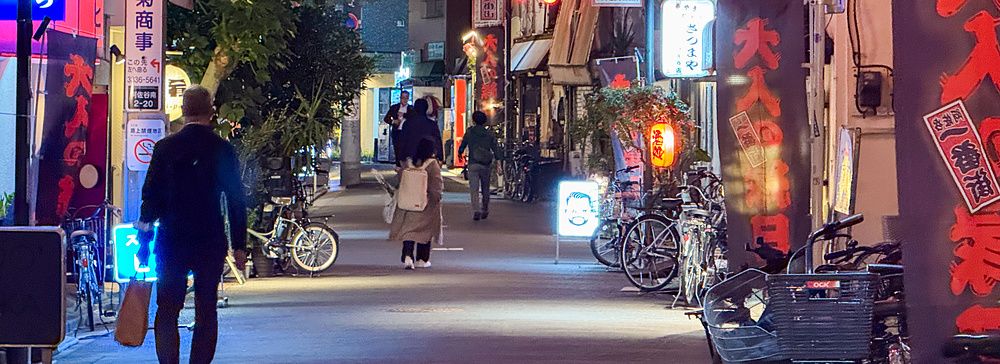
At night, the stretch under the train tracks at Yurakucho is packed with countless tiny restaurants, especially yakitori places. You eat sitting on stools and beer crates, often outdoors, with smoke drifting off the grills, trains rumbling overhead and office workers who’ve just gotten off work all around you. The atmosphere is fantastic and there are almost no tourists, so don’t tell anyone!
It’s not far from Ginza.
Yanaka
Yanaka is one of the few corners of Tokyo that came through the 1923 earthquake and the wartime bombing unscathed, and you can tell: wooden houses, narrow little alleys and an amazing number of small temples.
The heart of the neighborhood is Yanaka Ginza, a street of little shops where you munch on croquettes and skewers as you walk, and where the neighborhood cats are practically mascots.
Take a stroll through the big, tree-filled Yanaka Cemetery too. It’s surprisingly peaceful, and beautiful when the cherry trees are in bloom.
Shibamata
Shibamata feels like a little village from another era, still standing inside Tokyo on the city’s far eastern edge. The street leading to Taishakuten temple is lined with old shops selling senbei and kusa dango, rice dumplings made with mugwort.
The temple is worth visiting mostly for the carved wooden panels decorating the main hall, and the carving is incredibly delicate.
Japanese people associate Shibamata with the Tora-san movies, a very long series of much-loved comedies, and that’s why the atmosphere is deliberately nostalgic.
Kiyosumi-Shirakawa
This quiet, residential neighborhood across the Sumida River has become the go-to spot for specialty coffee lovers, with quite a few artisan roasters tucked among its renovated warehouses and low-rise houses.
In the middle of it all is Kiyosumi Garden, a Japanese garden with a pond and stepping stones across the water. If you love modern art, the Museum of Contemporary Art Tokyo (MOT) is the place to go.