Hiraizumi
In the small town of Hiraizumi, in Iwate Prefecture, you can still sense the former glory that inspired poets and writers centuries ago. During the Heian period it was Kyoto’s rival, at a time when Kyoto was the capital. With the wealth from the gold mined in the area, the Fujiwara clan, the most powerful family in Japan back then, built palaces, temples and monasteries and made Hiraizumi a city rich in culture. Minamoto Yoritomo razed it to the ground in 1189, but the town still has some of the most important historical treasures in Tohoku, which have been on the UNESCO World Heritage list since 2011. With its beautiful temples and the nature around them, it’s perfect for a day trip or a weekend.
Contents
Chusonji Temple
The Chusonji temple complex is the main attraction in Hiraizumi, and you can get there by bus from the station or on foot in 20-30 minutes. It dates back to 850. The Fujiwara clan later expanded it, and at its peak it had around 40 buildings. Sadly only two of the original structures survive today, but one of them is the beautiful Konjikido, a hall covered entirely in gold that will remind you of the famous Kinkakuji in Kyoto. There are plenty of interesting buildings to see around the temple, including halls that display precious artifacts and sacred texts, a noh stage and statues of the Buddha. Under the Konjikido’s altar lie the mummies of the Fujiwara lords: the bodies of the first three lords and the head of the fourth. That detail tells you a lot about what the hall was for. It wasn’t built only as a tribute to the Buddha. It was also a family mausoleum.
The Konjikido is now protected inside a modern building. The old wooden structure that sheltered it for centuries is still there, a little farther along the path.
The path up to the temple is a real pleasure to walk too. It winds through the forest, with views of the Kitakami River and Mount Kotagatamine.
Motsuji Temple
Motsuji is another popular stop in Hiraizumi, and it’s best known for its beautiful garden. Like Chusonji, the temple rose and fell with the Fujiwara family. All of its buildings are reconstructions, but the best part of the place has survived intact. The garden is one of the few Pure Land gardens from the Heian period still left in Japan. Gardens in this style tried to recreate the Buddhist idea of paradise. The temple is a few minutes from the station by bus, or about 10 minutes on foot. The garden is laid out around the Oizumi ga Ike pond, with a gravel spit sloping gently into the water and a cluster of stones arranged to look like a rocky coastline battered by waves. On the north side runs the yarimizu, an artificial stream that snakes between the rocks. It’s the only one in Japan left from the Heian period.
All that remains of the temple halls are their stone foundations, marked out on the lawn. Walking among them gives you a sense of how huge the original temple was.
Walking from Chusonji to Motsuji
A beautiful trail runs from Chusonji to Motsuji. It’s about 3 km long and starts out through the forest, then continues along a raised wooden boardwalk that winds across a marsh, giving you a view of all the natural scenery around the town.
Hiraizumi’s other UNESCO sites
Besides Chusonji and Motsuji, the UNESCO listing covers three other places that get far fewer visitors but tell you quite a lot about the town. Kanjizaioin Ato is right next to Motsuji. None of its buildings are left, but the garden with its large pond has been reconstructed, and it’s a quiet, relaxing spot to stop for a few minutes.
Not far from the station is Muryokoin Ato, where a temple modeled on the Byodoin in Uji once stood. All you can see today are traces of the pond and the foundations, but the building was oriented so that the sun set exactly behind Mount Kinkeisan. That small hill is the last of the five sites, and the whole of Hiraizumi was planned around it to represent the Pure Land.
Geibikei
If you want to get out into nature, you only have to go a short way from Hiraizumi to reach the spectacular Geibikei Gorge. You see it from a boat, on a river trip of about an hour and a half that lets you appreciate how massive the gorge is and take in the beautiful scenery all around it. The boat has a flat bottom, and the boatman stands at the stern and pushes it along by hand with a long pole. Before turning back, the boat pulls in to shore under the highest cliff, where you can buy unadama, little clay balls you throw at a hole in the rock. Tradition says that getting one in brings you good luck and love. On the way back the boatman sings the Geibi Oiwake, the gorge’s folk song, a cappella.
Takkoku no Iwaya
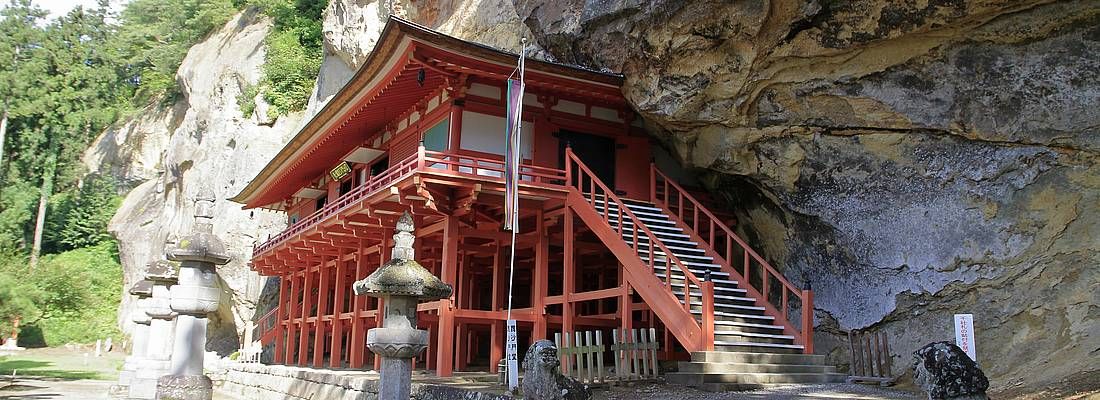
A bit out of the way from the center, the Takkoku no Iwaya temple is an atmospheric place that’s worth the trip. It’s perched on a rock face, which makes for a really dramatic setting. The temple is very old and is dedicated to the deity who protects warriors. At the foot of the rock face there’s a small, lovely garden laid out around a pond. You can get to the temple by bus from the town’s station.
Takadachi Gikeido
Takadachi Gikeido is a memorial to Minamoto Yoshitsune, a samurai and general of the Minamoto clan who took his own life before his brother and rival, Minamoto Yoritomo, could kill him. It’s one of the most famous tragedies in Japanese history, and it has inspired paintings, books and poems. Yoshitsune’s fate is closely tied to Hiraizumi, because this is where he took refuge, only to be betrayed by the son of the Fujiwara lord. Inside the memorial there’s a wooden statue of Yoshitsune. From the small hill where the memorial stands, you get a lovely view over the Kitakami River and the plain where the lost city once stood. Matsuo Basho looked out on this same view when he came here in 1689 and wrote his most famous verse, about the summer grass and the dreams of warriors. A stone carved with that poem stands a short way from the entrance.
Takadachi Gikeido is about a 15-20 minute walk from the station, or you can take the bus.
Festivals in Hiraizumi
Hiraizumi holds several festivals throughout the year, and they’re a great chance to see the town in a festive mood and get to know other sides of the local culture. The two biggest take place at Motsuji. At Gokusui no En, on the fourth Sunday of May, participants dress in Heian-period costumes, drink sake and compose poems. The other one, Ennen no Mai, is also held in May and includes Buddhist ceremonies and traditional dances.
The seasonal festivals are lovely too. At the spring festival, locals get together to enjoy the cherry blossoms, and in November the town celebrates the autumn leaves with food and lots of performances.
Getting to Hiraizumi
The easiest and fastest way to get to Hiraizumi is by train. From Tokyo, take the JR Tohoku Shinkansen to Ichinoseki Station, then change to the JR Tohoku Main Line for Hiraizumi. The whole trip takes about two and a half hours and can be covered by several passes: the Japan Rail Pass, the JR East Tohoku Area Pass and the JR East South Hokkaido Pass.
Getting around
Hiraizumi isn’t very big and you can walk to the main sights, but if you’re short on time or have trouble walking, you can take the “Run Run” Loop Bus, which connects the train station with the town’s main sights. You can pay for a single ride or buy a one-day pass, which costs 550 yen.
Besides this bus, there are also regular bus lines that stop at the temples and in the town center.
You can also get around Hiraizumi by bike, which is perfect for exploring the town at your own pace and getting a bit of exercise. There are a couple of rental shops near the train station that rent bikes by the hour or by the day.