Hoshizuna Beach
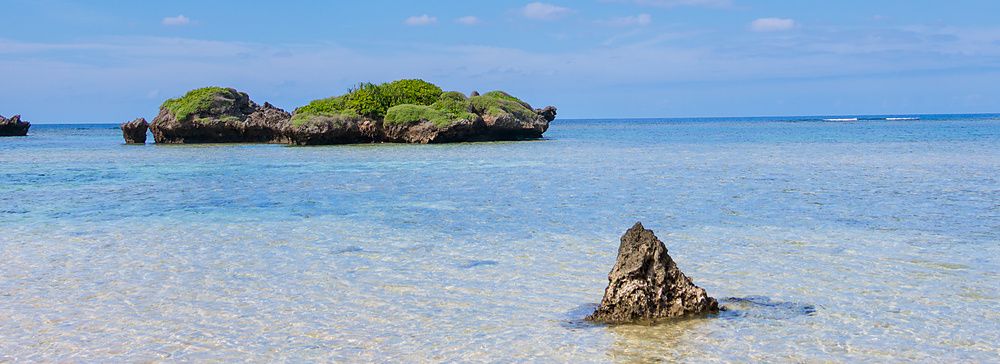
A beach on the north coast of Iriomote, a Yaeyama island almost entirely covered in jungle, where the sand near the water is full of tiny star-shaped grains. It’s called Hoshizuna Beach, literally “star sand beach.” Besides hunting for the little stars, you get calm, shallow water, green rocks rising out of the sea and tropical fish just a few steps from shore.
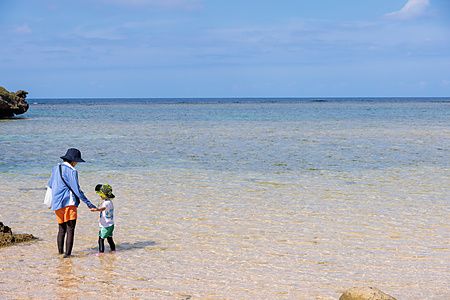
Come here if you’re on Iriomote and want to see something unique, or if you’re traveling with small children and looking for calm water where they can splash around in peace. If you’re dreaming of a deserted beach, though, keep in mind that this is the busiest one in the area.
Contents
What you’ll see
The stars are the reason people come all the way out here, but I’ll tell you up front that the sand isn’t all stars. Pick up a handful and you’ll find relatively few good ones, whole and with every point intact. The rest are fragments, ordinary grains and bits of shell.
At the same time, there are billions of them. All it takes is plenty of patience: sit down near the water and look for them one by one, and after a while your eye adjusts and you start seeing them everywhere. They’re the shells of tiny marine organisms that live on the reef right offshore, and the reef is so close that they wash up whole instead of breaking on the way in.
Here’s what to look for:
- The star sand: crouch down and look closely along the water’s edge, where the sand is wet and the grains are easier to see.
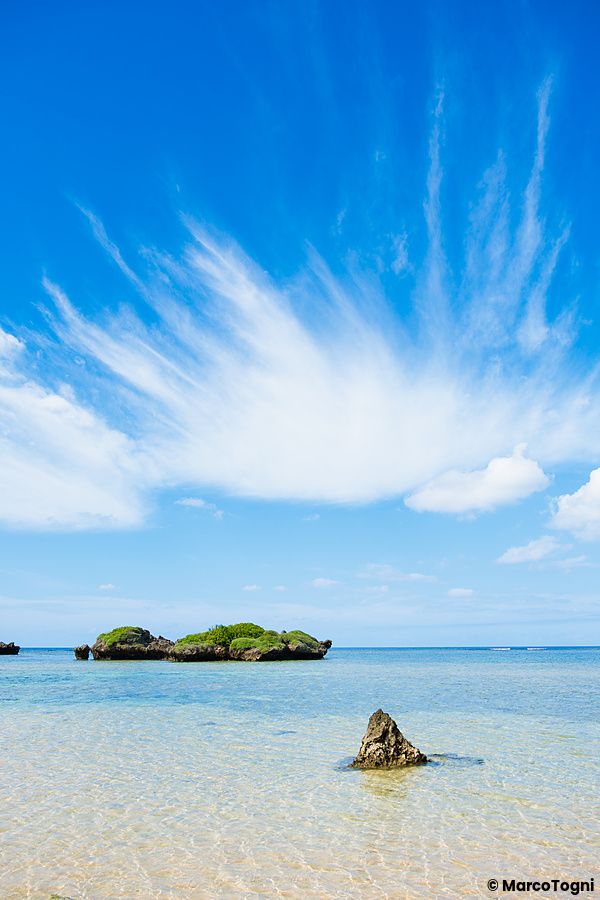
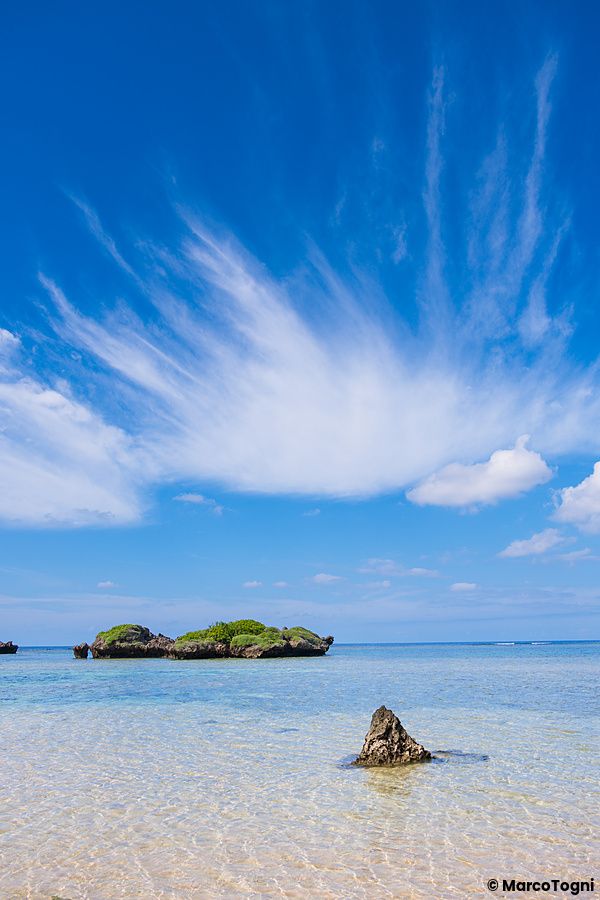
- The rocks in the water: dark boulders topped with tufts of greenery, standing in the shallows in front of the beach. They act as a breakwater, so behind them the sea stays flat even when it’s windy.
- The shallows and the fish: in knee-deep water you’ll see colorful tropical fish, and some of them are a good 30 or 40 centimeters long.
- The reef at low tide: when the water pulls back, you can walk almost out to the coral, past tide pools and exposed rocks.
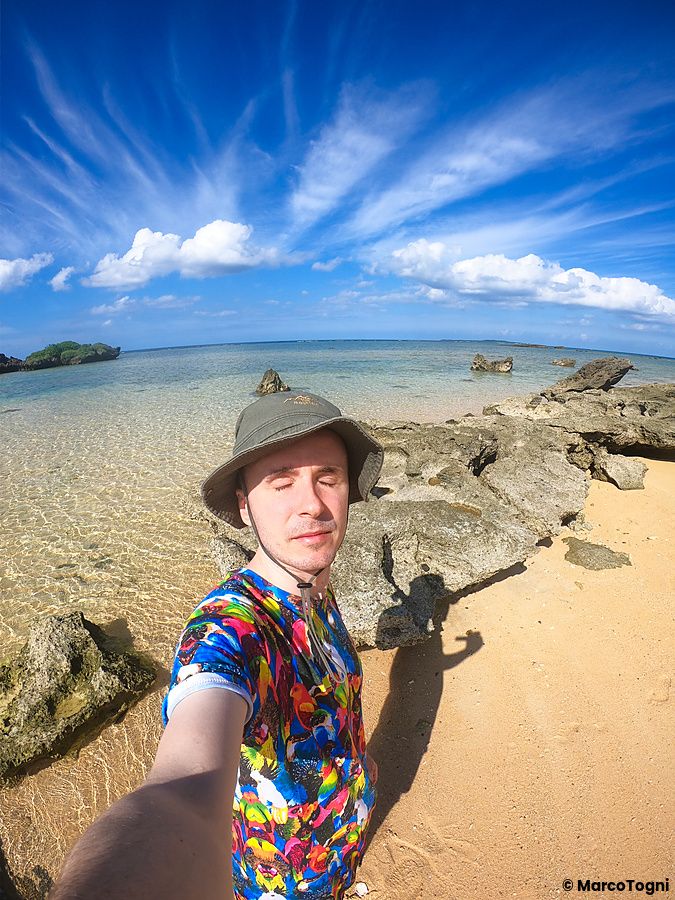
- The view from the shore: clear water shifting from pale green to blue, the rocky islets lined up in a row and, on clear days, a sky streaked with the thin, wispy clouds typical of the Yaeyama Islands.
- The little jars of star sand: the small shops nearby sell vials already filled with star sand, to take home or to hold up for a photo.
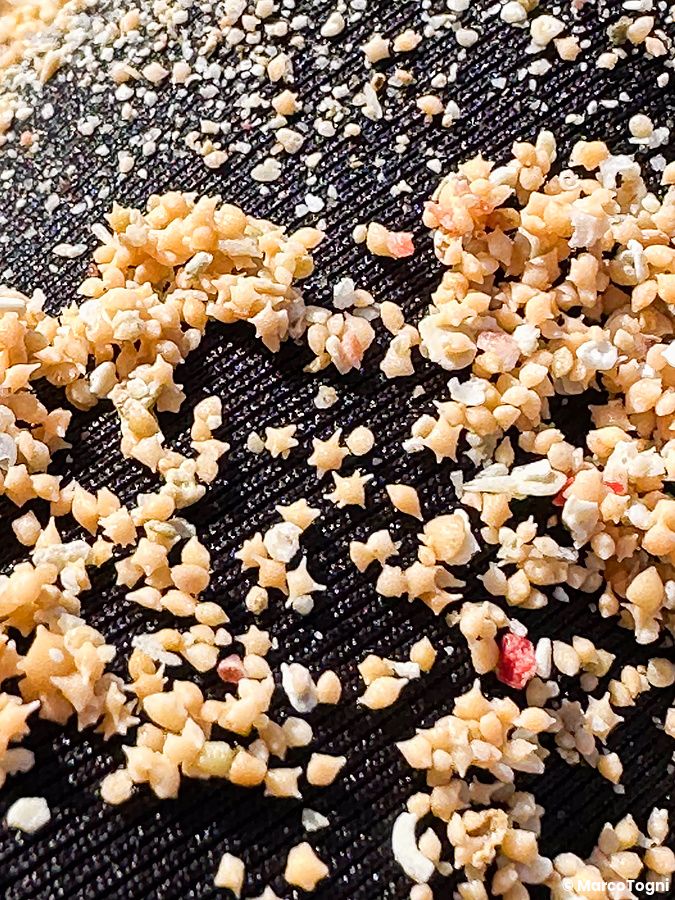
Here’s my take on the jars: if you want the souvenir or need a photo where the little stars really show, buy one and you’re set. But if you have the time and a bit of patience, finding them yourself is a lot more fun, and kids get completely lost in it.
There’s no shade. There are no trees on the sand and nothing natural to hide under, and the Okinawa sun is fierce even when the air feels cool. A hat, sunscreen and a shirt to wear in the water aren’t optional.
Take away the stars and, as beaches go, it’s not the prettiest on the island. The bottom alternates between patches of sand and rock, and right next to the beach there’s a guesthouse with a restaurant, a shop and a campground. With restrooms and showers around, it doesn’t feel like a remote spot.
That said, you won’t find this many stars to pick up with your fingers anywhere else: no other beach in the Yaeyama Islands has as many. I come back every time I’m on Iriomote, even if it’s just a quick stop, because sitting at the water’s edge searching the wet sand for the tips of tiny stars is something I never get tired of. Whoever’s with me always ends up on all fours doing the same thing.
When to go
Summer is the season for swimming and snorkeling. The water is warm, and you can stay in for hours and lose track of time. In winter the sea is colder, but the beach is still pleasant when the sun is out: you walk around with a hat on, and you can hunt for stars just fine without getting in the water.
Typhoon season has an upside too. Rough seas wash fresh sand up onto the beach, so after a storm you’ll find more little stars along the water’s edge.
The tide changes the beach more than the time of day does. At high tide the water comes up high between the rocks and the swimming is good, with fish all around you. At low tide the sea pulls back and you can poke around out toward the reef, but it’s too shallow to swim. Check the tide table before you go and decide what you want to do. And when you swim, stay in the shelter of the rocks and don’t head out past them toward the open sea. Out there, especially when the tide is turning, you get currents that pull you out to sea, and even experienced swimmers have gotten into trouble.
Early in the morning the beach is almost empty and the low sun makes the wet sand sparkle, so it’s the best time to look for stars without rushing. Around midday in summer the families show up, along with groups carrying rented snorkel gear and people driving around the island, and the shore fills up with towels.
When it’s overcast, the water loses that clear green and turns grayish, and the fish are harder to see.
Quieter beaches nearby
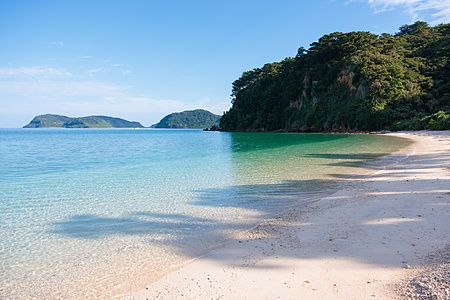
Once you’ve seen the stars and want somewhere to enjoy the sea in peace, there are less crowded options on the same north coast. Tsukigahama sits at the mouth of a river. Its very fine sand squeaks underfoot, and at sunset the sun goes down right in front of you.
Ida no Hama is a different story. There’s no road, so you get there by boat, and that’s why you’ll find very few people there and some of the clearest water on the island.
Here’s the combination I recommend: Hoshizuna Beach for the stars and for letting the kids swim between the rocks, then one of these two for the rest of the day. That way you get the unique experience and the quiet beach without having to choose.
At a glance
- The highlight: the star sand at the water’s edge, which you hunt for grain by grain.
- When to go: summer for swimming, early morning for star hunting, high tide if you want to swim.
- Best for: anyone on Iriomote, even just passing through, and families with small children.
- Atmosphere: flat water between green rocks, people bent over the sand, strong sun and no shade.
The bottom line
You come here for one thing, and that thing is really here: little stars to pick out of the sand one at a time, with the patience it takes to find the whole ones. If you’re on Iriomote, it’s worth adding to your itinerary for that alone, and even more so if you have kids.
If you’re after a perfect, empty beach to spend the whole day on, though, you’re better off seeing it and then moving on to another spot on the coast. The sea is beautiful, but that’s not why people come here, and in the heat of the day you won’t have it to yourself.
Getting There
The beach is on the north coast, about 5 minutes by car from Uehara Port, so if your ferry from Ishigaki docks on that side, you're there in no time. The island bus has a stop named after the beach, and from there you walk down in a few minutes.
If the ferry drops you at Ohara Port on the southeast side, allow around 50 minutes for the drive along the coast.
In winter, when the wind blows from the north, sailings to Uehara are often canceled and the ferries dock at Ohara instead, so check which port your boat is going to before you set off.
Useful Info
- Uehara Port: ferries from Ishigaki, about 5 minutes by car
- Hoshizuna no Hama stop: Iriomote Kotsu bus, Ohara–Shirahama coastal road line
- About 50 minutes by car from Ohara Port
Map
This place is on MarcoMaps
Hoshizuna Beach
My map of Japan: over 4,000 places I've tried myself, each with photos, rating, and hours. Filter by category and rating, find veg-friendly spots and places near you with GPS. No sign-up, right from your phone.
- 4,000+ places
- Rating, photos, and hours
- Veg friendly
- Near me (GPS)
- Favorites without login
- Works offline

