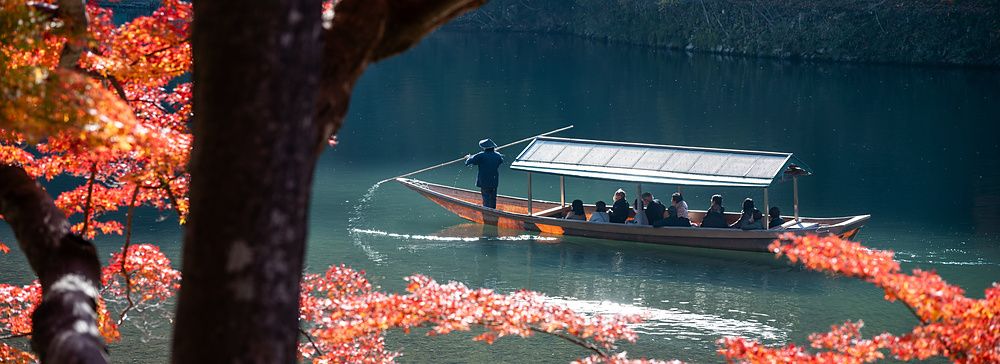
Hozugawa River Boat Ride
A ride in a wooden boat down a mountain gorge, from Kameoka all the way to Arashiyama in Kyoto. On the Hozugawa River Boat Ride you cover sixteen kilometers of river between rock walls, still pools and rapids that really soak you, while the boatmen stand and push off with their poles within arm’s reach of the rocks.
It works for just about anyone: people traveling with kids, people who’ve seen enough temples and want a change of scene, people who want Japan’s mountains without having to hike through them. I think it’s the best thing to do in Kyoto outside the city.
What you’ll see
The gorge closes in right after you set off, and from then on there’s nothing man-made around you apart from a few railway bridges passing overhead. You sit twenty centimeters above the water and look at the mountains from below, an angle you never get from land.
The things that stay with you:
- The rock walls: they keep closing in and opening out again, and in places the boat passes so close that the boatman at the bow plants his pole right on the rock to push the boat away.
- The rapids: the best known is Koayu Falls, a drop of a couple of meters where the boat tips forward and the bow disappears into the foam. There are several others, with long stretches of smooth water in between.
- The rocks with nicknames: the lion rock, the one shaped like a frog, the one that looks like an open folding screen. The boatmen point them out one by one on the way down.
- The crew at work: there are three of them, one with the pole at the bow, one working the oar and one steering at the stern, and they swap places during the ride. When the water’s high, the crew goes up to four or five.
- The boat that sells food: on the calm stretch toward Arashiyama, a floating stall with its grill going pulls up alongside, selling grilled squid, oden, dango and canned beer. You reach over with cash and eat on board while the boat drifts slowly on.
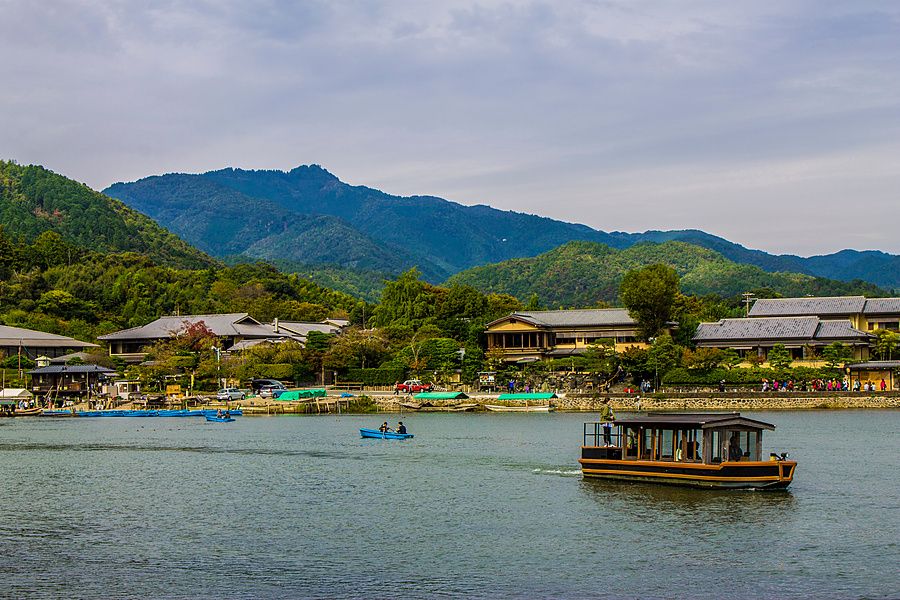
- Arriving in Arashiyama: the river opens up, the tourists’ rowboats appear and Togetsukyo Bridge comes into view at the far end.
You don’t pick your seat. The boatman assigns seats based on how many of you there are, and whoever ends up along the sides or toward the bow gets much wetter than everyone else. There’s no arguing with it.
The river level also changes the trip completely. When the water’s low, the boatmen have to muscle the boat along and you go slowly, with the bottom scraping on the stones here and there; when it’s high you move fast, the rapids come one after another and you finish much sooner. In normal conditions the ride takes about two hours. With high water it can take just over an hour and a half, and when the river is low it can go past two hours, so build in some extra time before whatever you’ve planned in Arashiyama.
The boatmen’s commentary is all in Japanese, and half of it is jokes about the town, their coworkers and the passengers, with the whole boat laughing along. If you don’t understand, you miss that part but not the rest: you don’t need the language to look at the gorge. How much fun the boatmen are also depends on the crew you get. Some keep everyone entertained and some just row.
In person it’s a lot more than a photo suggests. It looks like a scenic boat trip, but what happens right in front of you is real work: men reading the current and correcting the boat’s line with a push of the pole. I go back every time someone comes to visit and has at least three days in Kyoto, because after two days of temples and gardens it’s the one thing that wakes everyone up, and at the first rapid even the most tired start yelling. It’s also an old trade. Suminokura Ryoi opened the waterway in 1606 to bring timber and rice to Kyoto from the Tanba mountains, and for centuries the boatmen themselves hauled the empty boats back up the gorge with ropes, walking along the bank. Today the boats go back to Kameoka by truck.
When to go
The first boat of the morning is the best one. The water is still and dark, a little mist hangs over the valley floor, and above all you have all of Arashiyama and the whole afternoon ahead of you, since that’s exactly where you get off.
On weekdays the boat can even leave half empty. Not on weekends, when the boats go out full and everyone waits their turn on the dock in groups.
Fall foliage season is when it all gets packed. The gorge walls turn yellow and red right down to the water, and it’s the most beautiful time of year, but it’s also when you have to wait in line to board and there isn’t a free seat on the boats.
In spring, once the cherry blossoms are over, there’s more room, and the fresh green on the rocks easily holds its own against fall. In summer it’s several degrees cooler on the river than in town, and the spray is actually welcome.
In winter the boat looks completely different. They add a clear plastic roof, carpet on the floor and a kerosene heater, and you sit on the floor. Your eyes are even closer to the water, you watch the waves coming at you up close, and with snow on the rocks it’s a whole different trip.
In heavy rain the boats don’t run at all. In light rain they still go, but they pull down the covers, and watching the gorge through fogged-up plastic is only half the experience, so if you can, move the trip to a dry day. An overcast sky doesn’t spoil anything, though. If anything, in flat light the rocks look darker and the leaves stand out more.
On board
Everyone boards wearing a life jacket, which is mandatory, and sits on low planks. There’s no backrest, there’s not much legroom, and once you set off you can’t stand up or change seats, so if you have back problems or can’t sit still, keep that in mind.
There’s no restroom on board and no stop along the way, so go before you board. They remind everyone at the dock, and for good reason.
You really do get splashed. The side covers block the worst of each wave, but water still gets in, and on the rapids you’ll get hit by a few bucketfuls. Put your phone and camera in a plastic bag, and if you really don’t want to get wet, bring a rain poncho.
It’s colder on the river than on the bank, and in fall and winter it’s much colder than you’d expect while you’re waiting in the sun. An extra jacket is the thing you’ll be most glad you brought.
It’s a great trip with kids, but only if they’re taller than 80 centimeters: smaller children can’t board, and babies in arms aren’t allowed because there’s no life jacket in their size. For kids around six or seven and up, it’s the kind of trip they’ll remember for a long time.
Getting the best shots
The good photos come on the stretches of still water, when you turn around and look back. You see the gorge stretching away behind you, with the boat’s wake and the walls closing in. The other shot worth getting is the boatman at the bow, backlit, with his pole braced against the rock.
The scenic train runs above the gorge on the old line, and if you’re lucky you get a shot of it from the side as it crosses a bridge, with people waving from the windows. You get very little time to aim, so keep your phone ready.
On the rapids, though, put everything away. You need your hands to hold on, the water hits you without warning, and the photos come out blurry and covered in drops. Just enjoy the rapids. Nobody comes home with those shots anyway.
At a glance
- Highlight: the gorge seen from water level and the boatmen poling their way around the rocks.
- When to go: first boat of the morning, ideally on a weekday; fall foliage for the colors, summer for the cool air on the river.
- Best for: families with kids, people who’ve had their fill of temples, people who want the mountains without hiking.
- Atmosphere: wet wood, yelling and laughter on the rapids, silence on the flat stretches, no buildings anywhere around.
Bottom line
It’s all about the physical experience: sixteen kilometers inside a closed-in valley, the water within reach and three people working a wooden boat between the rocks with a pole. It’s the only trip in Kyoto where you’re not looking at something from behind a rope, and it’s worth the detour out of town.
Skip it if you can’t stand sitting still without being able to get up, if you don’t want to get even a little wet, or if you’re traveling with a child too small for the life jacket. For everyone else, there’s nothing like it in Kyoto.