Japanese Cheesecake
You should try Japanese cheesecake at least once fresh out of the oven and still warm, while it’s wobbling in the box. It sits somewhere between a cheesecake and a soufflé, and it’s soft, light and not very sweet. Outside Japan it got famous through videos of it jiggling right after it comes out of the oven.
In Japan, though, you won’t find it on every corner the way a lot of people imagine. If you’re passing through Osaka, I’ve always gone to the same place for it: Rikuro. And with a bit of patience you can make it at home too.
Contents
What it actually is
Abroad, Japanese cheesecake almost always means the soufflé version, which in Japan is called sufure chizukeki. You start by melting cream cheese with milk, butter and egg yolks, then fold in whipped egg whites. The meringue gives it the texture Japanese people call fuwafuwa, meaning puffy and airy, and in your mouth it’s closer to chiffon cake than to American cheesecake.
You can taste the cheese, but it stays subtle, with a slightly tart hint of lemon, and there’s not much sugar. That’s why plenty of people who usually find cheesecake too heavy can get through a big slice without feeling full.
In Japan, though, the word chizukeki doesn’t mean just one cake. Bakeries usually carry three kinds:
- Baked cheesecake, dense and cooked in the oven, the classic at old-style coffee shops and the one you’ll most often get with your coffee.
- Rare cheesecake, which never goes in the oven and sets in the fridge with gelatin. It’s refreshing and creamy, often made with yogurt and topped with a berry sauce.
- Soufflé cheesecake, made with meringue, which is the cake from the videos.

Where it comes from
The story starts in Kobe. In the late 1960s Tomotaro Kuzuno, president of Morozoff, a well-known pastry shop in Kobe, went to Berlin and tasted Käsekuchen, a German cheesecake made with quark. Back in Japan he recreated it with cream cheese, and Morozoff’s cake, made with Danish cheese, set off the country’s first real cheesecake craze in the 1970s.
Cheesecake had already reached Japan with the Americans after the war, but it stayed a little-known dessert. In the ’70s women’s magazines and bakeries brought it into people’s homes, and since the 1990s you’ve been able to find it more or less everywhere.
The jiggly soufflé version everyone knows today grew out of that craze, and one of the first chains to make it their main product was Rikuro, in Osaka. Uncle Tetsu, which many people now know from its shops abroad, comes from Fukuoka, and it opened its first shop devoted entirely to cheesecake in 1990. The way I see it, it’s a German dessert remade with an American ingredient and reshaped to suit Japanese tastes: less sweet, lighter, and the right size for an afternoon snack.
Harder to find than you’d think
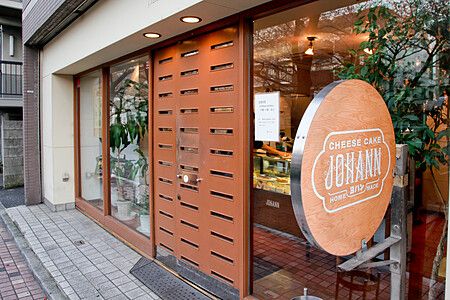
I’ll get this out of the way first, because it’s the question I get asked most: soufflé cheesecake isn’t everywhere in Japan. A lot of travelers arrive convinced they’ll find it in every bakery, then walk into a coffee shop, order cheesecake and get a dense slice of baked cheesecake or a cold rare one. Both are good, but neither is the cake from the videos.
Soufflé cheesecake deflates and changes texture within a few hours, so it’s at its best freshly made. A regular bakery that makes its cakes in the morning and keeps them in the display case all day prefers cakes that hold up, so the soufflé version has been left to the specialty shops that make almost nothing else.
Abroad the opposite happened. Chains like Uncle Tetsu opened in Canada, Australia and half of Asia, and there “Japanese cheesecake” became a name that sells. In Japan nobody calls it that. It’s just one cheesecake among many.
So here’s where you’ll find it:
- At specialty shops that bake it all day, your best bet because you get to eat it warm.
- At some bakeries and in the sweets sections of department stores, where it’s often already cold and a bit denser.
- At supermarkets and konbini, in small packaged versions that give you an idea of the taste but not the texture.
- At souvenir shops in cities, where local cheesecakes, often of other kinds, are sold boxed up as gifts.
My pick is Rikuro
Rikuro, full name Rikuro Ojisan no Mise, meaning Uncle Rikuro’s shop, is where I recommend eating it. The shop has been around for decades. It started as a small pastry shop, and once the cheesecake took off it was named after its founder, Rikuro Nishimura. His big smiling face became the brand’s symbol, and you’ll find it stamped on top of every cake. The stamp didn’t come from marketing: the founder was a wagashi maker, and branding wagashi, traditional Japanese sweets, with a hot iron is an old custom. The cheesecake only arrived in 1984, when it became the signature product of the second shop.
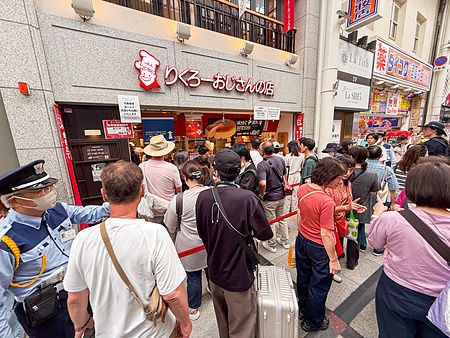
There are about ten shops, all in the Osaka area, with none in Tokyo or abroad, so that’s the only place to buy the cake fresh out of the oven. Nearly every shop has its own oven, and the best known is the main shop in Namba, a few minutes’ walk from the station, in the area where lots of tourists are already wandering between Dotonbori and Shinsaibashi.
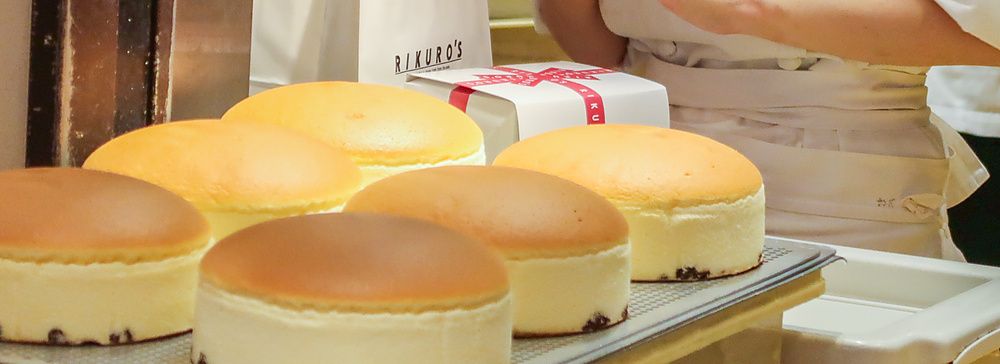
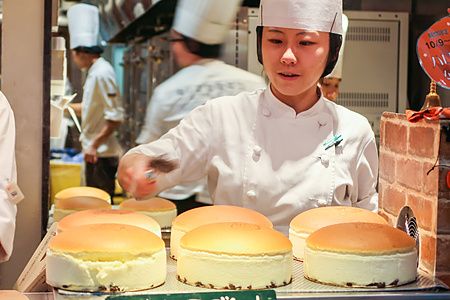
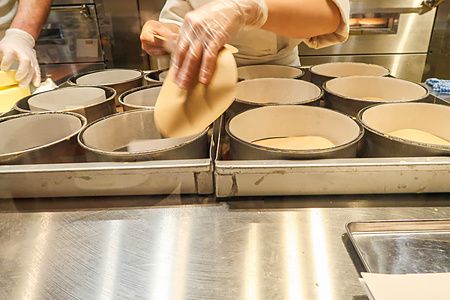
The show is part of why people line up. When a new batch comes out, a staff member rings a bell, and the round cakes, still puffed up, move along the counter where each one gets a hot stamp of Uncle Rikuro’s face. Behind the glass you can see the young staff turning them out of the pans, and the cakes wobble every time they’re moved.
Rikuro’s cake is made with Danish cream cheese plus butter and milk from Hokkaido, and at the bottom there’s a layer of raisins soaked in a syrup they make themselves. I like it precisely because it’s light and not very sweet: two people can get through a whole cake fast. If you don’t like raisins, keep that in mind, because there’s no version without them.
Prices and lines
The price is one of the nicest surprises. A whole cake costs around 1,000 yen, about what you’d pay for two slices at a Tokyo pastry shop. For the amount of cake you get, it’s one of the best deals I know of in Japan, but it’s still a good idea to check current prices before you go.
Since it’s cheap and famous, there’s often a line in Namba, especially on weekends and holidays. The line moves, though, because cakes come out nonstop and the staff sell them fast. At the busiest times the shop may limit how many cakes each person can buy, so don’t count on getting ten to take back to the whole family.
A few practical tips for buying it:
- Go to the less central shops if you don’t want to line up, because the cake is the same and the wait is often much shorter.
- Wait for the bell to ring, so you walk away with a freshly stamped cake that’s still warm.
- Don’t plan on taking one home on the plane, because it keeps outside the fridge for only a few hours and in the fridge for a few days.
- Keep the box level, because a warm cake squashes easily and slides over to one side.
Warm or cold
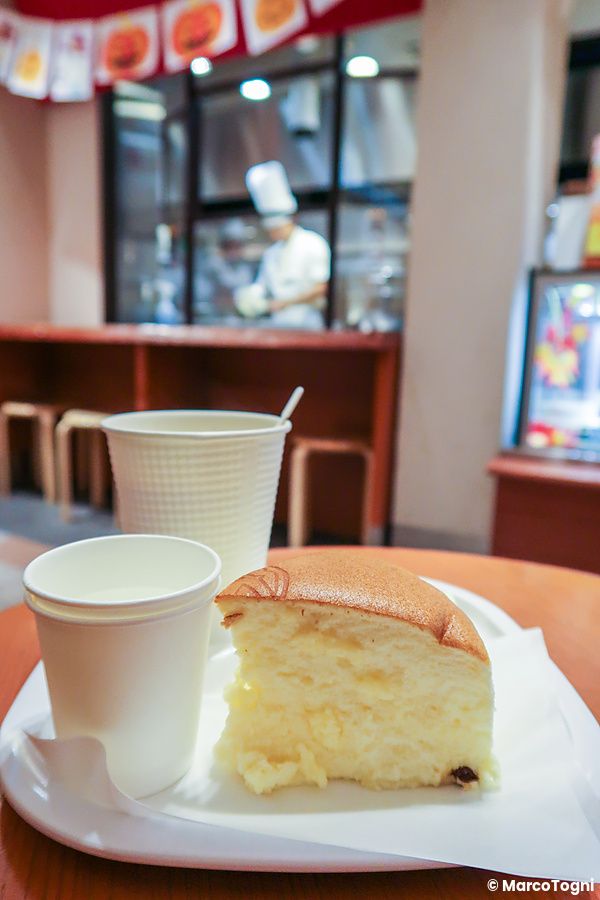
The same cake changes a lot between warm and cold, and almost nobody expects it. Fresh from the oven it’s soft, full of air and tastes slightly eggy. After a night in the fridge it sinks a little, gets denser and the cheese comes through more, almost like a custard.
My advice is to try it both ways. Eat half right away, maybe on a bench near the shop, and keep the other half in the fridge for breakfast the next day. If you miss the warm version, a few seconds in the microwave on low power make it soft again.
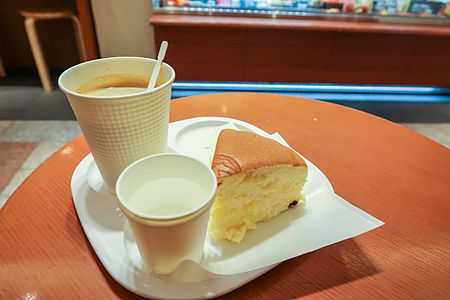
If you want to sit down, there’s a Rikuro café above the Namba shop that serves the cake straight from the oven with a drink, and the brand has other cafés in Osaka too. Eating there costs more than buying at the counter, but you get a table and a slice that’s still steaming. When I take someone to Osaka for the first time, I often tell them to buy it at the counter and save the money for another dessert.
Other places to try it
Outside Osaka the best-known name is Uncle Tetsu, which has only a few shops in Japan compared to abroad, mostly in a few big stations and around Fukuoka. Its cake is smaller than Rikuro’s and has no raisins, but the style is the same.
Pablo, which many travelers know because it has shops in several cities, makes a different small tart instead: a tart crust with a soft, partially baked cream filling that’s richer and heavier. It’s good, but it isn’t soufflé cheesecake, and I often see people mix the two up.
Hokkaido has several pastry shops known for cheese desserts, thanks to the region’s dairy, and in Kobe Morozoff still sells the cheesecake that started it all. These make great gifts to take home, because many are packaged to last a few days. But if it’s the wobble, the softness and the warmth you’re after, your only option is a shop that bakes it fresh.
A quick recipe
Making it at home isn’t hard, but it takes some patience with the meringue and the oven. For a pan about 18 centimeters across you’ll need roughly 250 grams of cream cheese, 50 grams of butter, 100 ml of milk, 5 or 6 eggs separated, about 100 grams of sugar, around 50 grams of flour and cornstarch combined, and the juice of half a lemon.
Here are the steps:
- Melt the cream cheese, butter and milk over a double boiler, stirring until the mixture is smooth with no lumps.
- Take it off the heat and add the yolks one at a time, then the sifted flour and cornstarch and the lemon juice.
- Whip the egg whites, adding the sugar a little at a time, and stop when the peaks bend over slightly, before they turn stiff.
- Fold the meringue into the batter in three additions, using a spatula and lifting from the bottom up, without deflating it.
- Pour into a pan lined with parchment paper, including the sides, and bake in a water bath at a low temperature, around 150°C, for about an hour.
- Turn off the oven and leave the cake inside with the door cracked open for about twenty minutes before you unmold it.
The two most common problems are a top that cracks and a cake that sinks as soon as it comes out of the oven. The culprit is almost always overwhipped meringue or an oven that’s too hot, so you’re better off lowering the heat and baking longer. Wrap the bottom of the pan well in foil, because if water from the bath gets in, the bottom stays soggy and the cake won’t dry out.
Is it worth it?
Yes, as long as you try it at least once freshly made. A soufflé cheesecake from a konbini gives you an idea, but it won’t tell you why people line up in Namba while the bell rings.
If you have a day in Osaka, honestly, I’d put it on your list right next to takoyaki. It’s cheap, you eat it on the street, and it’ll stay with you more than a lot of more elaborate desserts. And the next day, when you open the fridge and find the leftover half, cold and creamier, you’ll be asking yourself something else: is it better warm or cold? Which do you prefer?