Japanese School System
Japan takes education very seriously, which is why its illiteracy rate is practically zero. The current Japanese school system was reformed after World War II and has five stages: preschool, elementary school, middle school, high school and university. You’ll often hear it called the 6-3-3-4 system, after the number of years in each of the four stages that come after preschool.
Compulsory education lasts 9 years and starts at age 6, when children enroll in elementary school. The school year runs from April to March. There are both public and private schools, and students with physical or mental disabilities have their own special schools.
Contents
Preschool
Preschool isn’t compulsory, but more than 90% of children go, and that’s where they start learning the basics of Japanese writing. There are two types. Hoiku-en also covers infant care and takes babies from 2 months old, while yochi-en is a kindergarten that takes children from age 3.
Elementary school
Elementary school starts at age 6 and lasts six years, until age 12, and it’s compulsory. Most elementary schools in Japan are public.
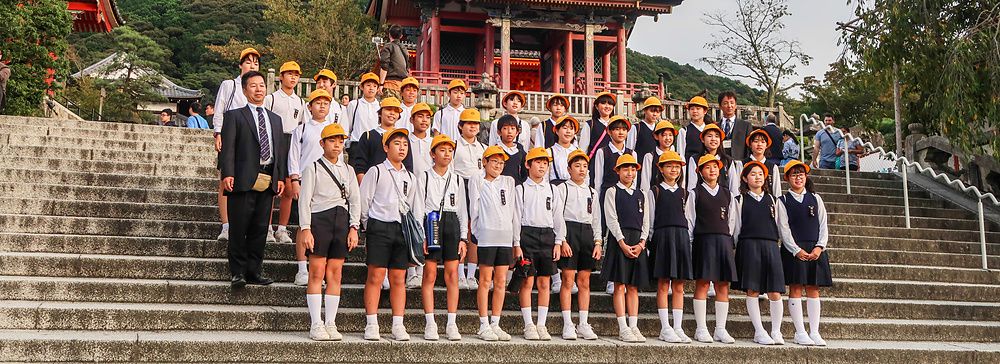
Classes are big, with 30 to 40 students, but the kids work in small groups for the various activities. One of those activities is cleaning the classrooms and the schoolyard, since Japanese schools don’t have janitors. Serving lunch is the kids’ job too. The school kitchen makes the meals, and the children take turns bringing lunch trays to their classmates before everyone eats together in the classroom. Another thing that stands out is that kids go to and from school on their own, often in small neighborhood groups with no adults, wearing yellow hats that make them easy to spot in traffic. On their backs they carry a randoseru, the hard backpack built to last all six years of elementary school. It’s also a classic gift from grandparents.
The subjects range from math, Japanese, science and PE to home economics, where kids learn to cook and sew, and traditional Japanese arts, which include calligraphy and poetry (haiku). In recent years more and more elementary schools have also added English and computer classes.
Middle school
Middle school lasts 3 years. There are only a few private middle schools, but some of the most prestigious ones require students to pass an entrance exam. Middle school ends at fifteen, and with it compulsory education is over. From then on, students are free to decide whether to keep studying or start working.
High school
High school isn’t compulsory, yet 97% of students go. From this point on school is no longer mandatory, and getting in means passing an entrance exam, which varies a lot in difficulty from one school to the next. Tuition, on the other hand, is covered by a government subsidy at both public and private schools, and there’s no longer an income limit. Families still pay the other costs, from the enrollment fee to textbooks and the uniform. There’s no dreaded final exam at the end of high school, but students still get a diploma, and they need it if they want to go on to university. There are several kinds of high school. Schools with a general curriculum suit students who want to go to university, while vocational schools train students for a specific field or job and are a better fit for those who plan to look for work after graduating.
School uniforms
If you’re picturing the Japanese students you’ve seen out on the street or in anime, you’ve got it right: the uniform is mandatory in middle school and high school, while it’s much less common in elementary school and preschool. The classic styles are the gakuran, the dark high-collared jacket for boys, and the sailor uniform for girls, though a lot of schools have now switched to blazers and ties.
It’s not just about the clothes, though. Twice a year there’s koromogae, the seasonal switch between summer and winter uniforms, which usually happens in June and October. Every school also has its own rules, and in many cases they go as far as dictating the color of your socks, the length of your skirt and even your haircut.
University
More than 50% of high school graduates go on to higher education. That may not sound like much, but it’s actually quite high when you consider how hard it is to get into university. The entrance exams are very difficult, especially for the most prestigious programs, but those programs guarantee you a job straight after graduation. The process is almost always the same: in January students take the national common test, which is the same for everyone, and then each university’s own exam. Students who fail can spend a whole year studying and try again. They’re known as ronin, “masterless” students who spend twelve months at a cram school. Once you’re in, though, the mood changes completely, and university is seen as the time when students have the most freedom in their whole education.
There are two routes through university. Students can earn a bachelor’s degree, which takes four years in Japan, and then go on to a master’s or a PhD. Or they can take short two-year programs if they want to start working as soon as possible. These short programs are especially popular with women, some of whom later leave their jobs to focus on family and children.
Juku
Juku are an integral part of the Japanese school system. They’re private schools where students go to do better in school or to prepare for an exam. Classes are held in the afternoon or evening, and about a third of students attend. They aren’t just for high school and university students, either: kids get enrolled as early as elementary school.
Extracurricular activities and school trips
All the way from elementary school through high school, schools organize tons of events around sports and culture: sports competitions, trips to historic sites, and art and music festivals where the students themselves are the stars. In their final years of elementary school, middle school and high school, students can also go on the end-of-year school trip, which means several days away at a cultural destination or in the mountains.
Extracurricular activities take up a big part of school life, and they cover sports, music, art and more. Baseball, soccer and martial arts are among the most popular sports, and school teams also play each other in regional tournaments. On the cultural side, the school band is by far the most popular, followed by art clubs, but students can also choose choir, tea ceremony, flower arranging or the board game Go.
School calendar and vacations
The school year is divided into three terms. It opens in April with the entrance ceremony, often right under the cherry blossoms, and closes in March with the graduation ceremony. Summer vacation lasts about forty days from late July through August. After that there are about ten days off around New Year’s, and one last short break in March, between the end of one school year and the start of the next.
The dates aren’t the same all over Japan, though. In Hokkaido, for example, the summer vacation is shorter and the winter vacation longer because of the climate. More importantly, summer vacation is anything but empty. Students get piles of homework, often including a research project or a diary to hand in, and they keep going to school for club practice and to juku for classes.