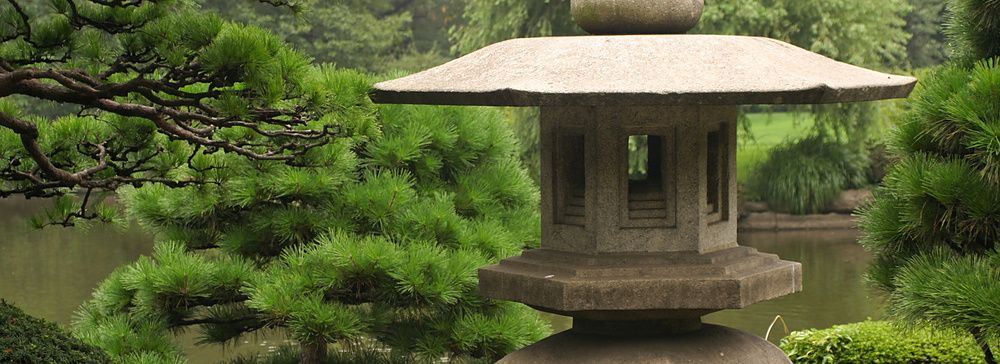
Japanese Stone Lanterns
Japanese stone lanterns are one of the loveliest details to look out for as you go around temples, shrines and gardens. They’re everywhere, and yet plenty of people walk right past them without a glance, as if they were just part of the scenery, like the trees.
But each one has a specific shape and its own name, and the shaft often has a date carved into it, along with the name of whoever donated it. Visiting a shrine feels quite different once you can tell the lanterns apart, know a bit of their history and know where to find hundreds of them in one place.
Contents
What they are
In Japanese they’re called toro, or ishidoro when they’re made of stone. Originally they were real lamps, with an oil lamp or a candle burning inside, and the light served as an offering in front of the Buddha hall or lit the path to the shrine.
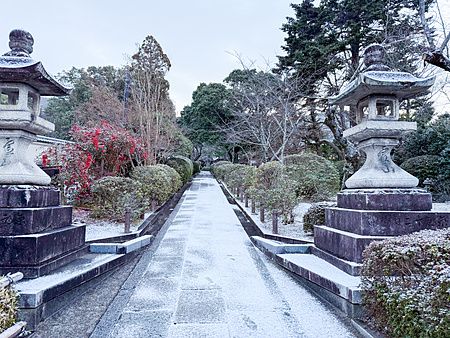
Hardly any are lit every night anymore, so today you’ll mostly see them as decorative and devotional objects. They’re still tied to the idea of offering light, though, which is why at shrines you usually find them in pairs on either side of the approach, or in long rows donated over the centuries.
There are bronze and iron lanterns too, and the big religious complexes have both kinds. But stone ones are the most common, because they cost less, stand up to rain and snow without any upkeep, and over the years get covered in moss and lichen.
That green patina is exactly what makes them so photogenic in gardens, and if you see one that’s perfectly gray and clean, it’s almost always a recent one.

How they’re built
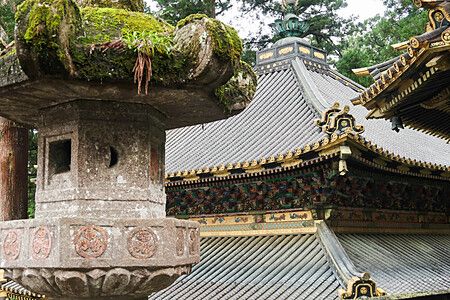
The classic lantern you see at shrines is made of separate pieces stacked one on top of the other. From the top down, the parts are:
- At the top is the hoju, a sort of jewel shaped like a bud or a flame that caps the whole thing.
- Below it is the kasa, the roof, often six- or eight-sided, with upturned corners.
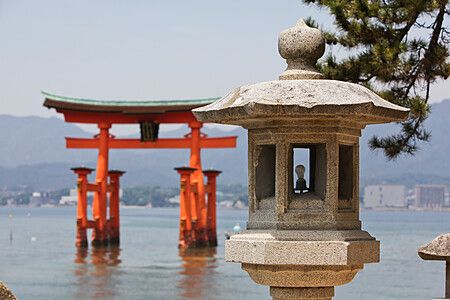
- Next comes the hibukuro, the light chamber, which is the part with openings the flame’s light used to shine through.
- It sits on the chudai, a platform that supports the light chamber.
- Below that is the sao, the vertical shaft, which is also where the inscriptions are usually carved.
- At the bottom is the kiso, the base that rests on the ground.
There’s also a symbolic interpretation that people like a lot. Each piece is said to stand for one of the five elements in Buddhist tradition (sky, wind, fire, water and earth), as with the five-tiered stone stupas you see in cemeteries.
Not every lantern has every piece. Some garden styles have no shaft and stand on legs, while others have the shaft set straight into the ground with no base. Checking which pieces are there and which are missing tells you what type of lantern it is.
From temples to gardens
Stone lanterns came to Japan from China by way of the Korean Peninsula, along with Buddhism. At first they were placed only at temples, in front of the main halls, as votive lamps. The oldest one still standing is at Taimadera, in Nara Prefecture, and it’s about 1,300 years old.
In the Heian period they started showing up at Shinto shrines as well, and that’s where the custom of donating them comes in. Noble families, samurai, merchants and later ordinary worshippers gave lanterns to shrines as an act of devotion or to give thanks for a prayer that had been answered.
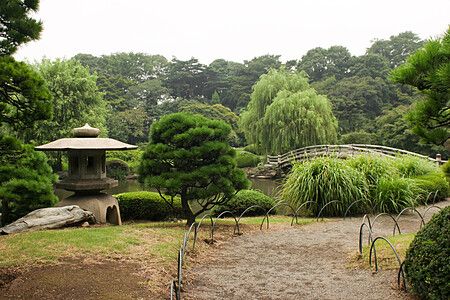
Lanterns made their way into gardens in the 16th century, thanks to the tea masters. They needed low, discreet lamps to light the path through the garden to the teahouse, and old temple lanterns, worn down by time, were a perfect fit for the tea ceremony aesthetic, which values things that are simple and a little weathered.
Some styles take their names from these masters, like the one associated with Sen no Rikyu or the one named after Furuta Oribe. In the Edo period lanterns were also used for public lighting. Joyato, literally “ever-burning lights,” stood at crossroads, at village entrances and in ports, and you can still find a few along old roads today.
The main styles
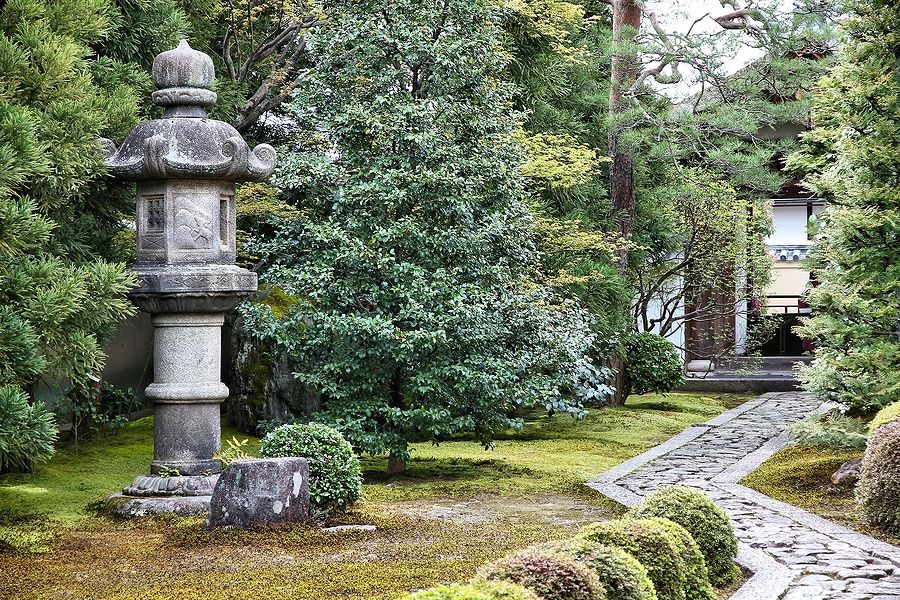
There are dozens of styles, but you’ll only really run into a handful, and with a bit of practice they’re easy to recognize. Here’s a quick rundown:
- The Kasuga doro takes its name from Kasuga Taisha in Nara and is the classic tall lantern you see at shrines, with a six- or eight-sided roof and a light chamber often decorated with deer, the sun and the moon.
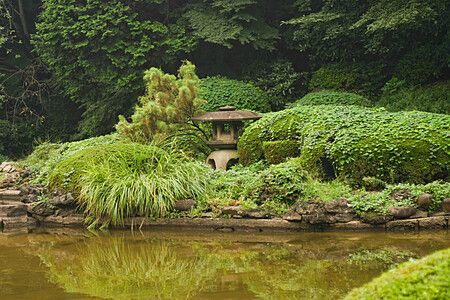
- The yukimi doro, the snow-viewing lantern, is low and wide, with a broad, flat roof where the snow piles up, and it usually stands on three or four legs near a pond.
- The Oribe doro has no base: the shaft goes straight into the ground, and the light chamber is square, with differently shaped openings on each side.
- The ikekomi doro is a small lantern with a buried shaft, made for tight garden corners and for the paths leading to the teahouse.
- The oki doro is the smallest of all. It has no shaft and simply sits on a stone or at the water’s edge.
There’s also a story attached to the Oribe doro that people always find intriguing. Some of these lanterns are called Christian lanterns, because the shaft bears a carved figure that, according to some, is Christ or the Virgin Mary disguised as a Buddhist deity, used by hidden Christians after their religion was banned.
I’ll be honest with you: it’s a fascinating story, but some scholars see it as more legend than proven fact, so take it for what it is.
Reading the inscriptions
Stop in front of a shrine lantern and look at the shaft. There are almost always carved characters, and you can quickly learn to spot a few of them even if you don’t read Japanese.
The most common are kento or hono, which mark it as an offering, and joyato, the ever-burning light. On the sides you’ll usually find the name of whoever donated it, whether a person, a company or a merchants’ association, along with the date.
The dates are what I enjoy most. They’re often written with the name of the imperial era, so a Showa-era lantern might stand next to one from the Meiji era or the Edo period, all mixed together along the same path.
I often suggest a little game to people visiting a shrine for the first time: find the oldest lantern along the way. It’s usually the most worn one, with its characters almost rubbed away and moss covering the whole roof.
Kasuga Taisha in Nara
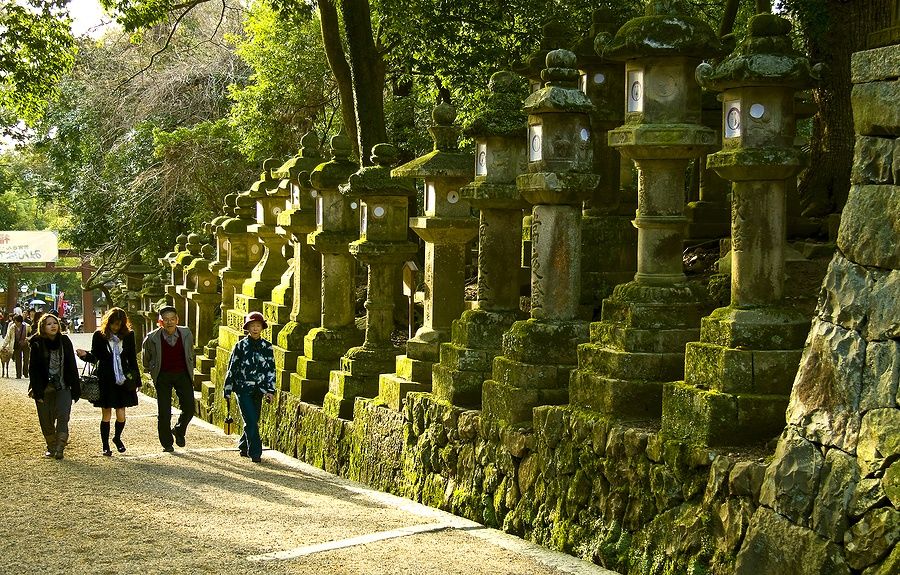
If you want to understand what lanterns mean to Japanese people, go to Kasuga Taisha, the shrine inside Nara Park, the one with all the deer. There are about 3,000 lanterns here: roughly 2,000 stone ones along the paths through the forest and about 1,000 bronze ones hanging along the covered corridors.
Lanterns have been donated here since the late Heian period, mostly by ordinary worshippers. Walking up the approach to the shrine, past one moss-covered lantern after another under the tall trees, is in my opinion one of the most beautiful walks in all of Nara.
Kasuga Taisha is also home to the Yunoki doro, considered the second-oldest stone lantern in Japan after the one at Taimadera.
All the lanterns used to be lit every night, which burned through huge amounts of oil. Today that happens only twice a year, during the Mantoro festival: once in February on the evening of Setsubun, and once in mid-August during Obon. Check the exact dates before you go.
On those evenings the shrine fills up, so expect lines and big crowds. If you can’t make those dates, you can go into the shrine’s lantern hall, where some lanterns are kept lit in the dark all year round, to get a sense of the effect.
Where else to see them
Kasuga Taisha is the best-known example, but you’ll find stone lanterns all over the country, and in some places they’re the main reason to go. These are the ones I recommend:
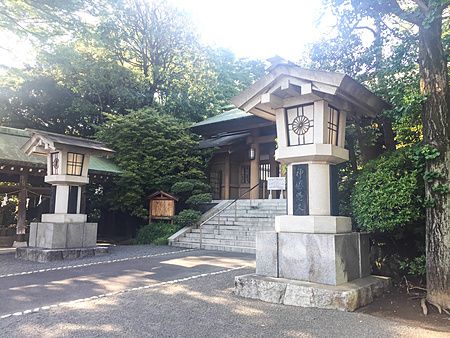
- At Ueno Toshogu, in Tokyo’s Ueno Park, there are about 200 stone lanterns donated by feudal lords from all over Japan as a sign of loyalty to the shogun, plus around fifty large bronze lanterns.
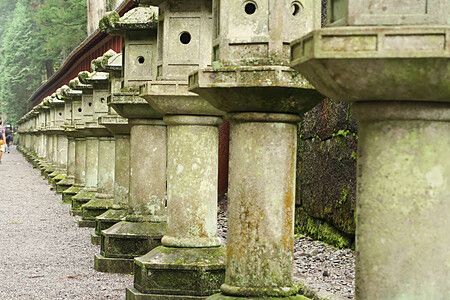
- At Toshogu in Nikko you’ll see the same thing on a larger scale, with rows of lanterns given by daimyo along the paths and in the shrine’s courtyards.
- At Kenrokuen garden in Kanazawa there’s the Kotoji doro, a lantern over two and a half meters tall with two legs of different lengths, which has become the symbol of the city.
- At Taimadera, in Nara Prefecture, you can see Japan’s oldest stone lantern, in a temple far less crowded than Nara’s big names.
- In Kyoto almost every temple garden has its own lanterns, and it’s the best place to see the low garden styles beside the ponds.
The Kotoji doro gets its name from the little bridge that holds up the strings of the koto, the traditional stringed instrument, because the shape of its two legs looks like one. The legs were originally the same length, but one broke and now rests on a stone, and that asymmetry is exactly what Japanese people like about it.
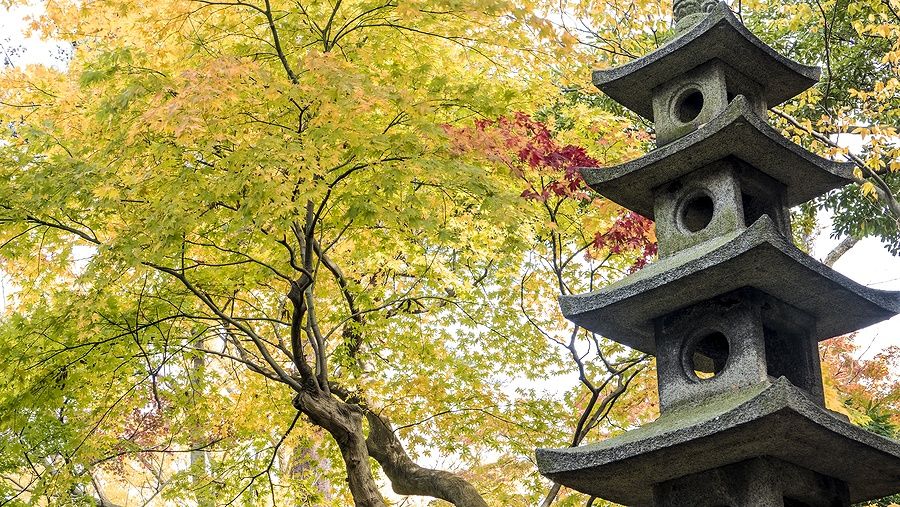
The lantern you see today isn’t the original, which was destroyed by vandals in the 1970s and then replaced. There’s almost always a short line of people in front of it waiting to take a photo, especially in the fall with the red maple beside it, and in winter when there’s snow.
How to see them
Lanterns look their best in low light and when everything’s wet. After a day of rain the moss turns a really vivid green and the stone darkens, and the paths through forest shrines look completely different than they do on a bright, sunny day.
Go early in the morning for Kasuga Taisha and the big shrines, because you’ll have the place almost to yourself and the light slants in through the trees. Yukimi doro, on the other hand, are designed for snow. If you ever get to see a garden covered in snow, you’ll understand right away why the roof is so wide.
A few practical things to keep in mind when you’re standing in front of a lantern:
- Don’t touch them, and don’t rest bags or cameras on them. They were donated, they’re often antique, and the pieces are just stacked on top of each other.
- Don’t climb onto the bases to take a photo from higher up: at shrines it’s considered disrespectful, and you could also damage the moss.
- If you want to read the inscriptions, take a photo and look up the characters later, when you have time, instead of standing for ages in the middle of the path.
- In gardens, stay on the paths. The lanterns almost always sit in moss or raked gravel, and you’re not supposed to walk on either.
Buying one
In Japan, stone lanterns aren’t just something you see at temples. People also buy them for their gardens at home, and there’s a real craft tradition behind them. The city best known for this craft is Okazaki, in Aichi Prefecture, where stoneworking began in the late 1500s, when the lord of the castle brought in stonemasons from other regions.
The surrounding hills supplied excellent granite, and the river made it possible to ship extremely heavy pieces all the way to Edo and Osaka. Okazaki’s stone products are still officially recognized as a traditional craft today. The pieces are carved by hand, one at a time, with hammer and chisel, and then assembled from the bottom up.
Prices are hard to pin down, because the range is huge. A small mass-produced garden lantern can cost somewhere in the tens of thousands of yen, while a large hand-carved piece or an antique lantern can easily run to hundreds of thousands, and high-end models top a million.
If you’re thinking of taking one home from Japan, the real problem isn’t the price, it’s the weight. We’re talking tens or hundreds of kilos, so it has to go by sea freight, and you’ll need to check your country’s import rules first. Honestly, I’d only recommend it if you have a garden that’s laid out to take one, because otherwise it can end up looking out of place.
For something lighter to bring home, the souvenir shops in Nara and Kyoto sell small stone or ceramic lanterns to keep indoors. They weigh next to nothing and won’t be a problem in your suitcase.
My advice
If you’re short on time and only want to see one thing, go to Kasuga Taisha early in the morning, ideally after a night of rain, and walk up the lantern-lined approach instead of coming in through the entrance closest to the road. You’ll understand everything I’ve been describing without needing it explained.
Then, for the rest of your trip, try looking at the shaft of every lantern you come across. A date, a name, a roof overgrown with moss. After a couple of shrines, you’ll find you can’t walk past one anymore without stopping.