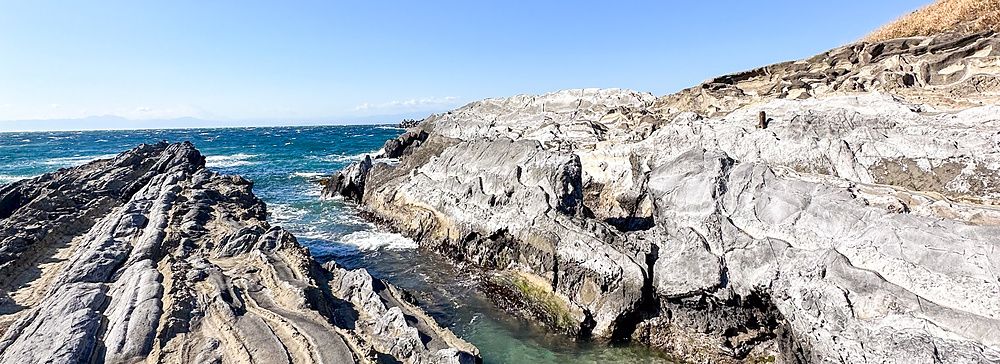
Jogashima Island
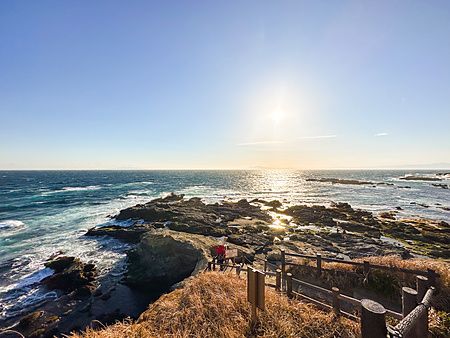
An island at the tip of the Miura Peninsula, south of Tokyo, where you walk across dark rock slabs with the waves breaking a few meters away and, on a clear day, Mount Fuji out beyond the sea. Jogashima Island is known for its rock arch, carved out by the sea, its two lighthouses and the trails along the coast. Near one of the lighthouses there’s also a little street of shops where you can eat tuna.
If you’ve already been to Japan a few times and you’re in the mood for sea, wind and rocks, it’s the right day trip from Tokyo. If you only have a few days and want to see the famous sights, save it for your next trip.
Contents
What you’ll see
The island is small and you can cover all of it on foot, from one lighthouse to the other, choosing between the high trail through the trees and the low route over the rocks. These are the reasons to come:
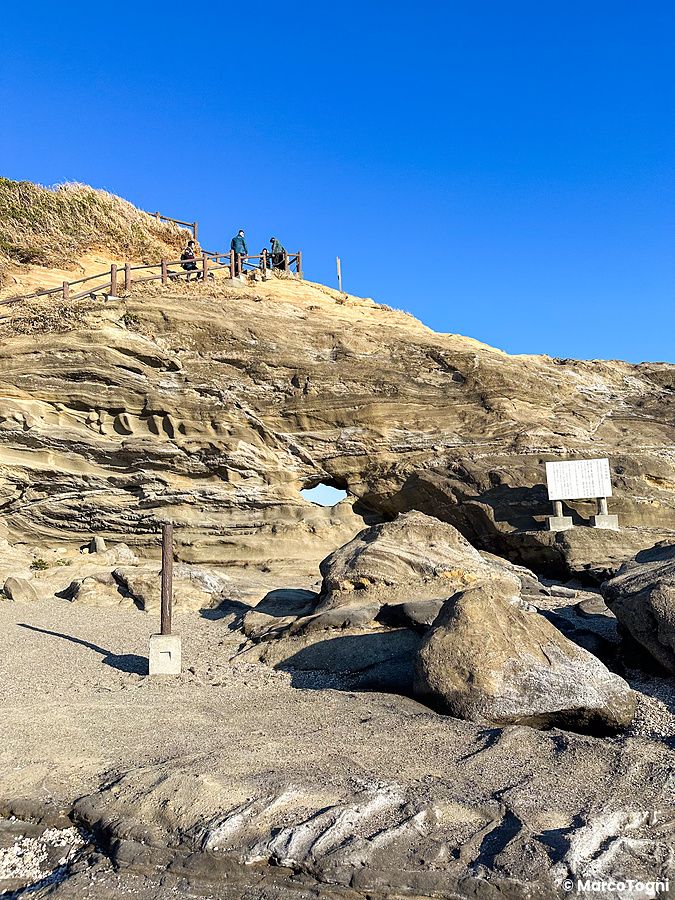
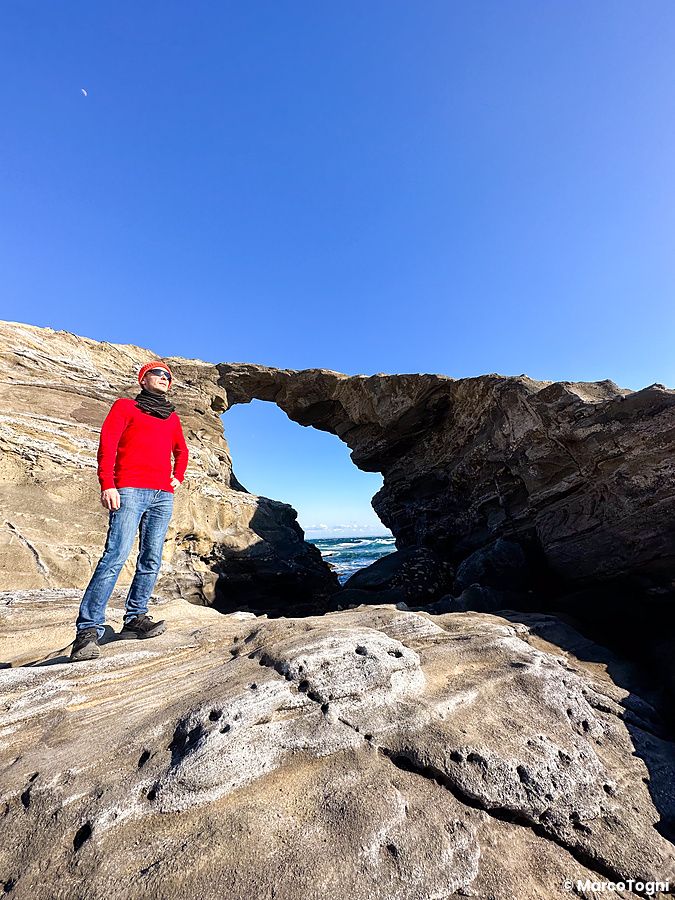
- Umanose domon: the rock arch the waves have carved out, eight meters high and six meters wide, with the open sea showing through it. It’s the most beautiful thing on the island.
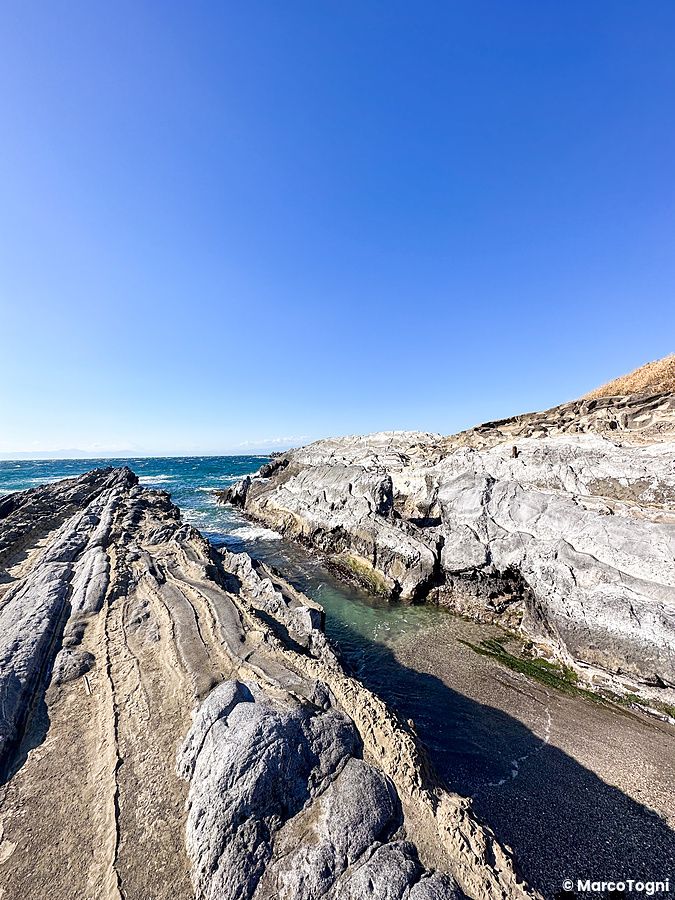
- The rock slabs on the south coast: gray and ocher layers tilted toward the water, which you walk on like a slanted floor. At low tide, pools form in them, full of tiny crabs and sea snails.
- The cormorant viewpoint: a lookout over the cliff where, from fall to spring, about a thousand cormorants gather, all perched on the rock face.
- Jogashima Lighthouse: the white one on the west side, where people go to watch the sunset. Below it is the little street with fish shops and restaurants serving raw tuna and shirasu, the tiny white fish.
- The park on the east side, with Awasaki Lighthouse: lawns, pine trees, picnic tables and an oddly shaped, modern lighthouse that looks like anything but a lighthouse. From the upper lawns you can see the sea on two sides.
Most people only do the arch and the white lighthouse, so the east side stays half empty. I think that’s a mistake, because the park’s lawns are the place to sit down and eat something with the wind in your face and not a single building around you.
The cormorants are there only in the cold months. In summer their viewpoint is just a cliff, a pretty one, but there’s no real reason to stop there. On the stone walls near the parking lot and along the inner roads you’ll see metal stairs and green signs with a little figure running uphill. They’re the tsunami evacuation routes, and they remind you that out here the sea has the final say.
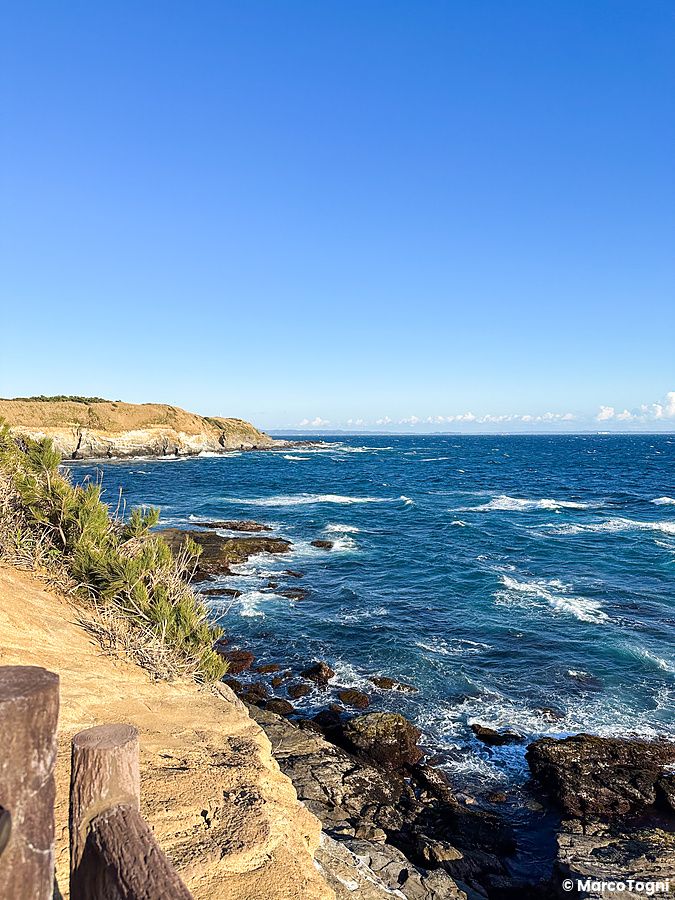
The slabs you walk on were under the sea until a major earthquake pushed them up, which is why the south coast looks like a stone staircase going down into the water. Getting to the arch over those rocks, with the waves throwing up white spray and the water shifting from turquoise to almost black, is more satisfying than plenty of famous views.
I bring people here when they’ve been to Japan two or three times and ask me for a day without temples and cities, because you spend the afternoon on the rocks and end it with a bowl of tuna in front of the lighthouse. Nobody has ever told me they felt they’d wasted the day.
When to go
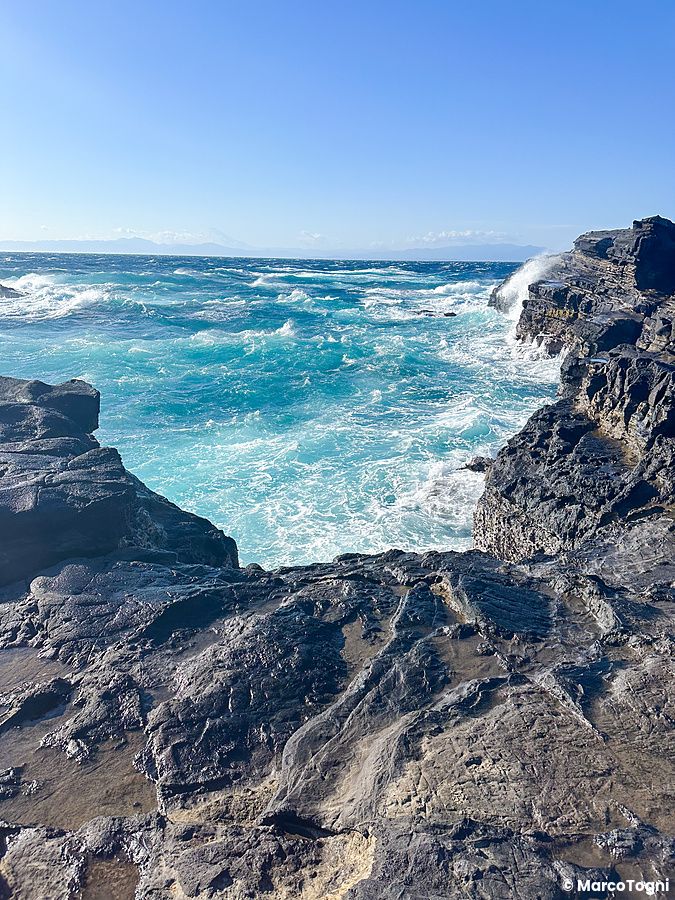
The best time is from late fall to early spring. The air is clear, and from the south coast and the west side you can see Mount Fuji capped with snow above the waves. The cormorants are on the cliff, and in January and February narcissus flowers bloom on the hills. The price you pay is the wind, which never lets up here and cuts right through you in winter, so bring a heavier jacket than you think you’ll need.
Summer is the wrong time. There isn’t a scrap of shade on the rocks, the stone gets scorching hot, and on weekends in July and August the island fills up with families and cars from early in the day.
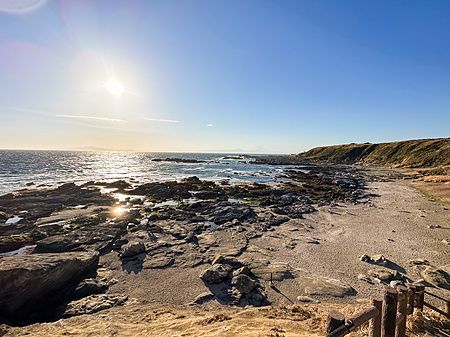
On weekdays, though, the only people you’ll find on the coast are fishermen with their rods pointed out to sea and a few couples sitting on the rocks. As the afternoon goes on, it pays to head toward the white lighthouse: that’s the side where the sun goes down over the sea, and the rock slabs turn dark while the light glints off the water.
If you’re interested in the tide pools, go at low tide. When the sea is rough, the waves wash over the lowest slabs, and you’re better off not going down there.
Difficulty and footwear
The upper trail is easy: almost entirely flat, partly paved, surrounded by greenery, and you can do it even with kids. The hard part comes when you go down to the arch, because the stairs down from the ridge are steep and you have to climb back up them afterward. Once you’re down, you look at the arch and take your photos from the rock opposite it. Climbing onto the ridge above the arch is forbidden because the stone is fragile, and you can’t walk under it either.
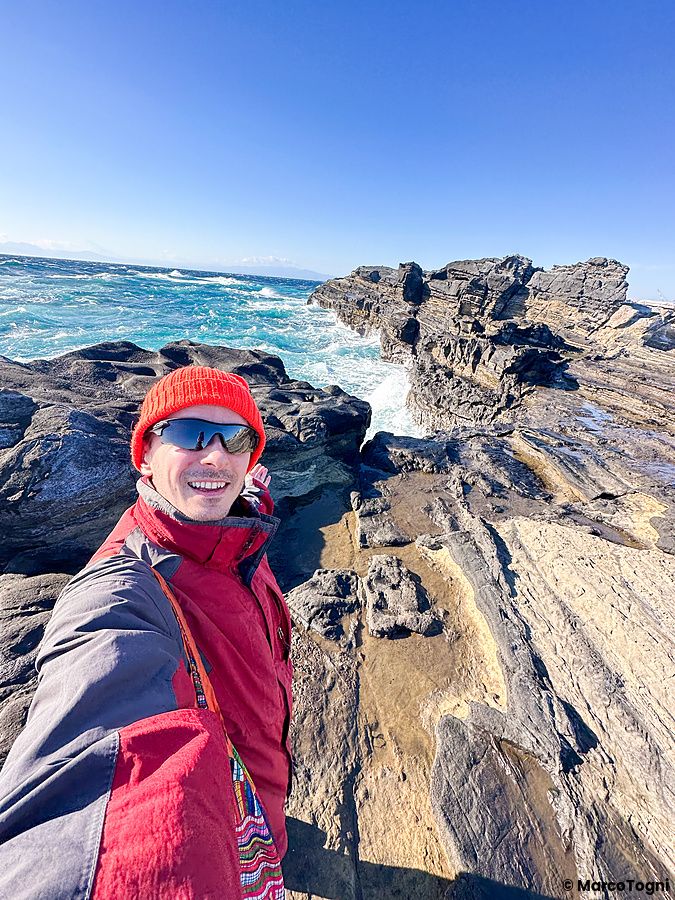
Along the coast you’re walking on uneven rock full of natural steps and holes, with no railings or barriers on the water side. You need sneakers with good soles, not sandals, and you’ll want to keep an eye on small kids near the edge.
There’s no shelter anywhere along the route except the shop area near the white lighthouse. In summer bring your own water, and in any season bring insect repellent too, because there are always mosquitoes in the woods along the ridge.
At a glance
- Highlight: the rock arch on the south coast and the walk across the rock slabs down to the sea.
- When to go: November to March, on weekdays with clear skies, staying until sunset on the white lighthouse side.
- Best for: people on their second or third trip to Japan who want a day by the sea outside Tokyo.
- Vibe: strong wind, waves, fishermen on the rocks and very few people away from the shops.
Final thoughts
Jogashima Island has no monuments to check off. You come here to walk along a coast of bare rock and feel the sea on your skin. If you have a free day in Tokyo and you’ve already seen the famous places, it’s worth it for the arch over the sea and that stretch of south coast, which is unlike anything else around Tokyo.
On a first trip, with a week in total, save that time for Kyoto or Nikko. This is a day trip for when you already know Japan a little.
Getting There
From Tokyo, take the Keikyu Line (there are also direct trains from Shinagawa) to the end of the line at Misakiguchi, then get on the Keikyu bus to Jogashima. In about 30 minutes it goes through Misaki, crosses the bridge and reaches the last stop, near the white lighthouse and the little street with the shops.
If you want to start from the park on the east side, get off earlier at Hakushuhi-mae, and you'll be on the lawns after a 5-minute walk.
For the trip, Keikyu's Misaki Maguro Kippu is the ticket to get: it covers the round-trip train, unlimited buses in the area and a voucher for a tuna meal. You buy it at the Keikyu station you're leaving from, not at Misakiguchi.
Useful Info
- Misakiguchi Station (Keikyu Kurihama): then the Keikyu bus to Jogashima
- Jogashima stop (last stop on the bus line): white lighthouse and shops
- Hakushuhi-mae stop (same bus): park and Awasaki Lighthouse
Map
This place is on MarcoMaps
Jogashima Island
My map of Japan: over 4,000 places I've tried myself, each with photos, rating, and hours. Filter by category and rating, find veg-friendly spots and places near you with GPS. No sign-up, right from your phone.
- 4,000+ places
- Rating, photos, and hours
- Veg friendly
- Near me (GPS)
- Favorites without login
- Works offline

