Kairakuen Garden
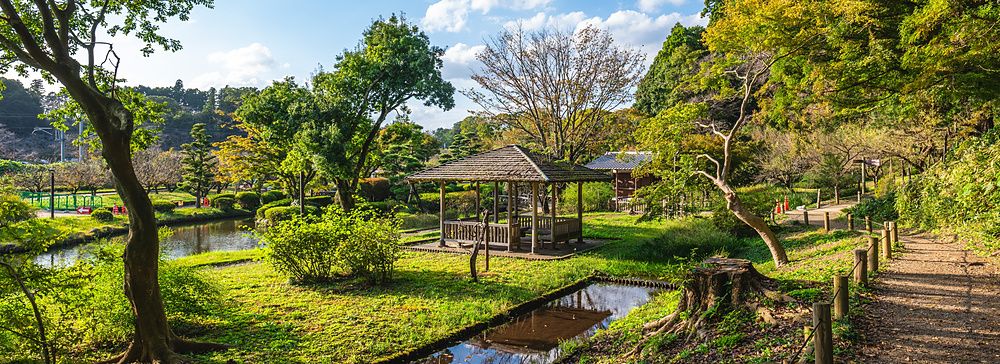
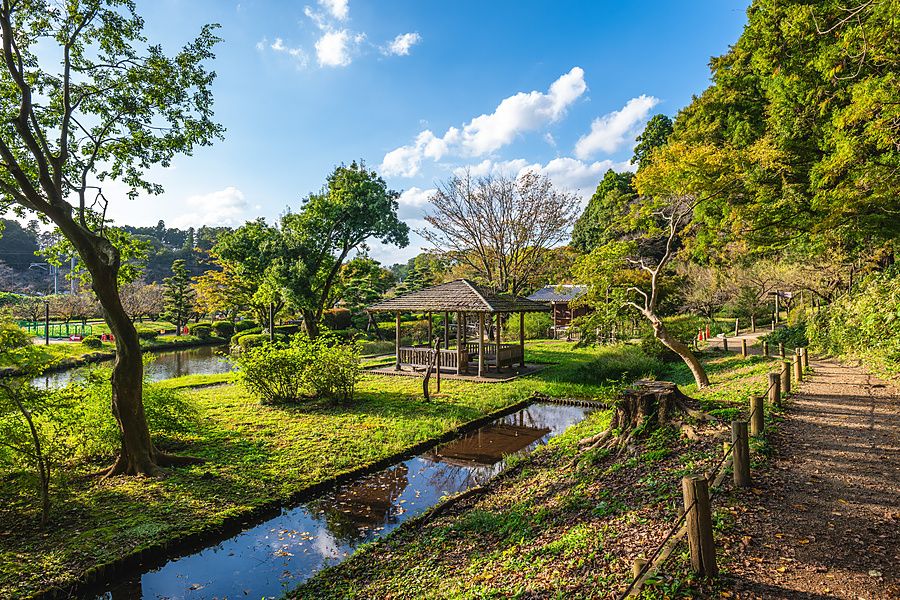
A historic garden in Mito, Ibaraki Prefecture, where half the park lies in deep shade under bamboo and cedars and the other half is open, bright and full of plum trees. Kairakuen Garden is one of Japan’s three most famous gardens. Everyone knows it for the plum blossoms, but inside you’ll also find a spring with a white marble basin, a wooden pavilion that looks out over the lake, a lawn at the top of the hill and a valley of maples.
There’s a lot of walking involved, and you don’t need to know anything about Japanese gardens to enjoy it. It’s the right place if you have a free day, even with kids in tow, and you like to wander slowly and take things in.
Contents
What you’ll see
- The plum grove: about 3,000 trees of 100 different varieties, split into two large clusters, one on the east side and one on the west. In bloom they range from white to deep red, and you smell them before you see them.
- The bamboo grove: more than 1,000 stalks of giant bamboo, just to your left once you’re through the main gate. A few steps in, the light turns green and the noise fades away.
- The Togyokusen: a spring that pours 100 tons of water a day into a white marble basin. Right next to it stands the Taro-sugi, an 800-year-old cedar whose trunk is too thick for two people to wrap their arms around.
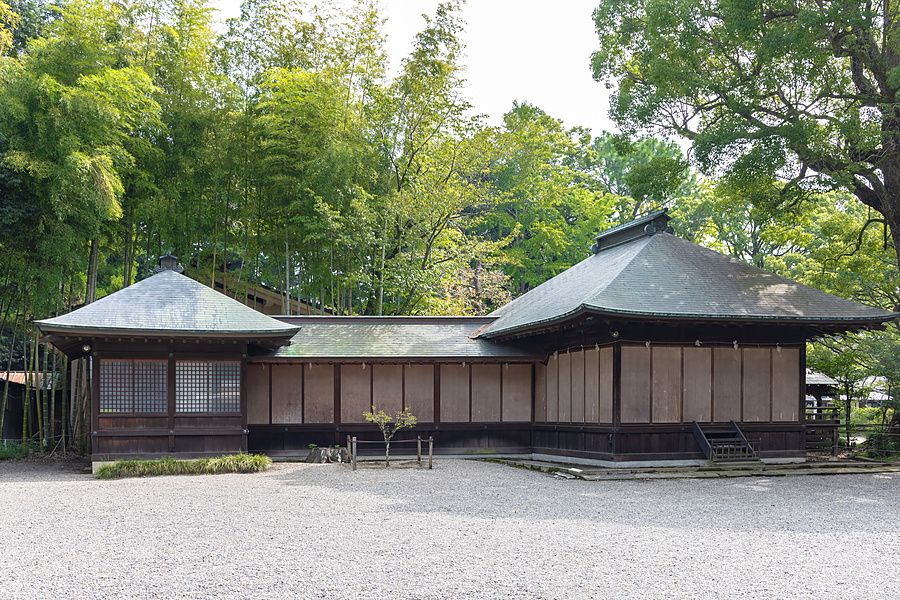
- The Kobuntei: the local lord’s wooden pavilion, with three levels, tatami rooms, ink paintings on the sliding doors and woven bamboo ceilings.
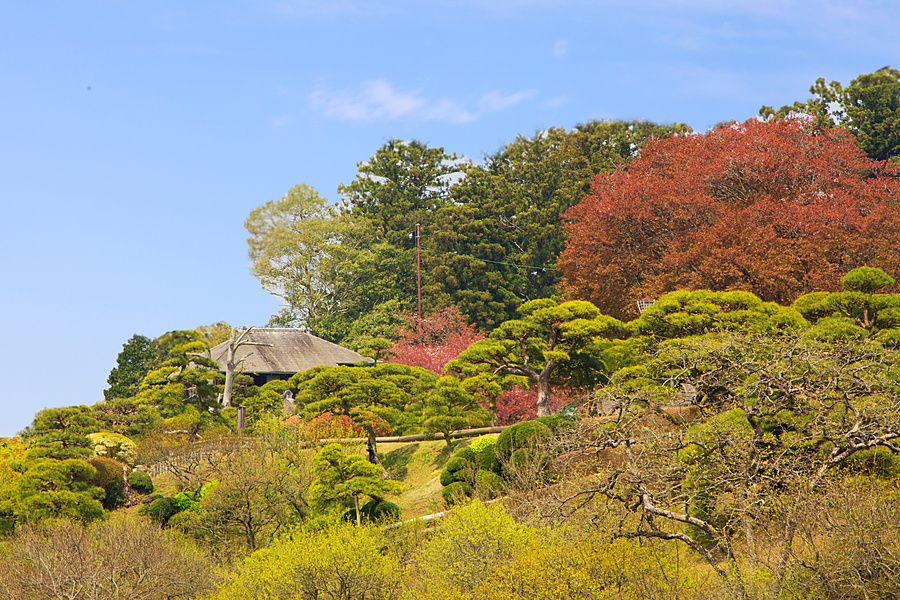
- The lawn with the view: a stretch of grass in the southeast corner, with Lake Senba shining below you and trains going by underneath. On its edge is the Senekidai, a stone platform with go and shogi boards carved into the rock.
- The maple valley: about 170 maples in a hollow in the lower part of the park, outside the main garden.
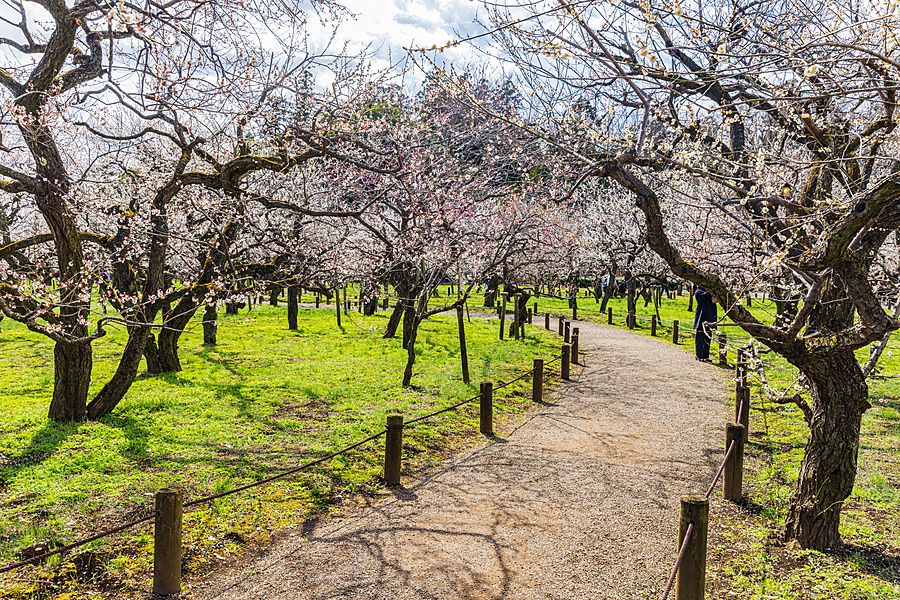
Outside blossom season, the plum grove is just a field of bare trees, and that’s all. If you show up in July expecting the photos you’ve seen, you’ll leave disappointed. What holds up in any month is the shaded side, with the bamboo, the cedars and the spring, plus the lawn and the lake.
The Kobuntei is where everyone crowds in, because it’s the only building you can go inside and people take turns going up. The lawn, on the other hand, is half empty even when the rest of the park is packed, and you get the lake in front of you with nobody in the way.
Almost everyone skips the maple valley, since it sits apart from the main garden and you have to walk to get there. In November it’s the best part of the park, and on weekdays you’ll have it nearly to yourself.
If you’re picturing a compact garden like the ones in Kyoto, with a pond, a bridge and lanterns all within a few steps, think again. Here everything is spread out, and there’s always a bit of a walk between one thing and the next.
I keep coming back for the stretch between the bamboo and the spring. I walk down into the shade, hear the water before I see it and pass maybe two people. Then I come out onto the open lawn with the lake ahead of me, and the light changes all at once.
That’s the part that stays with me every time, even when the trees are bare, and it’s why, when someone asks me for a place outside Tokyo to spend a whole day, this is the one I suggest.
When to go
Peak season is late February and the first half of March, during the plum blossom festival, but check the exact dates before you go. On weekends, from mid-morning to mid-afternoon, you walk the plum grove paths in single file, and food stalls set up around the east gate and Tokiwa Shrine: plum ice cream, vegetable udon, and plates of natto, which Mito takes very seriously.
On those days get there early. In the morning the plum grove is silent, and the low light coming through the branches is the best thing about the place. Late afternoon is the next best time, when the tour buses leave and the park empties out.
Outside plum season everything changes, and not for the worse. April brings cherry blossoms, May the azaleas, September the hagi bushes, low and untidy, with their purplish-red flowers, and mid-to-late November the maples in the valley.
In winter, before the plums bloom, the park is quiet, with a few cherry trees flowering out of season. That’s when you’ll find the fewest people all year.
If it rains, don’t bother. A good part of the paths are unpaved and sloped, so they turn to mud, and you end up spending your time inside the pavilion looking out.
August has the opposite problem. The bright half of the garden is in full sun, the plum trees are too low to give you any shade, and by the time you reach the lawn you’re baked.
Inside the Kobuntei
You take your shoes off and walk around on a polished wooden floor that creaks. The rooms come one after another: the small four-and-a-half-mat room where the lord used to retreat, the bare, dark tea room, and the women’s quarters with their painted walls. Ink drawings cover the sliding doors.
There’s also a wooden dumbwaiter with pulleys, which they used to haul trays of food up from the lower floors. It looks like a toy, and it’s the most curious thing in the building.
The best part is at the top. The room on the top floor is open on three sides, and from up there you can see Lake Senba, the plum grove below and, on clear days, Mount Tsukuba on the horizon. The movable panels were placed so they don’t block the view in any direction, and you can tell.
The wooden stairs to the top are narrow and steep, with a thin handrail, and when the park is busy people line up on the steps because only one person can pass at a time. Wheelchairs can’t get up there, and tripods aren’t allowed.
Outside the pavilion, in the western part of the park, there’s a small café where you can sit down with something sweet and the garden in front of you. It’s a handy place to stop halfway around, especially in winter when it’s windy.
How much walking it takes
It’s up and down the whole way. From the main gate you head down into the bamboo on a sloping path with a few steps, reach the spring at the bottom, then climb back up toward the pavilion and the lawn. None of it is hard, but there are at least two climbs, and in the wrong shoes you’ll feel them.
Wear comfortable closed-toe shoes. Most of the route is gravel and packed dirt, and the shady spots stay damp even the day after it rains.
You can get around the main garden with a stroller, with a few bumps on the gravel, and the lawn is perfect for letting kids run because it’s wide and there’s nothing in the way. In the wooden pavilion, though, the stroller has to stay outside, and you’ll need to carry your child up the stairs.
The maple valley takes a bit more legwork, since you go down and then back up. If you’re a slow walker you can skip it without feeling guilty, except in November.
For photos, the two best spots are the lawn in the morning, when the lake reflects the light, and the bamboo around midday, when shafts of sunlight come through the stalks and cut across the path. When the plum grove is in bloom, the trick is to stand under a tree and shoot upward, because at eye level half the crowd ends up in your frame.
Who built it and why
Tokugawa Nariaki, lord of the Mito domain, created the garden and opened it in 1842 with a fairly unusual goal for the time: it wasn’t meant just for him, but for the local people too. That’s where the name comes from. Kairaku roughly means “enjoying together,” and on certain days of the month the park was open to ordinary townspeople as well.
He didn’t plant the plums only for their looks. They’re the first trees to bloom, while it’s still cold, and their fruit was made into umeboshi, pickled plums that were kept as emergency food in case of famine and as rations for soldiers.
The shift from shade to light isn’t an accident either. The original route starts at the main gate precisely so that you first walk through the shaded side, with its bamboo and cedars, and then see the plums and the lake open up in front of you, on the principle of yin and yang.
The Kobuntei you see today isn’t the original, though. It burned down during the 1945 air raids and was carefully rebuilt following the old design.
At a glance
- The highlight: the walk from the shaded bamboo grove down to the spring, and then the lawn up top with the lake below.
- When to go: late February and early March for the plums, the second half of November for the maples, always early in the morning; avoid festival weekends in the middle of the day.
- Best for: anyone with a full day to spend outside Tokyo, families with small kids, people who want a long walk without hopping on public transportation.
- Atmosphere: crunching gravel and falling water on the shaded side, wide, bright open space in the plum section, retirees with tripods and tour groups on peak days.
Final thoughts
Kairakuen Garden isn’t a place you take in from one spot. You come for the walk, for the way the dark of the bamboo sets you up for the light on the lawn, and the 3,000 plum trees are a bonus that lasts two weeks a year. It’s worth the detour even out of season, because the spring, the old cedar and the lake view are there year-round, and because here people spread out and nobody pushes you along.
If you’re after a half-hour garden with the perfect shot already lined up for you, this isn’t the place. Here you have to walk, and anyone who doesn’t feel like it goes home thinking it’s just a bunch of trees.