214 m
Okochi Sanso Villa214 m
A dream home.
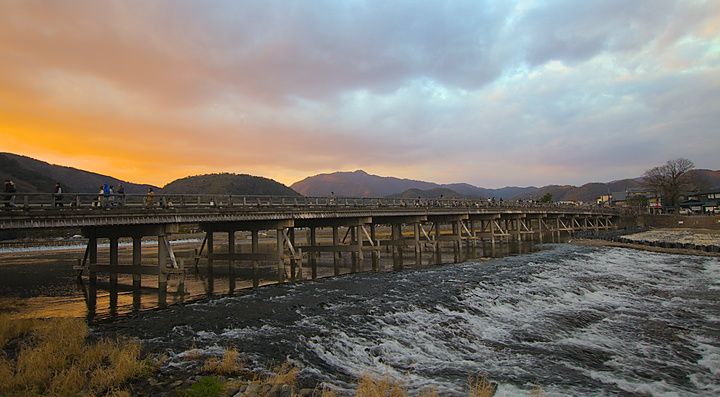
Right by Togetsukyo Bridge in Arashiyama, Kameyama Park isn’t well known among tourists, and that’s exactly why it makes such a good green refuge when you want some peace and quiet away from the crowds at the area’s big sights. It sits behind Tenryuji Temple and isn’t far from the Arashiyama bamboo forest, so it could easily fit into your itinerary as you explore the best of the neighborhood.
The park runs alongside the river and climbs the slope of a mountain, with a network of paths leading up to some beautiful viewpoints where you can take in the scenery and catch glimpses of the city. In spring the whole place turns pink with cherry blossoms, and in autumn the maples take over, filling it with warm shades of red. Give yourself time to enjoy the scents and colors of the seasons, and you’ll see why this part of Kyoto has always been loved by nobles and emperors and has inspired so many artists and writers.
There’s a reminder of this in the park itself: a large rock with Japanese writing carved into it. The writing is one of the poems by Zhou Enlai, who later became premier of China. In 1919, as a young student in Japan, he was so struck by the scenery at Arashiyama that he wrote two poems about it.
If you’re lucky, you might also spot a few monkeys on your walk. They come down from the nearby Iwatayama Monkey Park looking for fruit to eat.
The best part of the walk is when the path comes out onto a viewing terrace over the Hozugawa gorge, about 40 meters above the water. Down below, the river squeezes between the green walls of the valley, and all of a sudden the chaos around the bridge feels a world away.
Sit down on one of the benches and give it a few minutes, because the view keeps changing. Every so often the wooden boats that take people down the river slip through the gorge, poled along by the boatmen, and on the far bank the Sagano scenic train rolls by partway up the hillside.
There’s more than one terrace. As you keep following the trails you’ll come across several, each with a different angle on the valley, and the highest one is also the quietest.
The park is named after the hill it climbs. Kameyama means turtle mountain, because its rounded outline looks like a shell.
Emperor Kameyama had his country villa here, and Tenryuji, which borders the park today, was later built on that same land. It’s easy to see why the whole area was a retreat for the imperial court for centuries.
Higher up, among the trees, are the burial mounds of three emperors: Go-Saga, Kameyama, and Go-Fushimi. They sit behind plain fences with hardly any signs, and as you wander around you end up in front of them almost without realizing it.
Zhou Enlai’s rock isn’t the only inscribed stone in the park. Scattered along the trails are about fifty stone tablets carved with waka from the Ogura Hyakunin Isshu, a collection of a hundred poems that takes its name from this very mountain, Ogurayama.
They’re small and covered in moss, and it’s very easy to walk right past them. Look down along the edges of the path and you’ll find one after another. Even if you can’t read Japanese, knowing that you’re walking through the same landscape court poets wrote about for centuries changes the feel of the walk quite a bit.
Somewhere in the park you’ll also come across a statue of a seated man looking out toward the river. This is Suminokura Ryoi, the Kyoto merchant who had the Hozugawa riverbed dug out and cleared in 1606 to make the river navigable.
From then on, the gorge stopped being an obstacle and became a waterway. Timber and goods came down it on their way to the city, and today the tourist boats travel the same route. It’s one of the few places in the park where the postcard scenery ties into a very real story of work and trade.
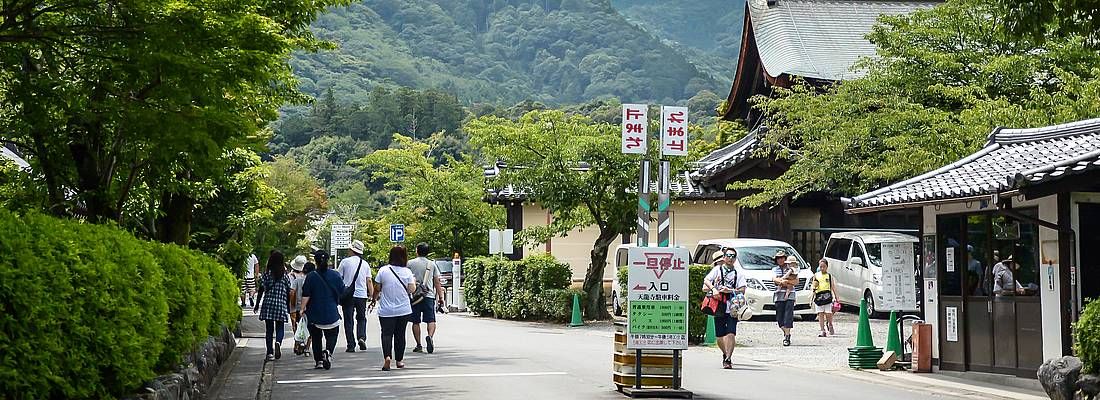
The park takes up the western end of Arashiyama. From Arashiyama Station on the Randen line, head down the neighborhood's main street and keep walking along the river on the north bank, past small restaurants and traditional inns, until you reach the entrance. It takes about ten minutes in all.
The second way in is the more scenic one: walk through the bamboo forest, and when you reach the top of the slope, turn left at the fork to go straight into the park.
If you come by train to JR Saga-Arashiyama Station, it's about a 15-minute walk southwest. From the Hankyu line, you first have to cross Togetsukyo Bridge and then keep right along the river.
This place is on MarcoMaps
Kameyama Park
My map of Japan: over 4,000 places I've tried myself, each with photos, rating, and hours. Filter by category and rating, find veg-friendly spots and places near you with GPS. No sign-up, right from your phone.