Kanazawa Station
Kanazawa Station isn’t just another station. The building captures the spirit of the city, a mix of modernity and tradition that leaves people passing through in awe. It’s considered one of the most beautiful train stations in the country, and amid commuters hurrying past and hugs welcoming people home, it’s worth setting aside a little time to look around.
Take in the huge glass ceiling that floods the interior with daylight, do some shopping, and stop in front of the giant wooden torii that towers over the station exit.
Contents
Tsuzumi Gate
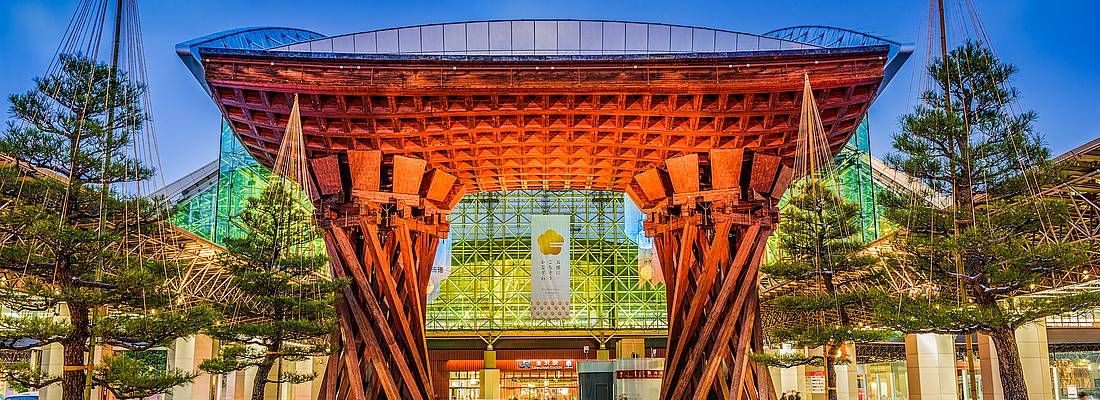
A torii normally marks the entrance to a shrine, but this one has become the symbol of the city. Its unusual modern design, all curves and decorative patterns, sits in perfect harmony with the station building behind it. The gate has symbolic meaning too, because it stands at the entrance (and exit) of a “sacred city”: Kanazawa is full of temples and shrines.
The torii at Kanazawa Station is 14 meters tall and went up in 2005 as a modern take on the traditional torii. It stands in a small plaza with plants and benches where you can sit and admire it. It gets its name, Tsuzumi, from the shape of its two vertical pillars, which are modeled on the tsuzumi, a type of drum used in traditional Noh theater.
For lots of tourists, a selfie with the torii and the station behind them has become practically compulsory!
The water clock
In the plaza outside the east exit, just steps from Tsuzumi Gate, there’s something almost everyone stumbles on by chance: a clock made of water. Hundreds of tiny nozzles form the digits of the time in midair, and at irregular intervals they spell out welcome messages like “Welcome” or “Kanazawa.” The words hang there for a moment before dissolving as the water falls to the ground.
It’s worth stopping for a minute to wait for the message to change. In the evening, with the lights on under the jets, it looks even better.
Art and architectural details
Not everyone will notice, but the torii theme carries on inside the station, in the Central Concourse, where a row of wooden gates lines the hallway and holds up the ceiling. There are 12 of them, made from local cypress. Take a closer look and you’ll spot beautiful decorative artwork in wood, lacquer and ceramic that shows off the city’s craft traditions.
You’ll also find ornaments in yuzen silk, gold leaf and washi paper throughout the station, even on the train platforms, giving the contemporary spaces a traditional touch.
Services and shopping
Right by the east exit of Kanazawa Station you’ll find yourself under the big glass dome called the Motenashi Dome, or “welcome dome.” The space underneath hosts events and has a tourist information office where you can pick up maps and ask for tips on the city’s sights and on getting around. The dome isn’t just for show. The idea is for it to act as an umbrella for everyone arriving in the city, a welcoming gesture that makes very practical sense here. It rains or snows in Kanazawa for a good part of the year, and an old local saying warns that you can forget your lunch, but never your umbrella.
There are also convenience stores, ATMs and a food hall with the best of Kanazawa’s specialties, some of them packed in colorful bento boxes that make a perfect lunch on the train. Shops selling local crafts and souvenirs sit alongside modern clothing and accessory boutiques in the Hyakubangai Shopping Center, a mall inside the station building. Right next to the east exit there’s another mall, Forus Shopping Mall, with 7 floors of fashion, cosmetics, music, restaurants and even a movie theater.
Finally, there’s a hotel inside the station, a perfect base if you don’t want to stray too far or if you’re arriving on a late train. You’ll find other places to stay around the station too, from luxury hotels to budget business hotels.
Trains
Lots of lines serve Kanazawa Station, with both regular trains and shinkansen. Here are some of the most useful for visitors:
Regular trains
- IR Ishikawa Railway, the former JR Hokuriku Line, which stops in towns along the coast like Komatsu and Tsubata and continues toward Toyama;
- JR Nanao Line, which links Kanazawa with Nanao and Wakura Onsen on the Noto Peninsula;
- Shirasagi Limited Express, which runs to Nagoya but now starts from Tsuruga, so from Kanazawa you take the shinkansen first.
Shinkansen
- Hokuriku Shinkansen, which gets you to Tokyo in just two and a half hours.
- Tsurugi, the shinkansen service between Kanazawa and Tsuruga, where you change to the Thunderbird for Kyoto and Osaka.
Night trains
Night trains don’t run through Kanazawa anymore, and all the old trains that used to stop here have been discontinued. The Nihonkai, which ran from Osaka to Aomori, and the Kitaguni, which went from Osaka to Niigata via Fukui and Kanazawa, were retired in 2012, and the Twilight Express between Osaka and Sapporo made its last run in 2015. Today, if you want to travel overnight, long-distance buses are the only option left.
Buses
Kanazawa Station is also the terminal for many local and long-distance buses. The long-distance ones run direct from Kanazawa to Japan’s big cities and other towns, including Tokyo, Kyoto, Yokohama, Nagoya, Sendai, Niigata and Takayama.
The city’s sightseeing bus, the Kanazawa Loop Bus, leaves from outside the East Exit. It runs a circular route and stops at some of the main sights, such as Kanazawa Castle, Kenrokuen Garden, Omicho Market, the historic Kazue-machi chaya district and more. It’s not the only sightseeing bus in town, but its route covers the most ground.
The buses to Komatsu Airport leave from outside the West Exit.
History of a “green” station
The current station dates from 2005, but Kanazawa’s first station was built on the same spot back in 1898, when a single line served it, the Hokuriku Rail Line. It was a small wooden building surrounded by fields, in what was then a fairly isolated area.
That station served the city for 50 years, until more passengers and a growing city meant a bigger, more modern building was needed. After World War II, though, money was short, so local authorities asked residents for help. The second Kanazawa station, completed in 1953, was officially named “Kanazawa Minshu Eki,” which literally means “the station of the people of Kanazawa.” Back then it had 44 shops. Adding more space in the basement led to a shopping center that’s still open today as the Hyakubangai Shopping Center, where Japanese and international brands sit alongside Kanazawa’s long-established shops.
In the 1990s, with the shinkansen line on its way, the building needed to expand, and a major rebuilding project got underway, finishing in 2005. The first shinkansen trains from Tokyo, however, didn’t pull into the station until 2015. Ryuzo Shirae’s futuristic design has earned the station a place among the most beautiful in the world and several awards. It’s not just good-looking, either: the building runs on power from solar panels on the roof, and its glass dome reaches all the way over the taxi and bus stands, so passengers have shelter while they wait.
The station at night
If you can, come back to the station after sunset. Tsuzumi Gate lit up is a whole different sight, and you won’t see the contrast between the wood and the glass dome during the day.
The lights stay on until late at night. At the top of every hour, for a couple of minutes, the gate changes color to one of the five Kaga colors, the area’s traditional palette: crimson, indigo, grass green, ocher and antique purple. On weekdays the gate shows a different color each day, while on weekends and holidays all five take turns. That’s when the plaza fills up with people with their phones out.