638 m
Nara Park638 m
Home to Japan's famous deer.
 ©000zzz - Dreamstime
At the foot of Mount Kasuga on the east side of Nara, surrounded by ancient forest, stands the Shinto shrine of Kasuga Taisha, which UNESCO has listed as a World Heritage Site together with the area around it.
If you’re in Nara, don’t skip it. It’s a refined example of kasuga-zukuri architecture, and with its bronze lanterns and bright red paint it catches your eye and wins your heart. It’s a sacred, deeply quiet place, ideal for a day of complete tranquility.
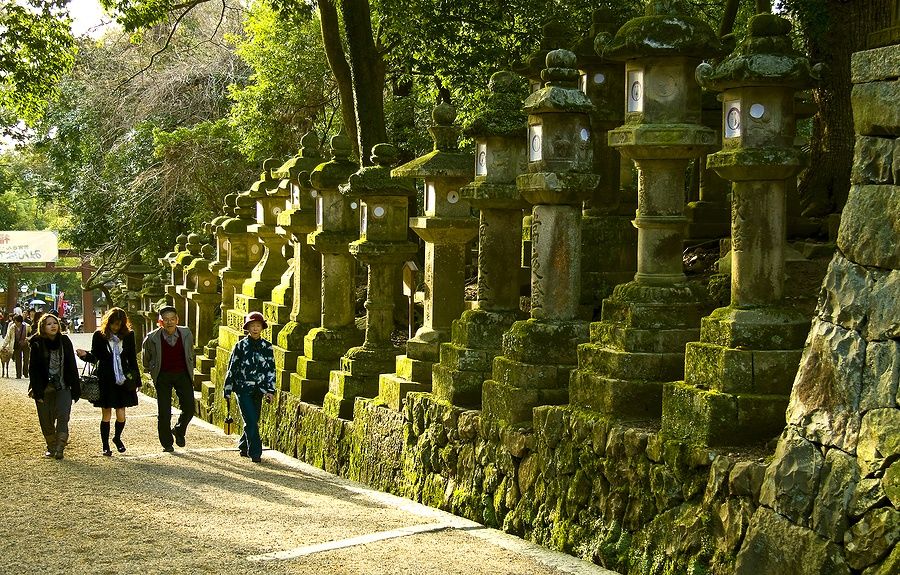
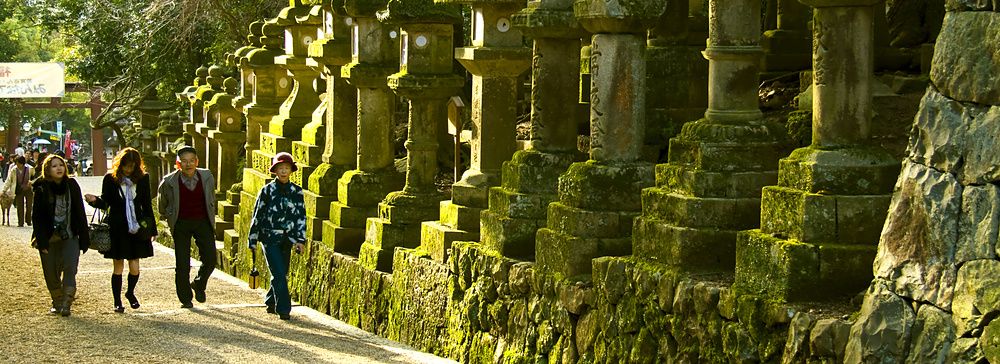
From Kintetsu Nara Station it's about a 30-minute walk. You cross the deer park and turn onto the long avenue lined with stone lanterns, and it's the nicest walk of all, because it's already part of the visit. From JR Nara the walk stretches to around forty minutes.
If you'd rather save your legs, buses leave from both stations and run along the edge of the park. Get off at Kasuga Taisha Honden and you're three minutes on foot from the shrine gate; get off at Kasuga Taisha Omotesando and you start at the beginning of the avenue and walk the last stretch through the woods.
This place is on MarcoMaps
Kasuga Taisha
My map of Japan: over 4,000 places I've tried myself, each with photos, rating, and hours. Filter by category and rating, find veg-friendly spots and places near you with GPS. No sign-up, right from your phone.


The powerful Fujiwara family built Kasuga Taisha in 768, and the shrine grew as the wealthy clan prospered. At first its only purpose was to protect the ancient city of Heijo-kyo, but it soon gained importance, and today it’s one of the three most important shrines in the country. For centuries Fujiwara daughters married emperors, which gave the clan enormous influence at court, and that closeness to power added to the shrine’s prestige. Besides honoring the Fujiwara ancestors, the shrine is dedicated to four major Shinto deities: Takemikazuchi, who came here from Kashima Shrine, Futsunushi from Katori Shrine, and Ame-no-Koyane together with the goddess Himegami from Hiraoka Shrine. Following the Shinto principle of purity, the buildings were torn down and rebuilt every 20 years until 1863. In the Heian period Kasuga Taisha was merged with the Buddhist temple Kofuku-ji, and the two stayed linked until the Meiji Restoration, when the government recognized Shinto as a religion in its own right, separate from Buddhism.
You can tell how closely Shinto is tied to nature just from where Kasuga Taisha sits and from the long path through the greenery you have to walk to get there. In Shinto, walking through nature is the best way to prepare your mind for meditation and prayer. The path winds through the Deer Park, where, as the name suggests, you may be lucky enough to spot some of the deer that roam freely in their natural habitat. Shinto considers the deer sacred, a messenger of the gods, and the bond between the shrine and the animal inspired many artists of the Nambokucho period, who often painted Kasuga Taisha with a deer beside it. That bond goes back to the founding legend: Takemikazuchi is said to have come here from Kashima riding a white deer, and ever since, the deer living at the foot of the mountain have been considered shinroku, the shrine’s divine deer. For centuries killing one was a very serious crime that carried harsh punishments, and even today they aren’t just park wildlife but protected animals tied to worship at the shrine.
The path brings you to the main entrance, the Minami-mon or south gate. Once you’re through it, you’ll come to the Temizuya, a water basin where it’s customary to wash your hands.
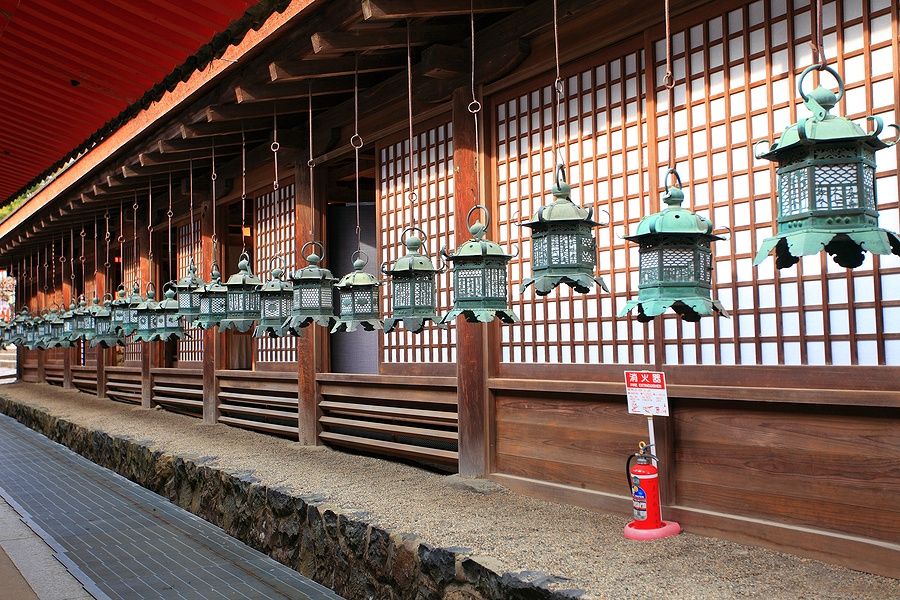
Besides its bright red color, the shrine’s trademark and symbol is its 3,000 bronze and stone lanterns. In the past they were lit every evening and gave the place a magical atmosphere; today they’re lit only on a few special occasions, such as events and festivals. The lanterns were donated by visitors and worshipers as a way to express their faith and gratitude. Another part of the shrine that’s well worth a visit is the beautiful Man’yo Botanical Garden, with its gorgeous wisteria, some of it hundreds of years old. Wisteria is very much a symbol of the shrine, since the name “Fujiwara” can also mean “wisteria field,” and the young women who work at the shrine wear it in their hair. The best time to visit the garden is late April and May, when about twenty different varieties of wisteria cover the pergola and the air fills with their scent. Inside the shrine, look for the Sunazuri-no-Fuji, the centuries-old wisteria growing next to the corridor, whose clusters hang so low they brush the gravel. That’s exactly what the name means: wisteria that brushes the sand.
If you’re curious about what the future holds, buy an omikuji, a small slip of paper that tells your fortune. If the prediction isn’t a good one, you can always leave the bad luck behind by tying the slip to a tree branch. Once inside, you can look around the buildings of the complex, including the Haiden prayer hall, the Heiden offering hall and the Honden, the main hall.
If you have time and love nature, I recommend a hike in the Kasugayama Forest, which gives the shrine a beautiful setting that has kept its charm over the years. The forest covers the mountain of the same name next to the shrine, and you’ll be amazed by how many plants and animals live there: more than 175 species of trees, 60 species of birds and 1,180 species of insects. It’s a very important, sacred place with deep ties to the shrine, and monks and worshipers often come here to pray and meditate. That’s why the forest is protected, and both hunting and logging are banned.
The lanterns aren’t all the same, and they’re worth stopping to look at. The stone ones, about two thousand of them, are lined up along the avenues, and a great many date from the Muromachi period: the shrine holds most of the Muromachi lanterns that survive anywhere in Japan. The bronze ones hang by the hundreds from the shrine’s corridors, engraved with the names of the people who donated them, including warlords such as Naoe Kanetsugu and Todo Takatora and even the shogun Tokugawa Tsunayoshi.
On about fifteen of the stone lanterns, the usual inscription is replaced by the name Kasuga Daimyojin, and legend has it that anyone who can find three of them in one night will become rich. At night it’s almost impossible, but the hunt works just as well during the day and makes you read the inscriptions one by one. There’s no better way to realize how many centuries old each stone is.
If the shrine has won you over, the Kokuhoden is where you see how rich its collection is. It houses 354 items designated as national treasures and more than 2,500 important cultural properties, all given as offerings by worshipers over the centuries. Many pieces date from the Heian period, and in several cases nothing like them exists anywhere else, which is why the shrine is called the Shosoin of the Heian period.
The museum has armor, swords and court objects, but the room that makes the biggest impression is the one with the da-daiko, the giant drums decorated with golden flames that accompany bugaku dances. The exhibits change several times a year, so you won’t always find the same pieces on display. The da-daiko, though, stand six and a half meters tall and are still the largest in Japan: one is carved with a dragon, the other with a phoenix, both inside a burst of golden flames. They’re the drums that keep the beat for bugaku dances, performed to court music that Nara has handed down for centuries.
For something truly special, visit the shrine when the lanterns are lit. That happens during the Setsubun Mantoro, held on setsubun day, usually February 3, and during the Obon Mantoro on August 14 and 15. On March 13 there’s the Kasuga Matsuri, when you can enjoy plenty of traditional dance performances. The biggest celebration, though, is the On-Matsuri at Wakamiya Shrine, from December 15 to 18. It has been held without a break since 1136, and for a few days it takes Nara back centuries. The day to circle on your calendar is the 17th, when the Owatari procession winds through the center of town with about a thousand people in historical costume and around fifty horses. At night the deity is escorted to a temporary shrine and later brought back, in darkness and silence.
Besides the four main deities, the sacred precinct holds sixty-two smaller shrines, and the ones clustered around Wakamiya make up a route of their own, the circuit of fifteen shrines. The idea is simple: each stop protects you from one of life’s difficulties, whether it’s raising children, your health, work or old age, and you visit them all one after another.
You start at Meoto Daikokusha, the only shrine in Japan dedicated to a divine couple. That’s where you pick up the bundle of small plaques to leave as an offering at each stop, and where you come back at the end. It’s a short loop in the shade of cedars and much quieter than the main courtyard: if the crowd in front of the Honden feels like too much, this is where the shrine turns back into a forest.
Kasuga Taisha - nearby you will find: