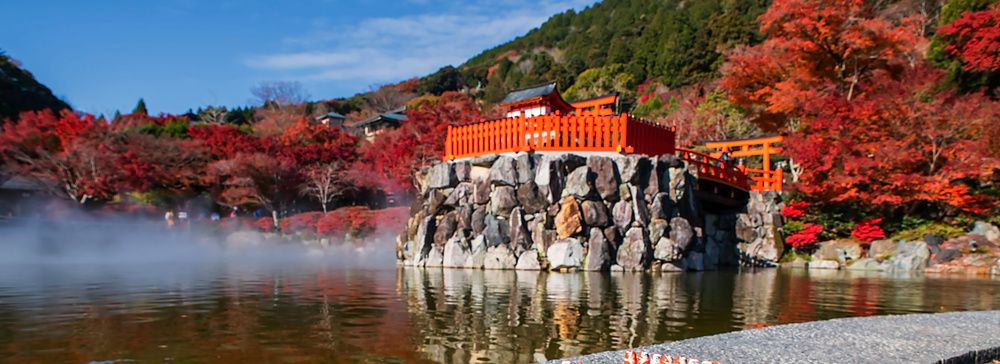
Katsuo-ji Temple
A mountain temple above Minoh, in the hills behind Osaka, where what sticks with you isn’t the buildings but the thousands of red daruma tucked into every crack. Katsuo-ji is the temple of victory. People come here to ask for victory, whether in an exam, a race or a championship, and they leave behind a little figure with one eye painted in.
The grounds are big and spread across one side of a hill: stairs, bridges, scattered halls and a maple forest.
It’s the right place if you feel like getting out of the city and going for a walk among the trees. If you’re bringing kids, be warned: they’ll like it even more than you do.
Contents
What you’ll see
The route starts at the entrance gate and climbs to the main hall, with the buildings spread over several levels. These are the things I think really matter:
- The purification bridge: right after the gate you cross a bridge over the pond, and a white artificial mist rises from below, covering the water, the carp and half the woods. It looks like a gimmick, but it actually works, especially when the light comes in at an angle.
- The stairs with the votive daruma: on the way up to the main hall, both sides are lined with shelves packed with big daruma, all with both eyes painted in. They’re wishes that came true, brought back by the people who made them.
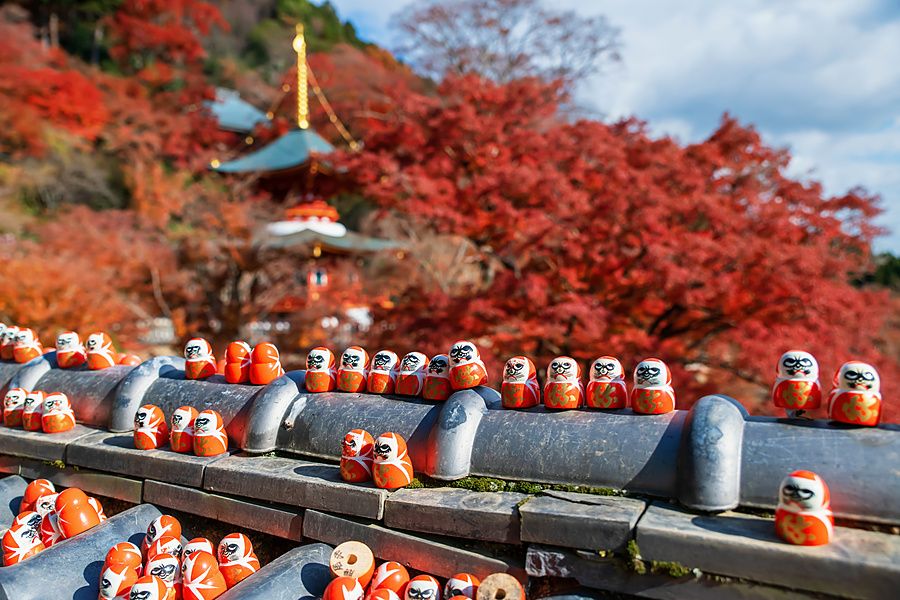
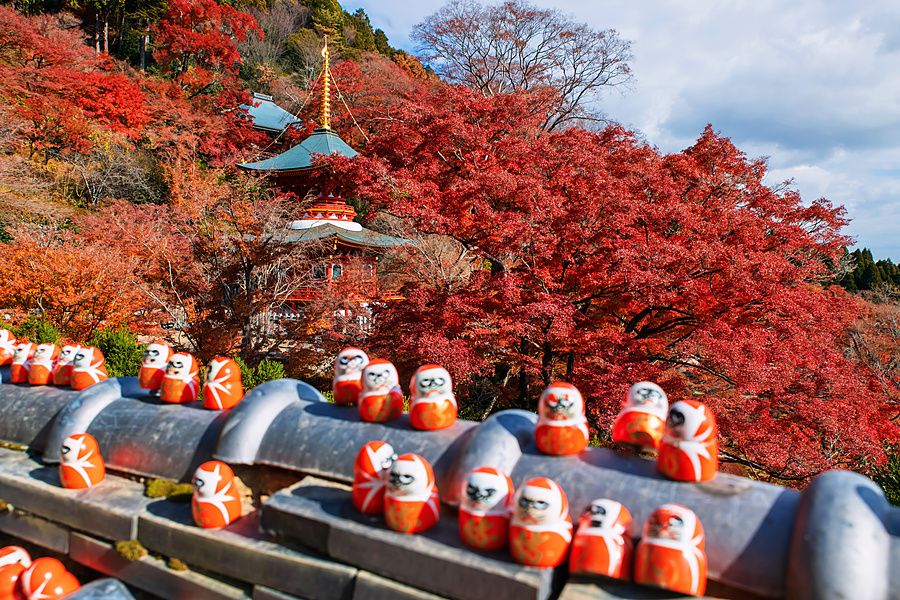
- The little daruma everywhere: they’re in the dry stone walls, under the stone lanterns, among the tree roots, on the handrails, on top of the offering boxes and inside holes in the wood. Nobody knows how many there are, not even the monks.
- The main hall: it sits at the very top, all dark wood and a wide roof, with heavy incense in the air and an orderly line of people clapping their hands.
- The bell tower and the pagoda: you climb a bit further past the main hall, and from up there you can see the valley and the temple roofs stepping down one below the other.
- The ring of wisdom: a spiral path marked on the ground. You walk seven loops in toward the center and seven back out. Not many people do it, and watching someone walk it in earnest is a strange sight.
Most of them come from the daruma fortunes sold at the temple. The slip with your fortune comes rolled up inside a miniature daruma, and a lot of people read it and then leave the figure on a wall.
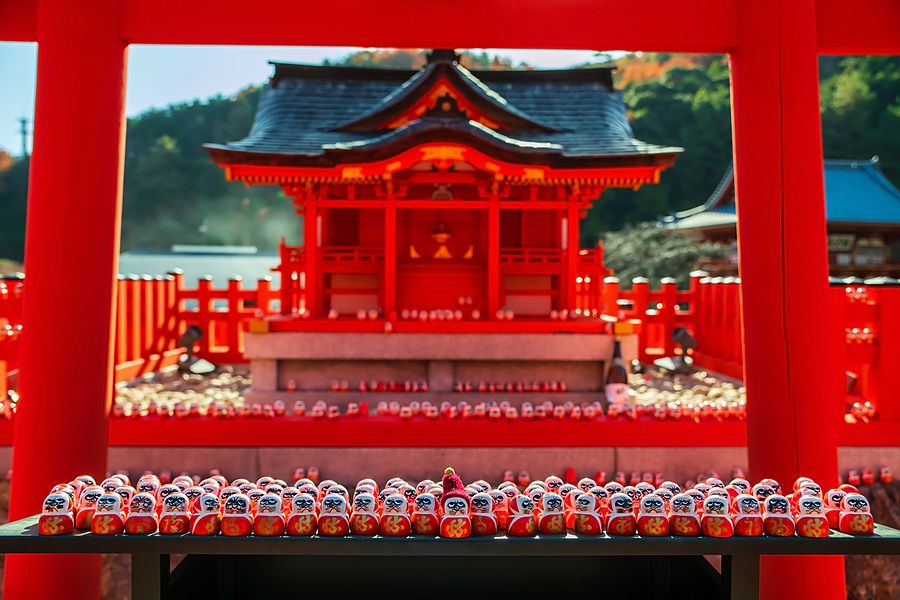
Taken one by one, the buildings won’t blow you away. If you’ve just come from Kyoto and seen pavilion after pavilion, the main hall and the pagoda will seem pretty standard. The reason to come all the way up here is the sheer number of daruma, the way they pile up, an invasion of little red faces that starts at the first step and never lets up.
Most people skip the upper part past the amulet counter. They stop in front of the main hall, buy their daruma and head back down. Keep climbing, because up there you’ll find only a handful of people and the noise suddenly drops.
Speakers scattered through the woods play sutra chanting throughout the grounds. I like it, but if you’re after the pure silence of the forest, you won’t find it here.
I go back every time someone comes to visit me after they’ve already done the classic temples, because it’s the only place I know where a six-year-old and a seventy-year-old wander around with the same look on their faces, hunting for daruma hidden in the walls as if it were a treasure hunt.
Why it’s the temple of victory
The temple’s roots go back a very long way. According to tradition it was founded in 727, when twin monks withdrew to this mountain to live as hermits.
Its name, though, comes from an emperor. The story goes that an abbot of the temple cured Emperor Seiwa, and the grateful emperor named it the temple that beat the king, because the monk had defeated his illness. Later, out of respect, the character for “king” was swapped for one that’s pronounced the same but means “tail.”
That story is where its reputation as the temple of victory comes from, and it’s why students come up here before exams, athletes before competitions, and anyone with a challenge ahead.
When to go
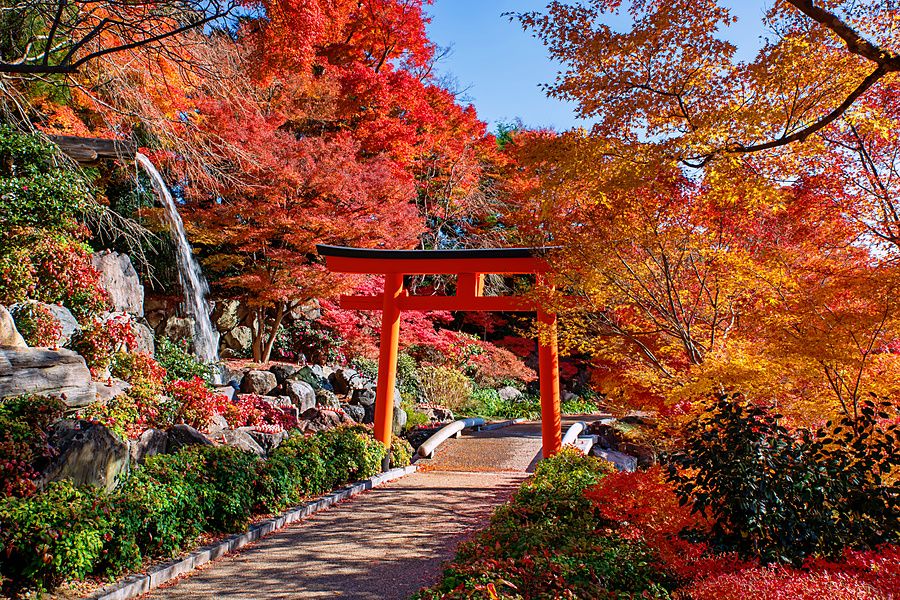
Fall is the best time, from mid-November to early December, when the maple forest around the temple turns red and orange and the mist from the bridge drifts through it. On weekends in November they light up the trees and the gate in the evening.
That’s also exactly when there are more people than the place can handle. You move up the stairs at a crawl, and you’ll wait in line a good while to get the right spot for the photo on the bridge. If you go during those weeks, go early in the morning on a weekday. It’s a completely different experience.
All the little daruma that visitors leave behind are collected once a year, around mid-December, and burned in a ritual bonfire before the end of the year. That makes a big difference to what you’ll see.
In early December the grounds are overflowing with them, at their absolute peak, while just after New Year’s you’ll find a clean, almost bare temple with the stones clear again. If you’re coming for the daruma, early December is the time to go.
The other seasons aren’t second best. In spring there are cherry blossoms and fresh green leaves coming in, in June hydrangeas line the paths, and in midsummer you can breathe easier up here than down in the city, even if the stairs in the sun take it out of you.
The place looks great in light rain, when the wet woods and the mist blend together. The only problem is the stone steps, which get seriously slippery.
Stairs and effort
You’ll be climbing, and a fair bit. From the entrance to the main hall there’s a long flight of stairs, plus shorter sets of steps linking one level to the next.
If you have bad knees or get out of breath easily, you’ll feel it. It’s not a mountain hike, but it’s not a flat stroll either.
The good news is that there are alternative sloped paths that avoid almost all the steps, and there are mechanical ways up to the main hall that skip the stairs. You can get around with a stroller if you follow the ramps instead of the staircases, and people with tired legs can still make it to the front of the main hall.
Seeing everything, though, still means going constantly up and down between buildings, and the best parts at the top can only be reached on foot. Wear regular shoes, not sandals.
With kids, it’s one of the best things I know of in the Osaka area. You buy the fortune daruma and decide where to put them, and meanwhile the kids run ahead looking for everyone else’s on the walls.
There’s also a spot where you can feed the carp in the pond, which as always is what keeps them in one place the longest.
Getting the best photo
The classic shot is the bridge at the entrance, with the mist rising from below. Stand with your back to the gate, wait for the mist to cover the water, then shoot. You can take it at any time of day since the mist is artificial, but it comes out much better in the low, slanting light of late afternoon.
In the fall, though, that spot is always taken, and you’ll have to wait your turn.
The other shot, which I’d take over the famous one, means getting down on your knees, close to the ground, in front of a cluster of little daruma in the cracks of a wall: red heads tilted every which way, piled on top of each other, with moss all around. It sums up this place better than any wide shot.
For the big picture, climb past the main hall and look back. From there you get the roofs one after another, the woods around them and the valley behind.
At a glance
- The highlight: thousands of red daruma in every corner of the grounds and stairs lined with votive ones.
- When to go: early morning on a weekday; early December for the most figures and maples that are still red.
- Best for: anyone who wants to get out of Osaka and walk among the trees, people traveling with kids, and anyone who’s already seen the classic temples and wants something different.
- Atmosphere: hillside forest, sutras from the speakers, incense, people searching the walls for little figures with their phones in hand.
The bottom line
You don’t come here for the architecture, and if you’re looking for a centuries-old hall straight out of a textbook, it’ll leave you cold. You come for something you won’t find anywhere else in Japan on this scale: an entire hillside covered in daruma, left there by people who asked for something or got it, with the forest all around.
It’s worth the detour out of Osaka, and I think even the fall lines are bearable. But if you hate climbing, noisy groups and things that are a bit theatrical, this isn’t the temple for you.
Getting There
The temple is up in the mountains, and without a car you get there by bus. From Umeda, take the Midosuji subway line, which runs straight through to the end of the line at Minoh-Kayano with no transfers. From there, take the direct Hankyu bus to Katsuo-ji, about 20 minutes of winding road through the woods.
You can also take a Hankyu bus from Senri-Chuo, but the ride is longer, a good half hour.
Buses only come every 20-30 minutes, and you'll need an IC card to pay. Before you go in, check the times for the return bus, especially in the late afternoon.
Useful Info
- Minoh-Kayano Station (Osaka Metro Midosuji / Kita-Osaka Kyuko): direct Hankyu bus, about 20 minutes
- Senri-Chuo Station (Osaka Metro Midosuji / Kita-Osaka Kyuko, Osaka Monorail): Hankyu bus, about 33 minutes
- Bus stop: Katsuo-ji, in front of the entrance
Map
This place is on MarcoMaps
Katsuo-ji Temple
My map of Japan: over 4,000 places I've tried myself, each with photos, rating, and hours. Filter by category and rating, find veg-friendly spots and places near you with GPS. No sign-up, right from your phone.
- 4,000+ places
- Rating, photos, and hours
- Veg friendly
- Near me (GPS)
- Favorites without login
- Works offline

