Kawachi Fujien Garden
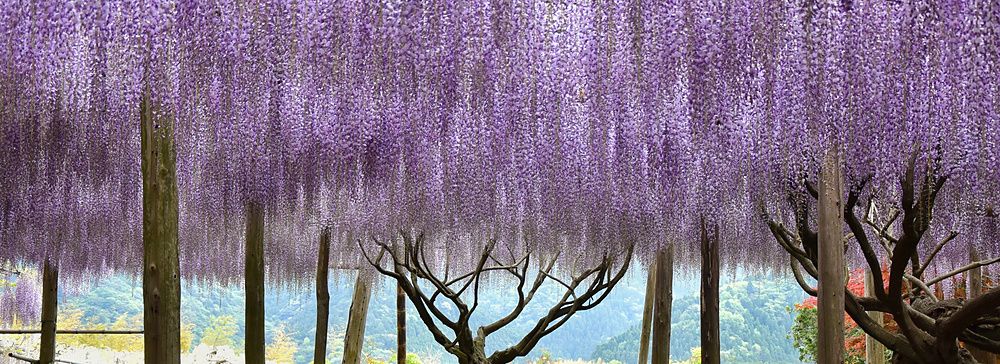
A private wisteria garden in the hills of Kitakyushu, Fukuoka, where you walk beneath two tunnels of hanging flowers that run from white to deep purple. Kawachi Fujien Garden is known for those tunnels and for a huge trellis that you look down on from above, with the clusters hanging like curtains. There’s more inside, though: a wisteria dome you can step into, and a maple forest that gives you a second reason to go in November.
It’s the right place if you have a free day in Kyushu during the bloom and want to see something unlike anything else in Japan. If you have trouble walking, be aware that the paths go uphill and are unpaved.
Contents
What you’ll see
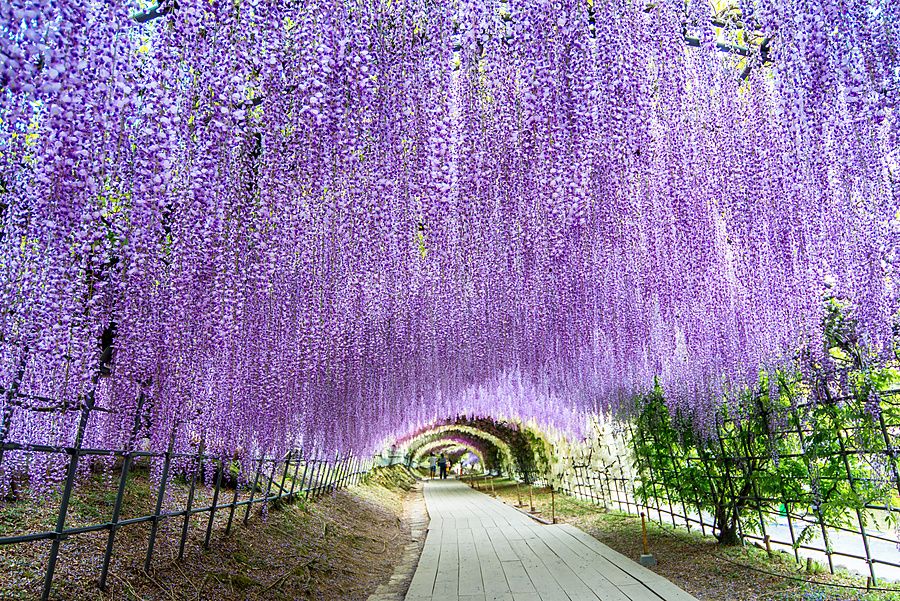
- The 110-meter tunnel: the more famous of the two, with clusters hanging down to head height and colors that keep shifting as you walk, because each stretch is planted with a different variety.
- The 80-meter tunnel: shorter, narrower and less mobbed, and for me the better of the two if you’d rather look at the flowers than at someone’s back.
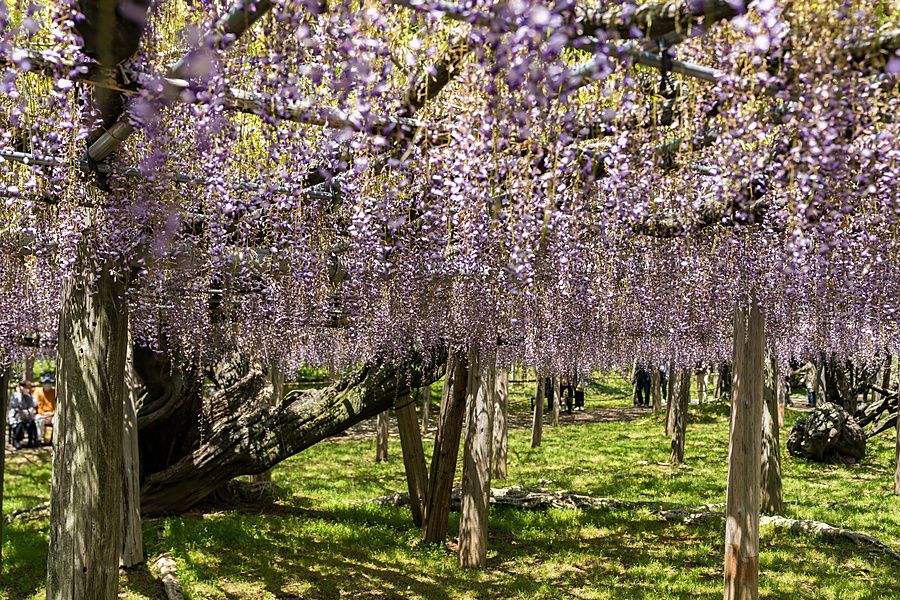
- The big trellis: a roof of wisteria over an enormous area, held up by low posts, where you stand with the flowers almost brushing your hair.
- The wisteria dome: a round structure you step into, and when you look up there’s no sky, only clusters on every side.
- The viewpoint: from the hillside you can see the whole trellis from above, surrounded by bamboo in the valley.
- The maple trail: about 700 trees, a red tunnel on the slope and, once the leaves start to fall, a path covered in red.
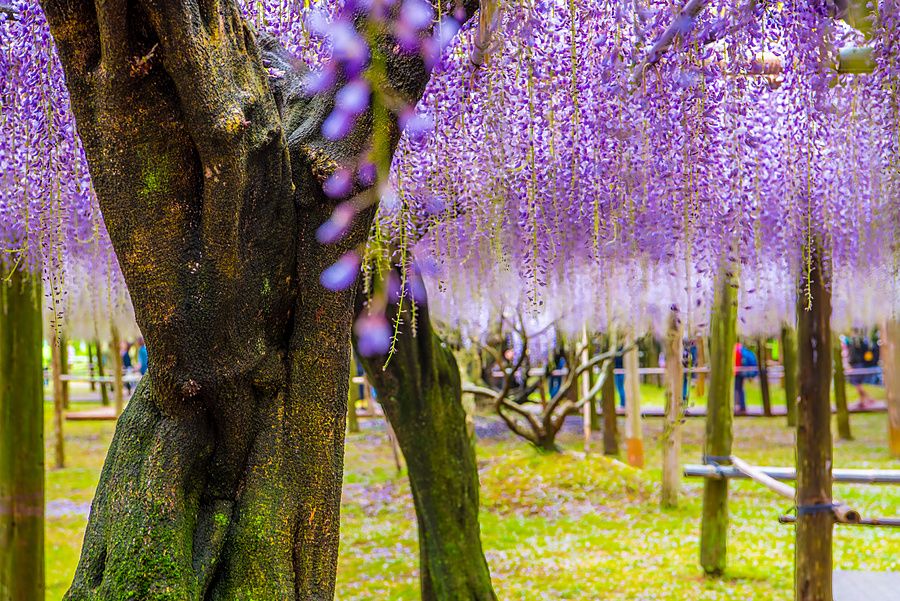
The big tunnel ends sooner than you’d expect. The photos going around make it look like an endless road, but it’s just a corridor and you’re through it in no time. The real payoff is somewhere else: the trellis seen from above. That’s where you realize how wide it is, and the people lining up for photos in the tunnel never even make it up there.
The twenty-two varieties don’t all bloom at the same time. The full range of colors, white to pink to lilac to purple all at once, doesn’t last long at all, and you only get it if you hit the right day. On other days you’ll still see a gorgeous tunnel, just not every color together. To me, that’s the most useful thing to know before you go.
I go back as soon as the wisteria comes out, and again in November for the maples, because it’s the only garden I know where the color is above your head instead of in front of you. After five minutes under the trellis you go quiet without realizing it. The scent is strong, not delicate, and you can smell it before you even reach the flowers. If you happen to be in Kyushu while it’s in bloom, I’d put it ahead of anything else that day.
When to go
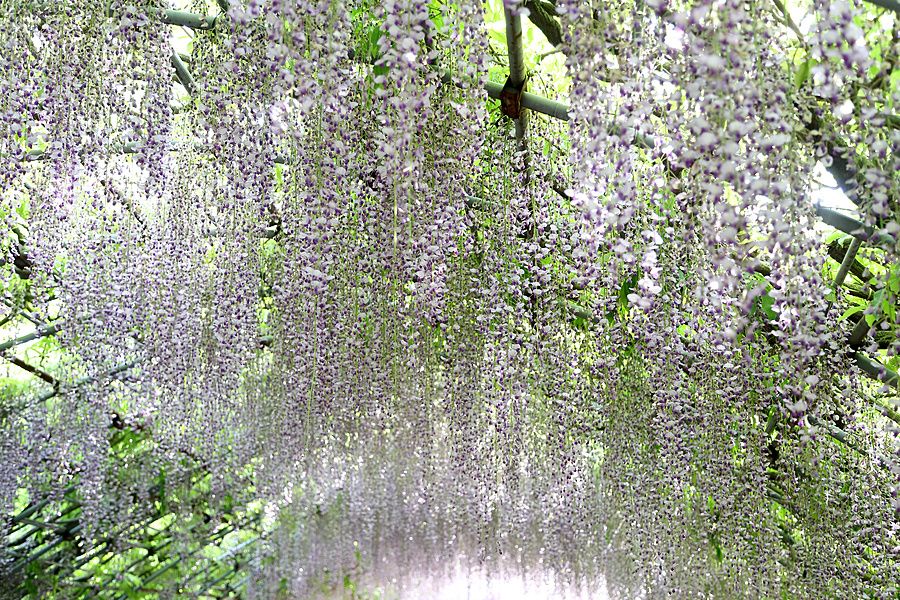
Early in the morning it’s a different garden. If you get there at opening time, you can walk through the tunnel without stopping, with low light filtering through the clusters and, at most, the voices of a few families with kids.
By mid-morning everything changes. You shuffle through the tunnel in a slow line, with people stopping every few steps to have their picture taken and groups of foreign visitors handing each other their phones. It’s not the end of the world, but you end up seeing flowers above you and heads in front of you.
By late afternoon it empties out again, and that’s my favorite time after first thing in the morning.
The difference between weekdays and weekends is huge. Peak wisteria season runs from late April into early May and overlaps with Golden Week, so if you can, go in the days before it: the flowers are already out and there are half as many people.
The second window is mid-November to early December, when people come for the maples. This time it’s not about the wisteria at all, and the garden turns into a red forest on the hillside.
In heavy rain, don’t bother. The clusters get weighed down, the wooden walkways under the tunnels turn into a skating rink, and the view of the trellis from above disappears into the gray.
How much walking it takes
This isn’t a city park, it’s a hill. The main path climbs, the ground is packed dirt in several places, and there are steep stretches where you’ll want closed-toe shoes with decent soles.
In spring, the climb that’ll leave you most out of breath is the one up to the viewpoint above the trellis. It’s only a few hundred meters, but it’s a steady incline and the handrail doesn’t run the whole way.
In the fall, the maple trail is the toughest of all: a 250-meter climb to the top on what’s basically a mountain trail. In the wrong shoes, you’ll give up halfway.
It’s hard going here with a stroller or a wheelchair, so bring a baby carrier if you have a little one. If your knees aren’t great, you can stop at the tunnels and the trellis, which are in the lower section and are the most beautiful part anyway. The viewpoint is a bonus, not a must.
The best photos
There are two, and they’re not the same kind of shot. For the first, you go inside the tunnel and kneel or hold your phone low to catch the clusters closing in overhead. You’ll wait in line for that one, because everyone wants it with nobody in it and some people stay planted there for ages.
The second is from the viewpoint above the trellis. From up there you see the whole roof of flowers at once, and the people underneath look tiny.
The best light is early in the morning or late in the afternoon. At noon the sun beats straight down and the colors in your shots look washed out.
The short version
- Highlights: the two wisteria tunnels and the trellis seen from above.
- When to go: early morning or late afternoon, on weekdays, late April to early May for the wisteria and late November for the maples.
- Best for: people in Kyushu in the right season who want to see something unique, photographers, and anyone who doesn’t mind a bit of a climb.
- Atmosphere: a cultivated hillside, a strong scent of flowers, silence at dawn and an orderly line by mid-morning.
Is it worth it?
You come here to walk through the wisteria, not to look at it from behind a railing, and there are very few places in Japan where you can do that on this scale. Don’t come for monuments, scenery or an easy stroll, because you won’t find any of those here. It’s worth a detour, even a long one, if you catch the right two-week window and don’t mind getting up early. Outside that period there’s nothing to see, apart from the maples in November. And if you hate crowds and can’t go on a weekday, you may end up remembering the line more than the flowers.
Getting There
The garden is up in the hills and no public transportation goes all the way to the entrance. The easiest option is a taxi from JR Yahata Station, about half an hour's drive.
By public transportation, take Nishitetsu bus 56 from Space World Station to the Kamishigeta stop. From there it's almost an hour of walking uphill.
If you're driving, there's free parking near the entrance.
Useful Info
Maple season: around 500 yen
Children: up to 2 children under 12 free with each adult
- JR Yahata Station (JR Kagoshima Line): then taxi
- Kamishigeta bus stop (Nishitetsu bus 56 from Space World Station): then about 50 minutes on foot
Map
This place is on MarcoMaps
Kawachi Fujien Garden
My map of Japan: over 4,000 places I've tried myself, each with photos, rating, and hours. Filter by category and rating, find veg-friendly spots and places near you with GPS. No sign-up, right from your phone.
- 4,000+ places
- Rating, photos, and hours
- Veg friendly
- Near me (GPS)
- Favorites without login
- Works offline

