Kiba
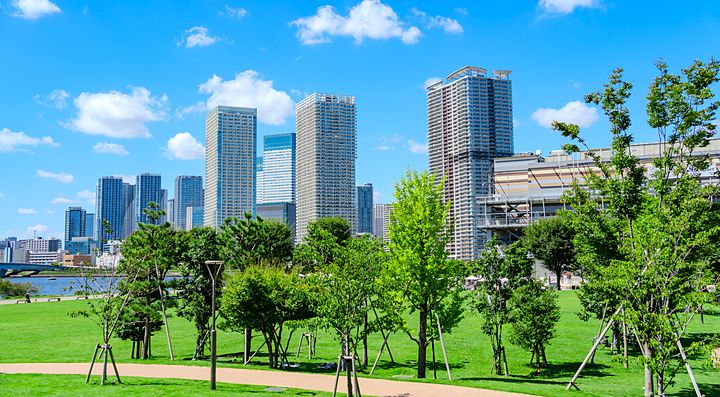
Kiba is the quiet side of Tokyo, east of the Sumida River, where you can walk without hurrying and find yourself surrounded by greenery just steps from a major museum. The name means lumberyard, and for centuries that’s exactly what it was: the place where logs arrived to build the city.
The lumber is long gone, and in its place there’s a huge park and one of the largest contemporary art museums in Japan. I like coming here when I want some breathing room away from the crowds of Shibuya or Shinjuku, and I usually recommend it to anyone who wants to see what everyday Tokyo is like.
Contents
Nearby neighborhoods

The park and the bridge
Kiba Park is seriously big. It’s split into three sections, north, central, and south, linked by a suspension footbridge you can spot from far away. The Sendaibori Canal runs underneath, and on clear days you can see the Skytree poking up above the trees from the bridge.
There’s a bit of everything here: wide lawns where families spread out their blankets, tennis courts, a botanical garden, and playgrounds for kids. The Museum of Contemporary Art Tokyo is in the north section. It’s one of the largest in the country, with enormous galleries and exhibitions that change often. The botanical garden is down in the south section, and it’s the park’s big surprise. You’ll find Japanese-style and Western-style areas, well-kept flower beds, and an indoor pavilion with a kids’ area and a small exhibition room, which comes in handy when the weather turns. The dog run and the barbecue area are nearby too, and it’s obvious right away that locals use this park more than tourists do.
I’d suggest coming during the day and taking your time, because this is a place to enjoy slowly. Have a coffee, walk through the park, see the museum, and half a day just slips by. In the evening there’s no nightlife. The lights dim, and all that’s left is the occasional runner along the canal.
Inside the museum
The Museum of Contemporary Art Tokyo, which everyone calls MOT, is the reason a lot of people come all the way out here, and it’s worth the trip even if contemporary art isn’t your thing. The collection has more than 5,000 works, almost all of them postwar: 20th-century Japanese art, big international names, and installations that fill entire rooms. Only part of it is on display at a time, in rotation, so you’ll find something different on every visit.
Alongside the collection there are always two or three temporary exhibitions, and that’s what brings Japanese visitors out here on weekends. The building is worth seeing too. It’s made of concrete and glass, the corridors are very long, and there are artworks even in the spaces you just walk through. I wander around at my own pace, because rushing through this place makes no sense.
Logs on the water
The name Kiba tells you everything about what used to be here. Starting in the Edo period, logs came in by water to build the city, and lumber merchants kept them soaking in ponds to sort and season them.
When the industry moved farther east, the ponds were filled in, and the museum now stands on one of them. What’s left of that past is a tradition worth knowing about: kakunori, the art of keeping your balance on a floating square log while doing spins with your feet.
It started as the way workers moved lumber across the water. Today it’s an acrobatic show you can watch in the park during Koto’s neighborhood festival, around mid-fall. Crowds pack in around the pond, and some performers even manage to plant a pole while standing on the log.
I’ll be honest, it’s not something you’d expect in a city like Tokyo, and it’s one of the reasons I like this area.
Cherry blossom season
In spring the park looks completely different, and the best spot is the bridge again. From up there you look down on the rows of cherry trees along the Sendaibori Canal, a view you’d never get from the ground.
The great thing is that cherry blossom season here lasts a long time, because there are so many varieties. The kawazuzakura kick things off as early as February, then come the someiyoshino and the weeping cherries, and finally the double-flowered yaezakura, which keep the season going well into spring. It’s hanami without the crowds, just local families sitting on their blankets, a world away from the crush at Ueno.
Getting There
You can cover the whole area on foot, and where you start depends on where you're staying. From Kiba Station on the Tozai Line, take Exit 3. The park starts less than five minutes away, and the Museum of Contemporary Art Tokyo is about fifteen minutes on foot, along wide, flat streets with no hills or stairs.
If you're on the Hanzomon or Oedo Line, get off at Kiyosumi-shirakawa and use Exit B2. The museum is under ten minutes away, and it's the best way to combine the coffee roasters of Kiyosumi with a walk in the park.
If you're on the Shinjuku Line, get off at Kikukawa, Exit A4, and walk a good fifteen minutes.
Useful Info
Name: Kiba
Time needed: Half a day: a couple of hours for the park, the bridge, and the canal, and the same again if you go into the museum
Closed: The park is always open, but the Museum of Contemporary Art Tokyo is closed on Mondays (Tuesday when Monday is a public holiday), between exhibitions, and over the New Year break. The botanical garden and its pavilion are also closed on Mondays.
Tips: The museum's art library is free to use, no ticket needed. It has catalogs, magazines, and armchairs, so it's the perfect midday break. And if you're in the area in mid-October, keep an eye out for the neighborhood festival, because that's when you can see kakunori on the water.
Getting there:
- Kiba Station (Tokyo Metro Tozai): Exit 3
- Kiyosumi-shirakawa Station (Hanzomon, Toei Oedo): Exit B2, the most convenient for the museum
- Kikukawa Station (Toei Shinjuku): Exit A4
Map
MarcoMaps100% free
This place is on MarcoMaps
Kiba
My map of Japan: over 4,000 places I've tried myself, each with photos, rating, and hours. Filter by category and rating, find veg-friendly spots and places near you with GPS. No sign-up, right from your phone.
- 4,000+ places
- Rating, photos, and hours
- Veg friendly
- Near me (GPS)
- Favorites without login
- Works offline

