Kinchakuda
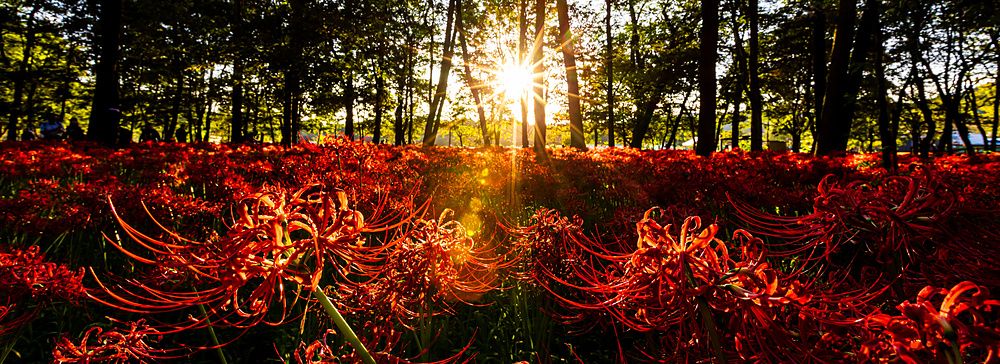
A patch of woods in the Saitama countryside where the forest floor turns completely red at the end of September, when five million higanbana come into bloom. These red spider lilies push up out of the ground bare, with no leaves. Kinchakuda, in Hidaka, is a pocket of flat land tucked inside a bend in a river, and the flowers grow under the trees instead of out in an open meadow. That’s what sets it apart from any other flower field.
There’s also a cosmos field and a wooden footbridge over the river. If you have a free day in autumn, this is the day trip I’m happiest to recommend, and it works for small children too.
What you’ll see
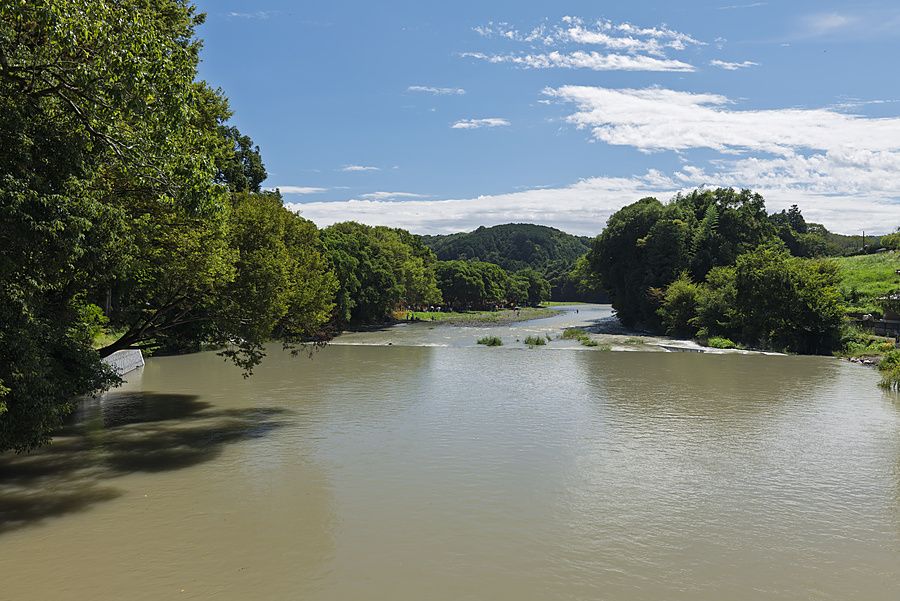
The Koma River swings around in a huge bend that almost closes back on itself, and inside it there’s a flat area about 500 meters across. The woods with the flowers cover five and a half hectares of it. The rest is fields, lawns, and paths along the water.
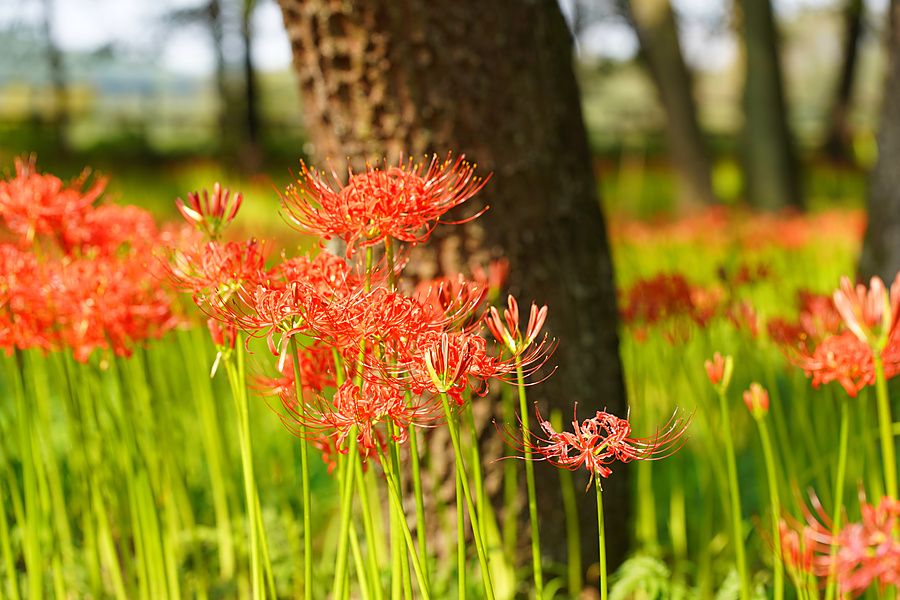
- The red woods: five million higanbana under slender trunks and high branches, with bare earth and dry leaves still showing between the clumps. The light comes through in patches, so the red shifts from one spot to the next.
- The upstream and downstream sections: the river cuts the field in two, and the two halves don’t bloom at the same time.
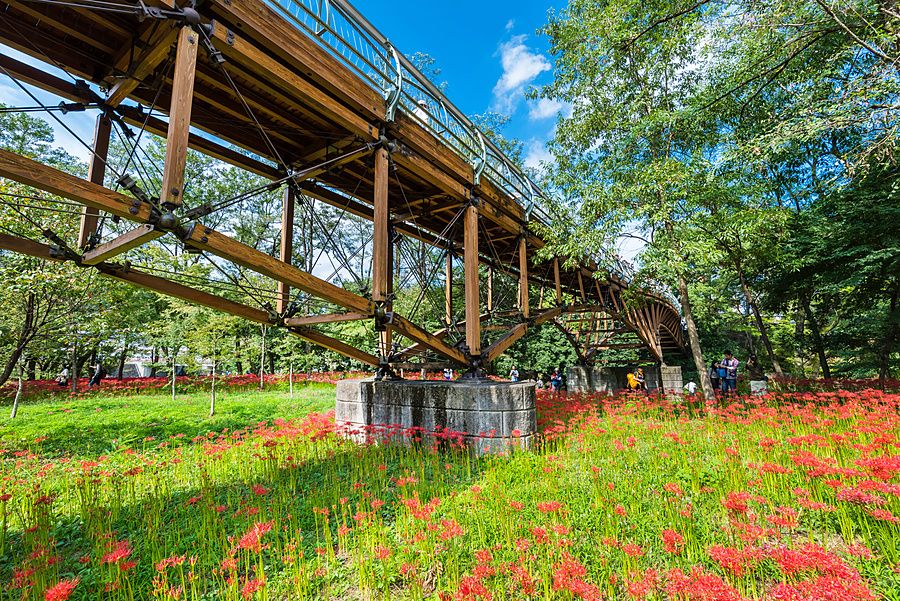
- Aiai Bridge: a pedestrian-only wooden footbridge just over 90 meters long, one of the longest truss bridges in Japan. From up there you look down on the river and the edge of the field.
- Doremifa Bridge: it isn’t a real bridge but a row of concrete blocks set in the river, and you cross by hopping from one to the next. The water is shallow and you can see the bottom.
- The cosmos field: about a hectare of pink, white, and magenta blooms that open just as the red flowers start to fade.
- White higanbana: there are only a few, scattered among the red ones. Spotting one turns into a game as you walk.
The first thing to know is that the two halves of the field can trip you up. The photos you see online almost always show one half at peak bloom, and there are only a handful of days when upstream and downstream are both in flower. You can easily show up to find one half already over and the other not yet in bloom. It’s not a disaster, because even half a field is a lot, but it’s better to know beforehand so you’re not disappointed.
Up close, the red carpet also isn’t as perfect as it looks in pictures. There are gaps and thinner patches, and toward the end of the bloom the spent flowers turn dark and a bit ragged. You get the real effect by looking out across the field at flower height, not straight down at your feet.
And from inside, you can’t see the purse shape that gives the place its name at all. It only makes sense from above, from Hiwadayama, the small hill right next to it, where you can see the river tracing the purse’s drawstring. If you go expecting to sense the shape while you walk around, it won’t happen.
All that said, it’s one of those places that delivers more than it promises. You’ll find the flower itself in clumps along any riverbank in Japan at that time of year. What makes the difference here is the woods: a higanbana field this big growing under trees is rare, and moving ten meters changes what you see completely. I come back every year around the same time, and it’s the one trip I always do exactly the same way. I take the inner path, walk slowly, and listen to the river behind the trees while everything in front of me is red. When people come to visit me in autumn, I bring them here before any temple.
This used to be rice paddies, and the bulbs arrived on their own, carried in by the river’s floods. Nobody planted them in rows, which is why the field looks messy in just the right way.
When to go
The time to go is around the autumn equinox. Red dots start appearing on the ground in mid-September, full bloom arrives toward the end of the month, and in October you still have the downstream field plus the cosmos. The window is short and moves from year to year depending on the heat, so check how the flowers are doing before you set off instead of picking a date a month ahead.
On holidays and peak-bloom weekends there’s a line of people along the path, and you shuffle forward staring at the backs of the people in front of you. Even getting there at first light won’t save you, because on those days it’s already packed at dawn. On weekdays it’s a different place: you’ve got room, with local men carrying their collapsed tripods and school groups hurrying through.
Early morning is the best time of all, because the low sun comes in sideways between the trunks and lights the petals from behind. By mid-afternoon the light goes flat and the field loses half its punch.
The most useful thing I can tell you is that the place loses a lot of its impact under cloudy skies. Without sun the red is still red, but it looks flat, and all the light and shade between the trees disappears. Rain makes it worse: the paths in the woods turn to mud and the flowers get flattened into the ground.
Outside bloom season it’s a riverside park with mowed grass, cherry trees in spring, and a yellow rapeseed field. It’s a nice place to take kids for an afternoon, not somewhere to plan a trip around.
Walking around
It’s completely flat, without a single step. The main paths are wide and packed down, and strollers and wheelchairs have no trouble on the outer loop and the wooden bridge.
The woods are a different story. The ground there is bare earth with roots sticking out, and in a few narrow spots you have to go single file, so pushing a stroller or wheelchair through is hard work. Closed-toe shoes, not sandals.
There’s a fair amount of walking, since seeing both the upstream and downstream halves means doing the whole loop, but it’s easy walking with no climbs. In the woods you’re in the shade and it’s a few degrees cooler. There isn’t a single tree on the cosmos field or along the river, though, and at the end of September, if the heat hasn’t broken yet, you feel it on that stretch. Bring a hat and water.
The flowers start right at the edge of the path, behind low ropes, so with small kids there’s only one rule: hold their hand and stay in the middle. Their reward is the river, where they can dip their feet.
During the bloom there are food stalls selling local food near the entrance and the central open area, and there’s something going on onstage almost every day. It’s not why you come, but something hot to eat after the walk goes down well.
The best shot
The easiest spot is Aiai Bridge, where you get the curve of the river with the edge of the red field behind it. It’s also the only place where everyone bunches up, so wait your turn at the railing.
The photo that really captures this place, though, is a different one, and you take it in the woods. Get down almost to the ground and shoot toward the sun: the petals turn translucent, and the dark trunks run through the frame like vertical stripes. Without backlight all you get is a red blob.
During the bloom, tripods aren’t allowed inside the field area, and neither are monopods. If you want long exposures among the trees, you’ll have to rely on steady hands and whatever you can lean on.
The other issue is people in your shots. In the middle of the day on a holiday there’s no way to get the path empty, while early on a weekday morning you’ll have whole stretches to yourself.
At a glance
- The highlight: millions of red spider lilies blooming under the trees, with sunlight coming through the branches.
- When to go: around the autumn equinox, on a sunny day in the morning light, avoiding holidays.
- Best for: anyone looking for an autumn day trip out of the city, even with kids or grandparents along, and anyone into photography.
- Atmosphere: cool woods, earth and dry leaves under your shoes, the river close by, and lots of polite people walking slowly.
Conclusion
There are about ten good days a year, and you come for one thing you won’t find anywhere else. It isn’t the flower, which blooms across half of Japan in autumn, but the flower in the woods, with the sun shining through it. It’s worth the detour, no question, if you get there in the right window, under clear skies and on a weekday. If you can only go on a Sunday at peak bloom, expect to see a lot of heads with a bit of red in between. And if the bloom is already over, skip it and save it for next year, because once the flowers are gone all that’s left is the grass and the river.
Useful Info
Map
This place is on MarcoMaps
Kinchakuda
My map of Japan: over 4,000 places I've tried myself, each with photos, rating, and hours. Filter by category and rating, find veg-friendly spots and places near you with GPS. No sign-up, right from your phone.
- 4,000+ places
- Rating, photos, and hours
- Veg friendly
- Near me (GPS)
- Favorites without login
- Works offline

