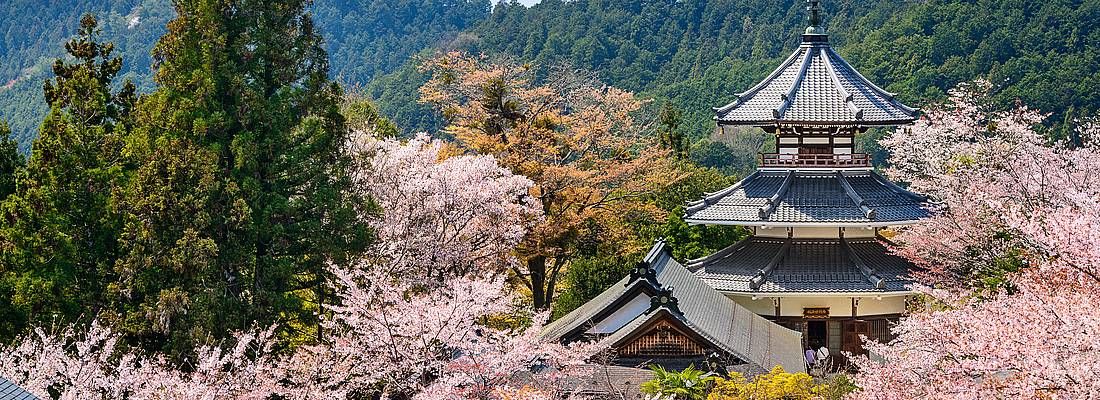
Kinpusenji Temple
Surrounded by the sea of cherry trees that covers the slopes of Mount Yoshino, Kinpusenji Temple is one of the most important sacred sites in the area and the main center of Shugendo. This ancient religious practice blends elements of Buddhism and Shinto, and at its core it’s about worshiping the mountains and nature.
Contents
The legend of En no Gyoja
Kinpusenji’s story begins in the 7th century with En no Gyoja, the ascetic regarded as the founder of Shugendo. According to tradition, after a long period of practice on the summit of Mount Omine, he was visited by Zao Gongen, a deity powerful and fierce enough to save people in a troubled age.
En no Gyoja is said to have carved the deity’s image in cherry wood and worshiped it both on the mountaintop and here in Yoshino. According to the legend, that’s how Yoshino’s connection with cherry trees began: for centuries, the faithful planted them as offerings to the deity.
Shugendo followers train body and mind through meditation and pilgrimages along mountain trails, and every summer plenty of pilgrims and worshippers still stop at Kinpusenji Temple before heading into the mountains. The temple is a UNESCO World Heritage site, and if you’re visiting Mount Yoshino I’d encourage you to come here to learn about its long, fascinating history and see some of its treasured buildings, like the main hall, the second-largest wooden structure in Japan.
Visiting Kinpusenji Temple
At the heart of the complex is that main hall, the Zao-do, the temple’s main prayer hall. It’s a massive cedar building 34 meters tall, and only the hall at Todaiji Temple in Nara is bigger. Take a close look at the pillars holding it up: many are trunks from different kinds of trees, left almost in their natural state, and one of them is a famous pillar made of azalea wood. The hall is designated a National Treasure.
The Zao-do was built in the late 1500s and houses three statues of Zao Gongen, who is one of the most important deities in Shugendo because he embodies the three Buddhas of the past, present, and future. These three monumental sculptures date from around 1590 (the central one is about 7 meters tall), and they’re kept as hidden images. To protect them, the temple keeps them behind closed doors for most of the year and shows them to the public only during special viewings, usually during certain periods in spring and fall.
Zao Gongen is considered the protector of the sacred mountains around Yoshino, which is why many pilgrims stop at the temple before setting out on one of the sacred routes through the mountains, such as the Mount Omine trail.
The blue Zao Gongen statues
If you’re lucky enough to be there during a special viewing, you’ll find yourself facing three giants, each with deep blue skin, hair standing on end, a furious face, and one leg raised as if about to kick. The central statue is over 7 meters tall and the two on either side are over 5 meters tall. They’re housed in Japan’s largest Buddhist altar.
Don’t let their terrifying look fool you. The blue stands for the Buddha’s great compassion, and the fury is there to drive away evil and protect the faithful. From left to right, the three figures represent the past, the present, and the future.
Some worshippers, and some visitors curious about Shugendo practices, especially those that test physical and mental endurance, take part in workshops held at the temple at various times during the year.
A visit to the temple is also a great chance to get out into nature on Mount Yoshino and see the cherry trees in bloom in spring or the warm colors of fall, which make this sacred place feel even more magical.
Getting There
From Kintetsu Yoshino Station, it's about a 3-minute walk to the Yoshino Ropeway, which takes you up the mountain in a few minutes. From the upper station, the temple is about a 10-minute walk along the main street, which is lined with shops.
Outside cherry blossom and fall foliage season, the ropeway doesn't run on Tuesdays, Wednesdays, and Thursdays. On those days there's a replacement bus, or you can walk up from the station, which takes about 30 minutes uphill.
Useful Info
During the special viewing of the statues: adults 1,600 yen, students 1,200 yen, children 800 yen
- Kintetsu Yoshino Station (Kintetsu Yoshino Line)
- Yoshino Ropeway: Yoshinoyama upper station, then a 10-minute walk
Map
This place is on MarcoMaps
Kinpusenji Temple
My map of Japan: over 4,000 places I've tried myself, each with photos, rating, and hours. Filter by category and rating, find veg-friendly spots and places near you with GPS. No sign-up, right from your phone.
- 4,000+ places
- Rating, photos, and hours
- Veg friendly
- Near me (GPS)
- Favorites without login
- Works offline

