Kirishima Onsen
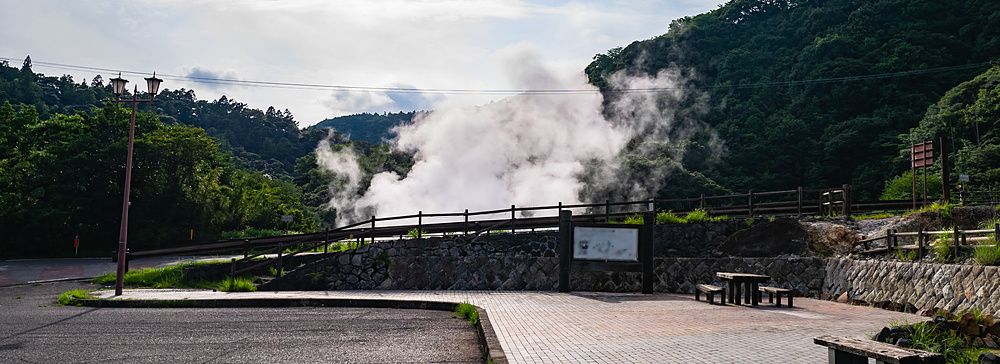
One of the best-known and oldest hot spring areas in Japan, set at the foot of the Kirishima mountain range. Kirishima Onsen is a quiet little town steeped in Japanese tradition and a great place for a completely relaxing vacation. You can alternate soaks in the hot springs with hikes on the local trails, which lead up to viewpoints over Kagoshima Bay and the island volcano of Sakurajima.
Contents
Relaxing in the onsen
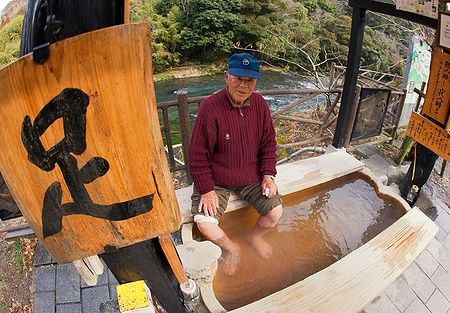
Kirishima Onsen is famous above all for its high-quality sulfur springs, which are good for both your body and your skin. A few hours in an onsen will leave your skin silky smooth and soothe your muscles after a day of hiking in the surrounding mountains. The hot spring area covers quite a lot of ground and is made up of separate small onsen villages. The largest is Maruo Onsen, which has a wide choice of ryokan and hotels. Together these villages are called Kirishima Onsenkyo, and between them they have almost ten different springs scattered through the woods, from Iodani to Shinyu and from Yunotani to Sekihira. Each spring has its own mineral composition, so the water changes from village to village. Try at least two during the same stay, say a sulfur one with that classic rotten-egg smell and a gentler one, and you’ll feel the difference on your skin.
You can have a relaxing soak in an onsen either by staying at one of the local ryokan or by going to a public bathhouse. Many ryokan also let non-guests use their baths for a small entrance fee. Here are some of the best ryokan and public baths in Kirishima Onsen:
Hotel Kirishima
Hotel Kirishima has one of the most unusual bathhouses in Japan. The baths fill a huge hall under a glass roof, with a large communal bath decorated with a fountain and patches of greenery meant to recreate a Japanese garden, plus several smaller pools set around the main one. A small section of the bath is for women only, and for part of the evening the whole hall is women-only.
Shinyu
Shinyu is a simple public bathhouse with traditional wooden interiors. It’s nothing fancy, but it has plenty of nostalgic charm, and it’s one of the bathhouses locals like best. It has a mixed-gender outdoor rotenburo with views of the surrounding landscape, plus several small indoor pools separated by gender.
Sakura Sakura
This remarkable public bathhouse belongs to the ryokan of the same name and has indoor and outdoor baths separated by gender. Its best-known feature, though, is the slightly radioactive mud brought in from a nearby hot spring: you spread it on your skin, leave it for a few minutes, then get into the hot water.
Ryokojin Sanso
A small, traditional-style ryokan known for the amazing views you get from its outdoor rotenburo. It also has an indoor bath and a sauna.
Hotel Kirishima Kokusai
A large, modern complex with two bathhouses separated by gender, each with several indoor baths and outdoor rotenburo.
Which village to stay in
Kirishima Onsen isn’t a single town but a cluster of hot spring villages scattered through the forest, and where you sleep makes a real difference to your trip. Maruo Onsen is the most convenient choice: it has the biggest concentration of ryokan, hotels and shops, plus the market, and it’s the best base if you don’t have a car.
If you’re after total quiet and an old-fashioned feel, go for the more isolated springs like Shinyu, surrounded by greenery up in the mountains. You eat dinner at the ryokan, there’s nothing around, and that’s exactly the point. One last thing worth paying extra for, if it comes to that: some places look out over the valley and give you views of the bay and Sakurajima right from the rotenburo, so pick one of those if you can.
A samurai honeymoon spot
Kirishima Onsen also has some romantic stories from the past. In Japan it’s famous as the place where the samurai Sakamoto Ryoma and his wife Oryo spent their honeymoon. Ryoma had survived an assassination attempt and chose Kirishima to rest and recover from his wounds. He later said he owed his quick recovery to Kirishima’s healing waters.
“Hot spring” food
The Kirishima Onsen market, near Maruo Onsen, is the place to try the local food, including snacks and sweets cooked with steam from the springs, like eggs, sweet corn and mochi rice cakes.
Hiking around Kirishima
The whole area around Kirishima Onsen is great for hikes and walks, with natural and cultural stops you shouldn’t miss, like the popular Maruo Falls and the revered Kirishima Shrine.
The Kirishima mountains that surround the town have some of the most fascinating volcanic scenery in Japan, with lots of craters and volcanic lakes that make for mysterious, moonlike landscapes. There are several good hiking routes if you’re traveling between spring and fall, since snow can close some of the trails in the winter months.
The best-known route is the Kirishima Ridge Trail, which follows the whole Kirishima range from the mountain town of Ebino Kogen, not far from Kirishima Onsen, to the Takachiho-gawara Visitor Center: about 12 kilometers and six hours on foot. You can’t walk the full traverse, though. The middle section, which crosses Mount Shinmoedake, is closed because of volcanic activity. Shinmoedake is well known to James Bond fans because scenes from one of the movies were shot here. The trails up Mount Karakunidake, Kirishima’s highest peak, and to the small volcanic lake of Onami-ike are still open and get plenty of hikers. Before you set out, check which restrictions are in place.
If you’re fit and have the time, you can keep going for another hour and a half from the Takachiho-gawara Visitor Center to the nearby summit of the sacred Mount Takachiho-no-mine, known as much for its mythology as for its scenery. The mountain is tied to several myths about the creation of Japan, and it’s said that this is where Ninigi no Mikoto, grandson of the Sun Goddess, came down to Earth to found the line of Japanese emperors and rule the land. Planted on the summit is the Amanosakahoko, a bronze halberd that legend links to Ninigi no Mikoto’s descent. Nobody really knows how long it’s been there, and they say anyone who tries to pull it out brings down the wrath of the gods. Sakamoto Ryoma actually tried it on his honeymoon: he pulled it out of the ground and then told the story in a letter to his sister.
The final climb is on volcanic gravel that slides under your feet. You’ll need proper hiking boots, and you should expect it to be harder work than the elevation gain suggests.
While you’re here, take the time to soak up the mysterious natural beauty of Kirishima. The area is part of a national park with more than twenty mountains, and the island volcano of Sakurajima is another highlight of the park.
Kirishima through the seasons
Every season at Kirishima Onsen has its own colors. Spring brings alpine flowers, summer thick, bright green vegetation and fall fiery red leaves, while winter brings heavy snowfall, the perfect backdrop as you sink into the hot water of an onsen.
Drinks and souvenirs
A trip to Kirishima Onsen is a great chance to try some of the local specialties and pick up products from the area to take home as souvenirs. One is shochu, made by many distilleries in the area. Another is Kirishima green tea, which stands out for its intense aroma and exceptionally good flavor, both thanks to the region’s climate. There’s also Sekihira mineral water, which is very pure and wells up from deep in the Kirishima mountains. Legend has it that samurai discovered it in 1832, guided by a revelation from the gods.
Getting There
The easiest way in is through Kagoshima Airport. Direct buses leave from the stops outside arrivals and get you to Maruo Onsen, the main village of the hot spring area, in just over half an hour.
If you're coming by train from Kagoshima, get off at Kirishima-Jingu Station (sometimes with a transfer at Hayato) and take the bus that climbs first to the shrine and then on to Maruo, another half hour of uphill curves.
The hot spring villages are scattered through the forest and buses don't run often. If you want to move freely between baths, waterfalls and trails, it's worth renting a car and picking it up right at the airport.
Useful Info
In winter, snow and ice can make some mountain trails impassable, and the stretch of the ridge that crosses Shinmoedake is closed because of volcanic activity.
- Kagoshima Airport (bus to Kirishima): Maruo Onsen stop, about 35 minutes
- Kirishima-Jingu Station (JR Nippo Line): bus to Maruo Onsen via the shrine, about 30 minutes
- Day pass: the Kirishima Nottari Oritari My Plan is valid on local buses
Map
This place is on MarcoMaps
Kirishima Onsen
My map of Japan: over 4,000 places I've tried myself, each with photos, rating, and hours. Filter by category and rating, find veg-friendly spots and places near you with GPS. No sign-up, right from your phone.
- 4,000+ places
- Rating, photos, and hours
- Veg friendly
- Near me (GPS)
- Favorites without login
- Works offline

