Kusatsu Skyland Hotel
A hot spring hotel in the upper part of Kusatsu, the onsen town in the Gunma mountains, set among the trees and away from the crowds around Yubatake, the hot spring at the center of town. The Kusatsu Skyland Hotel is known for its baths made of hinoki wood and filled with Kusatsu’s acidic water, and for a dinner in the dining room that takes up the whole table.
It’s the right place for a couple who want a night at a real onsen, for a family whose kids are trying a hot spring for the first time and, in winter, for skiers who just want a scalding bath and a big dinner at the end of the day.
Rooms
The hotel comes in two styles. The main building has classic Japanese rooms with tatami, a low table and a futon for the night, while the Seifutei wing has more modern rooms with real beds, themed decor and, in some cases, a bathroom with a tub.
All rooms are non-smoking and come with fast Wi-Fi, a TV, a kettle and tea, and an empty fridge for whatever you bring along. There’s a yukata for everyone, kids’ sizes included.
These are the rooms you can choose from:
- Japanese-style room: ten tatami mats and futons, up to five people, for families and groups or anyone who wants to sleep on the floor like in a ryokan.
- Seifutei superior twin: 22 square meters and two Simmons beds, with Asian or Nordic-style decor, for couples who really don’t want a futon.
- Natural Mode Luxury: 55 square meters in Nordic style, two large beds plus sofa beds, up to four people.
- Oriental Modern Luxury: over 50 square meters, half tatami and half beds, with sliding doors to separate the two areas and a bathtub in the room, up to six people.
The superior twins have a bathroom with a Japanese bidet toilet and a sink, but no shower. You wash downstairs at the onsen, which is why you come to Kusatsu in the first place. I don’t see it as a flaw; it’s just something to know in advance.
The walls in the Oriental Modern rooms are made of clay and diatomaceous earth, which absorb moisture and keep the air dry even after a bath. For a group of friends or a three-generation family it’s the room to get: the grandparents sleep in the beds and the kids on the tatami, and nobody steps on anyone’s toes.
If you’re traveling with small children, the Japanese-style room is still the easiest choice. With futons on the floor nobody falls out of bed, and the kids can play on the tatami.
This isn’t the hotel for people who want to walk out the door straight into the shops, or for anyone looking for a hotel bar with a pianist in the evening. Here you spend the night going between the bath, the dining room and your room.
Prices are midrange for Kusatsu ryokan with dinner and breakfast, lower for the Japanese-style rooms and higher for the big Seifutei rooms. Kusatsu fills up on winter weekends, during fall foliage season, over New Year’s and during Golden Week. Prices go up at those times and the best rooms go fast, so it’s worth booking a little ahead.
In return you get a top-notch onsen, a proper dinner, and a room you can pick based on who you’re traveling with. When someone asks me where to stay in Kusatsu without paying what the historic ryokan on Yubatake charge, this is the name I give them. In the evening you’re treated as if you were staying somewhere much more expensive, and in the morning you leave with your skin still smelling of sulfur.
Onsen and private baths
The large bath is made of hinoki wood, and the moment you open the door you catch the scent of the wood mixed with the smell of sulfur. Outside there’s an open-air bath made of volcanic rock; on the men’s side you sink in up to your neck and look out at the green of the trees.
The water comes from the Bandai spring, one of the most acidic in Kusatsu, and it’s nice and hot. Ease in slowly, and leave silver rings and necklaces in your room, because this water turns them black.
The large bath is included in your stay, and after dinner you head down in your yukata through the hallways.
There are two private baths. They cost extra and you book them in 45-minute slots. Yuhinoki is all hinoki wood, while Yuraku has a ceramic tub. Both have big windows and a wooden deck where you can step out to cool off, so it feels like you’re outdoors even when it’s cold outside.
For couples, they’re the best thing about the hotel, since men and women bathe separately in the large bath. There’s also a hot stone bath, again at an extra charge, for when your back is wrecked after a day on the slopes.
Dinner and breakfast
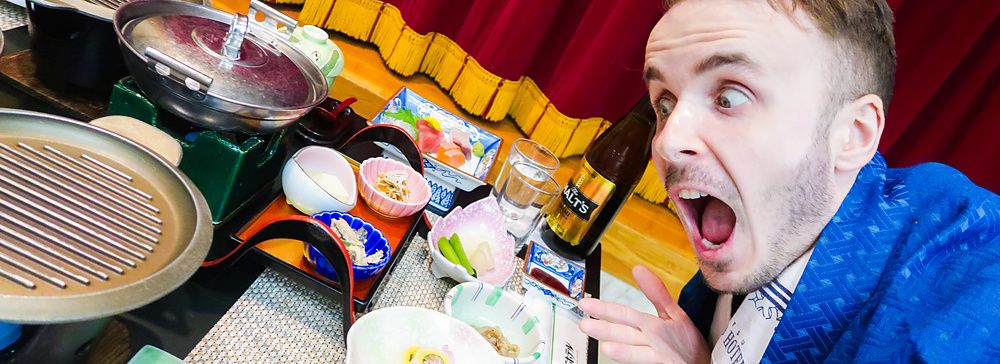
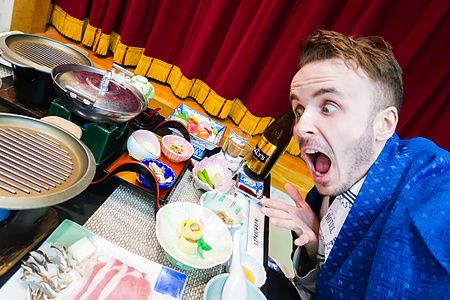
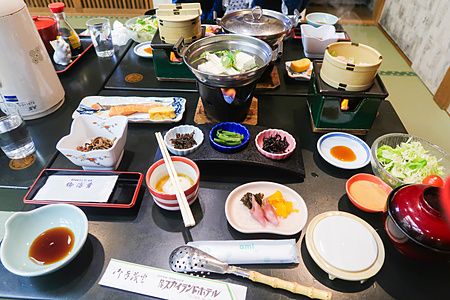
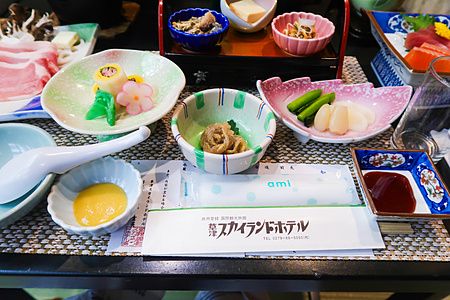
Dinner is served at a table in the dining room, not in your room, and you go down in your yukata like everyone else. The table fills up with small petal-shaped bowls in blue and pink on a black lacquered tray, along with little burners already lit.
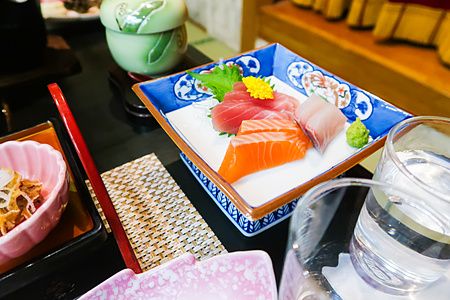
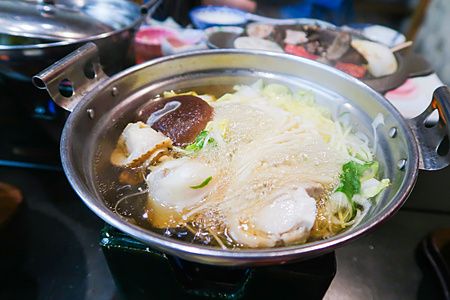
What sticks with me from dinner is the tuna sashimi, with salmon and some white fish, served on a square blue-and-white plate with a shiso leaf, a small yellow flower and wasabi. Then there’s raw meat you cook yourself on the hot plate, and a pot of broth bubbling over the flame with shiitake, enoki mushrooms, vegetables and pieces of meat. With all that food in front of you, you can’t help looking surprised.
Dinner is a multi-course meal mixing Japanese and Western cooking that changes with the seasons, and on some menus the main dish is Joshu beef, the prefecture’s own beef.
Breakfast is Japanese, served at your seat on a tray with a place mat printed with the hotel’s name. There are pickles, vegetables, lots of small bowls, and tofu cooking on a little burner in front of you, to eat hot with the sauce.
The dining room staff smile like they mean it and explain what you’re eating even if you don’t speak Japanese. You’ll find the same kindness at the front desk.
Around the hotel
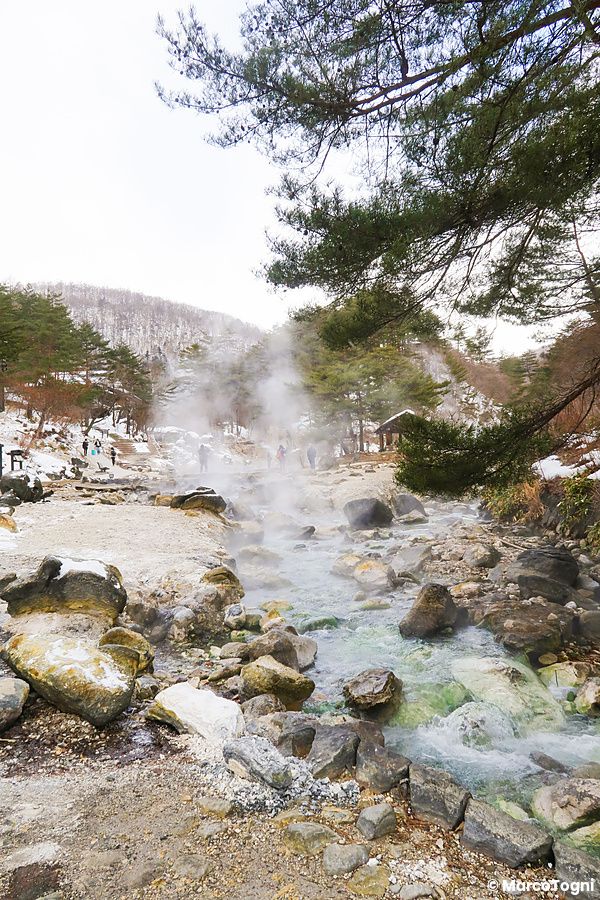
The hotel sits up high, in the woods above the town center, near Sainokawara Park. Around it there are trees and a few other hotels, but no shops, restaurants or bars, so at night you don’t hear a sound from your room, only the forest.
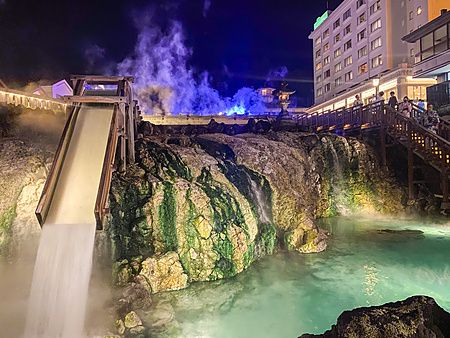
The center of Kusatsu is Yubatake, the big hot spring where scalding water steams as it runs through wooden channels, and it’s lit up in the evening. It’s a downhill walk to get there; you wander among the shops selling steamed sweets and souvenirs, then head back up. The walk back is uphill and cold, but the hot bath is waiting for you when you get there.
In winter you’ll run into skiers and families in the lobby, because Kusatsu’s slopes are on the same mountain. By the entrance there’s a kids’ corner and an area with tables for anyone who needs to get an hour of work done on a laptop.
At a glance
Pros:
- large hinoki bath and open-air bath with acidic water from the Bandai spring
- dinner in the dining room with lots of courses, a hot plate and a pot over the flame
- rooms for everyone, from tatami for families to Simmons beds for couples
Cons:
- the superior twins have no shower, so you wash at the onsen
- the private baths and the stone bath cost extra
Best for: couples looking for a night at an onsen, families with kids, skiers who want to warm up in the evening
Room to ask for: the Oriental Modern if there are a lot of you, the Seifutei superior twin if there are two of you
Atmosphere: wood, steam and yukata, with the forest outside the windows
Final thoughts
What stays with me from Kusatsu is this: walking down to Yubatake with steam rising into the dark, climbing back up toward the woods with a cold nose, and ending the evening in the hinoki tub, smelling of wet wood.
The next day you leave with the feeling that someone there genuinely cared about you, from the tea in your room to the last little bowl at breakfast. If you’re planning a night in Kusatsu, book here.