Matsunoo Taisha Shrine
A large shrine in the southern part of Arashiyama, where people come for sake and for three stone gardens that are among the most beautiful in Kyoto. Few people think of coming here, and even when the bamboo grove to the north is packed, you have plenty of room inside.
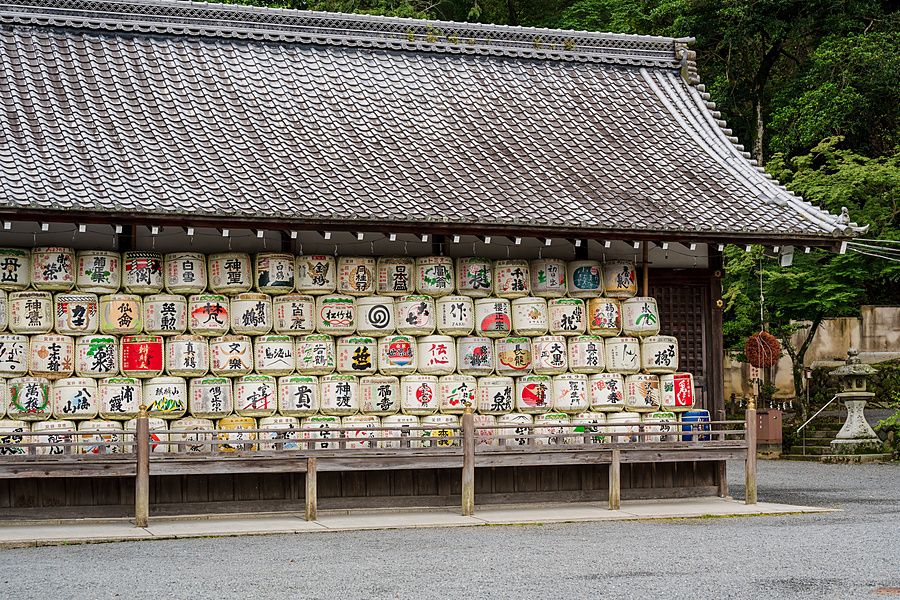
Sake brewers from all over Japan think of Matsunoo Taisha Shrine as their shrine. Their barrels are stacked in front of a storehouse, and the water they take away for fermentation comes from a spring behind the halls. In spring, yellow flowers bloom all along the stream. It’s the right place if you’ve already seen Kyoto’s famous sights, if you love gardens, or if you have half a day in Arashiyama and want a bit of quiet.
What you’ll see
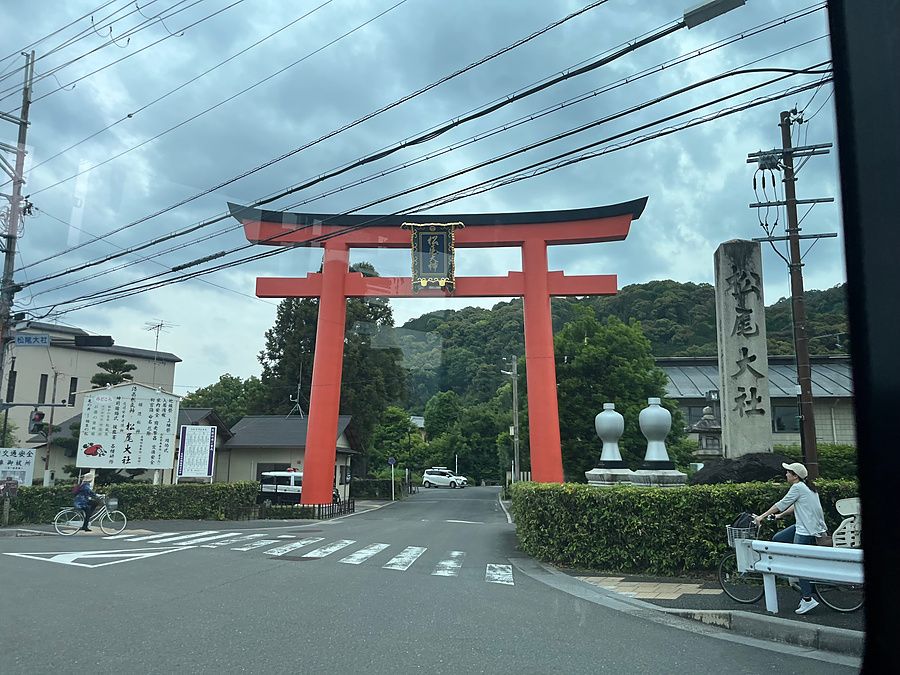
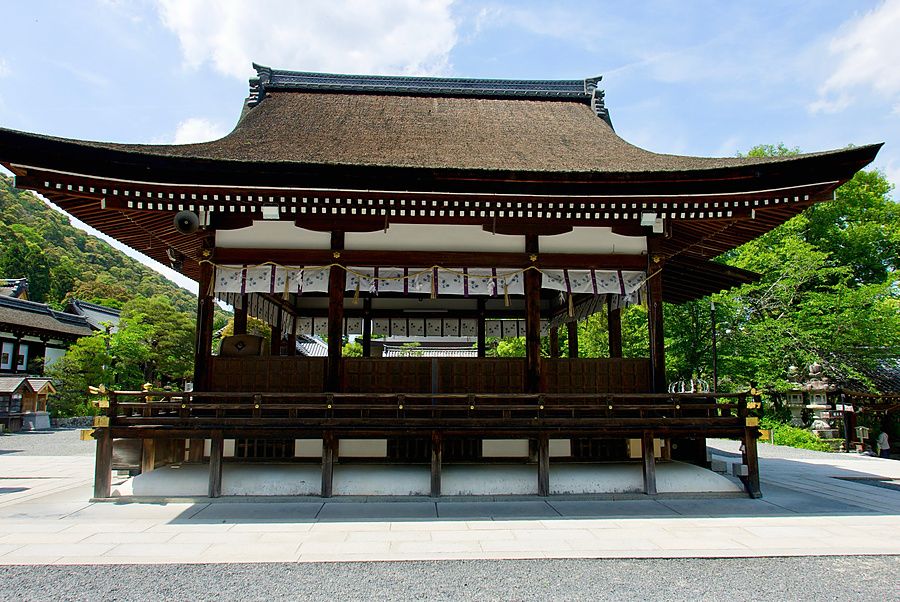
A huge red torii marks the entrance, and you can spot it from the main road. Past it, the approach leads to a two-story wooden gate with red trim. Through the gate you step into the courtyard, with the prayer hall and the smaller halls in front of you and a green mountain rising behind them, closing off the view. It’s a big shrine, but you don’t get the endless walking you do at other complexes in Kyoto.
- The sake barrels: dozens and dozens of straw-wrapped barrels stacked in several rows, each with a different brewer’s colorful logo. They’re reason enough to go in.
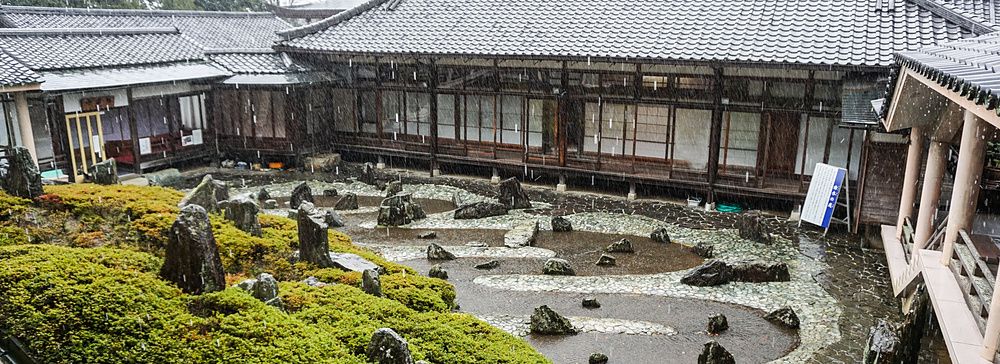
- The Horai garden: a pond shaped like a crane with its wings spread, blue-green rocks set on edge, and a small waterfall at the back.
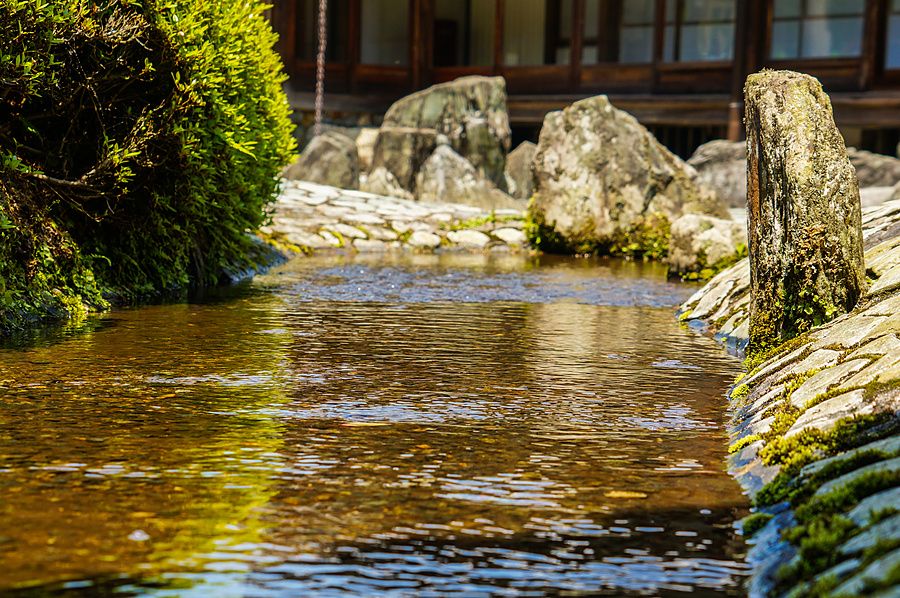
- The stream garden: a carpet of azaleas clipped low, with a trickle of water winding through it, between stones set upright like blades.
- The sacred rock garden: large gray and green boulders arranged on the hillside, a reminder of the time when people here prayed directly to the mountain, before there were any buildings.
- The turtle spring and the waterfall: behind the halls is the well the sacred water flows from, and a little farther on a small waterfall runs down the rocks with a small altar in front of it.
- The statue museum and the sake museum: one hall displays about twenty ancient wooden statues of the deities, dark and worn; the other holds sake-making tools, barrels, and bottles.
The gardens are the part almost everyone skips. They were designed by Mirei Shigemori, who also made the checkerboard gardens at Tofukuji, and they were the last thing he worked on before he died. The rocks, more than two hundred of them, are blue-green stone from Shikoku. Set on edge in the moss and gravel, they look almost modern, a world away from the soft, rounded gardens at the most famous temples.
In the Horai garden I’d recommend you sit on the veranda and stay a while. The small waterfall is the only sound, and the pond changes shape depending on where you sit. You view the sacred rock garden on the hill from below and from the path. There’s no veranda, just boulders and trees.
Turtles are everywhere, and kids notice right away. There are stone turtles, bronze turtles, turtles drawn on the amulets, and a small black one on a rock by the water that people pat on the head for luck. You’ll spot it by its shiny patina.
At the turtle spring you’ll see people showing up with jugs and bottles to fill with water. It’s the same water sake brewers have been taking away for centuries to put in their barrels, in the belief that it keeps the sake from spoiling.
The main halls aren’t the reason to come. Their roofs have two slopes of equal length, front and back, and they’re nice to look at, but you can only see them from the outside, so it doesn’t take long. The sake museum is a room and a half: if you don’t read Japanese, look at the barrels and old tools and move on.
To reach the garden on the hill you walk a short stretch of uphill path with a few uneven stone steps. It’s nothing strenuous, but with a stroller you’ll want to skip it. The rest of the shrine is flat.
When I have guests who’ve already done the bamboo grove and the bridge in Arashiyama, I bring them here in the late afternoon. I keep coming back because it’s where I find both of the things I love most about Kyoto, sake and stone gardens, and I always sit on the same veranda in front of the little waterfall.
When to go
Spring is the best time, from mid-April to early May, when about three thousand yamabuki plants bloom along the stream that runs through the shrine grounds. The bushes along the water fill with small, bright yellow flowers, with the red gate in the background. Those weeks bring more people, but it’s nothing like the cherry blossom crowds in central Kyoto.
In the fall the maples turn red around the gardens and above the small waterfall. In winter, when it snows, the green rocks of the gardens stand out against the white and there’s hardly anyone around.
Early on weekday mornings there are only a few people around: some men from the neighborhood stopping by to pray and a shrine worker sweeping the gravel, and all you hear is running water. On weekends Japanese families come with their kids dressed up for blessings, so the courtyard gets busier, but you never have to push your way through.
The gardens look their best in light rain, when the wet rocks turn a green that’s almost blue and the moss lights up. If it’s pouring, though, the veranda is the only place to sit it out.
The best shot
The best spot for photos is the little bridge over the stream in front of the gate, when the yellow flowers are out. Frame the bushes in the foreground, the water in the middle, and the gate in the background. Overcast skies help, because when the sun is straight overhead the yellow gets blown out.
For the sake barrels, stand back a bit so the rows bunch together and fill the whole frame. In the Horai garden, take the shot from the veranda, sitting down, with the small waterfall coming in from the side.
At a glance
- Highlight: Shigemori’s three stone gardens, plus the wall of sake barrels.
- When to go: early on weekday mornings; mid-April to early May for the yellow flowers, fall for the red leaves.
- Best for: people who’ve already been to Arashiyama and want something different, people who enjoy sake, people who love modern Japanese gardens.
- Atmosphere: more locals than tour groups, running water everywhere, room to sit and look.
Final thoughts
Matsunoo Taisha Shrine doesn’t have the instant wow of Fushimi Inari or Kinkakuji, and if you come for a quick photo you’ll be disappointed. What makes it worth it is what you find when you stop for a while: gardens unlike any others in Kyoto, the spring that sake brewers still come to today, turtles tucked into the corners. If you’re already in Arashiyama, it’s a detour that really pays off, especially in spring. If you only have one day in Kyoto and haven’t seen a shrine yet, start somewhere else.