Matsushima
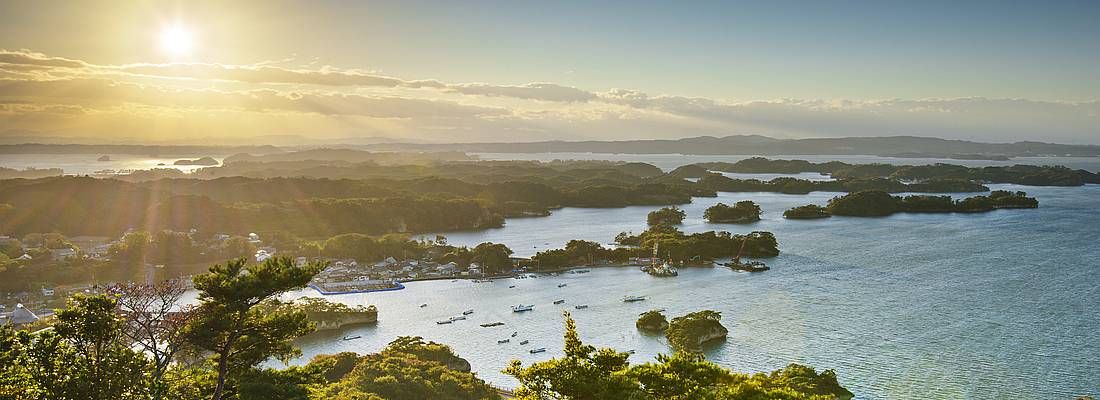
The 260 pine-covered islands of Matsushima Bay, on the coast of Miyagi Prefecture, inspired the legendary haiku poet Matsuo Basho and are among the most beautiful sights in Japan. Basho himself struggled to put into words the wonder he felt when he saw them.
Some of the islands can be reached on foot, so you can walk through the pine forests, visit ancient temples and hear the gripping legends and the history behind this magical place.
Contents
One of Japan’s three most scenic views
Matsushima isn’t famous only for its islands. It’s one of the Nihon Sankei, Japan’s three classic views, along with the sandbar at Amanohashidate and the torii standing in the water at Miyajima. The list goes back to 1643, when the Confucian scholar Hayashi Gaho listed the three landscapes that, in his view, summed up the country’s beauty, and it hasn’t changed since.
Knowing this helps you figure out what to expect. There’s no single landmark to photograph here, but a scatter of islets, wind-bent pines and shallow water that changes color with the light. It’s a landscape to take in slowly and from several different spots, and it rewards anyone who doesn’t rush through it in an hour.
Seeing the bay from different angles
Start exploring Matsushima with a walk along the shore, taking in the contrast between the clear sea and the lush green islands. For a better look, climb the observation tower right by the bay, built in the style of an old castle. From up there you can pick out the details of the landscape and the islands, including the three main ones, each linked to the mainland by its own bridge.
Another way to see the landscape is by boat. Hop on a ferry for a ride around the bay, with an audio guide telling you the history of the main islands and a few interesting facts about them.
The four classic viewpoints
In the Edo period, scholars of the Date clan picked four hills around the bay as the best places to look at it from. These are the four great views, Shidaikan in Japanese, and each one shows Matsushima in a different way.
From Otakamori, on Oku-Matsushima, the islands look like a miniature garden, and this is the viewpoint to pick for sunset. Tomiyama is the highest of the four and has the most elegant view, with the islets lined up in the distance. Tamonzan faces the open sea and the ships heading into the port of Shiogama, while Ogidani is the most intimate, with the inlet spreading out like a fan below you.
None of the four is on the waterfront. They’re all up in the hills around the bay, and you only need to visit one of them to really understand the shape of this landscape.
Walking across three islands
If you want a closer look at the islands, you can visit three of them, linked to the shore by a series of bridges.
The middle one of the three, next to the ferry terminal, is home to the small Godaido Temple, which has become the symbol of Matsushima.
Fukuura Island is easy to spot thanks to its picturesque red bridge, just over 250 meters long. For a small entrance fee you can cross the bridge and explore the island’s beautiful forest, all the way to lookout points with beautiful views over the bay. Along the way you might see scenes of everyday local life, like fishermen sitting comfortably on the bridge, patiently waiting for a bite.
The other island you can visit is Oshima, known for its temples and the sacred caves where monks once meditated. You can walk there by heading south along the shore.
Two temples worth visiting
Besides the Godaido, Matsushima has other important sacred sites, like Zuiganji Temple, the most prestigious Zen temple in the Tohoku region, whose history is closely tied to the Date clan. You can see the link with the samurai family in some details that are unusual for a temple, such as the chimney of the monks’ kitchen, which doubles as a watchtower. Before you even go into the halls, take a look at the approach: the rock face along it is dotted with dozens of hand-carved niches and caves, holding statues, gravestones and inscriptions left over the centuries by people who came to pray for their dead. Inside, the rooms of the main hall are decorated with gilded sliding doors painted with pines, peacocks and court scenes on a gold background, a luxury that says a lot about how powerful the Date family was.
Right next to Zuiganji stands the smaller Entsuin Temple, especially popular for its Japanese garden, which sits alongside a European-style rose garden. Entsuin is beautiful in the fall, when the season’s colors are reflected in the gardens. The roses aren’t a recent fad, either. Entsuin was founded in 1647 as the mausoleum of Date Mitsumune, Masamune’s grandson, who died at just 19, and the reliquary kept in the Sankeiden is decorated with paintings of what are considered the oldest roses in Japan. They’re said to have arrived with the Hasekura Tsunenaga mission, the embassy Masamune sent all the way to Rome, and that’s how Entsuin got its nickname, the temple of roses.
Trying the local seafood
Surrounded by waters teeming with life, Matsushima has a local cuisine built mostly on fresh fish, which you’ll find in the area’s restaurants and at the stalls of the Matsushima Fish Market. Oysters are one of the local specialties, but don’t miss the chance to try sea eel and squid too.
Green tea on a veranda over the sea
For a classic Japanese experience, visit the Kanrantei Teahouse, which Toyotomi Hideyoshi gave to Date Masamune, the samurai and feudal lord of Sendai. Sit on the veranda with a cup of matcha and some local sweets, and enjoy the sweeping views over the bay.
Festivals in Matsushima
Matsushima hosts plenty of festivals through the year. The main ones are the Matsushima Oyster Festival in February, dedicated to oysters, and the Toro Nagashi Hanabi Taikai in mid-August, when the bay takes on a magical feel: fireworks light up the sky while hundreds of lanterns float on the water.
Getting There
Your starting point is Sendai, an hour and a half from Tokyo by shinkansen. From there, take a local train on the JR Senseki Line and in about 40 minutes you'll reach Matsushimakaigan Station, by far the most convenient option.
From the station it's just a five-minute walk to the water, with the Godaido and the cruise pier right there; Zuiganji and Entsuin are a little farther along the main street.
Don't confuse it with Matsushima Station, on the Tohoku Main Line: that one leaves you a twenty-minute walk from the bay.
Useful Info
- Matsushimakaigan Station (JR Senseki Line): the one you want, with everything a few minutes' walk away
- Matsushima Station (JR Tohoku Line): farther out, about a 20-minute walk from the bay
- Boat from Shiogama: cruises connect Marine Gate Shiogama with the Matsushima pier
Map
This place is on MarcoMaps
Matsushima
My map of Japan: over 4,000 places I've tried myself, each with photos, rating, and hours. Filter by category and rating, find veg-friendly spots and places near you with GPS. No sign-up, right from your phone.
- 4,000+ places
- Rating, photos, and hours
- Veg friendly
- Near me (GPS)
- Favorites without login
- Works offline

