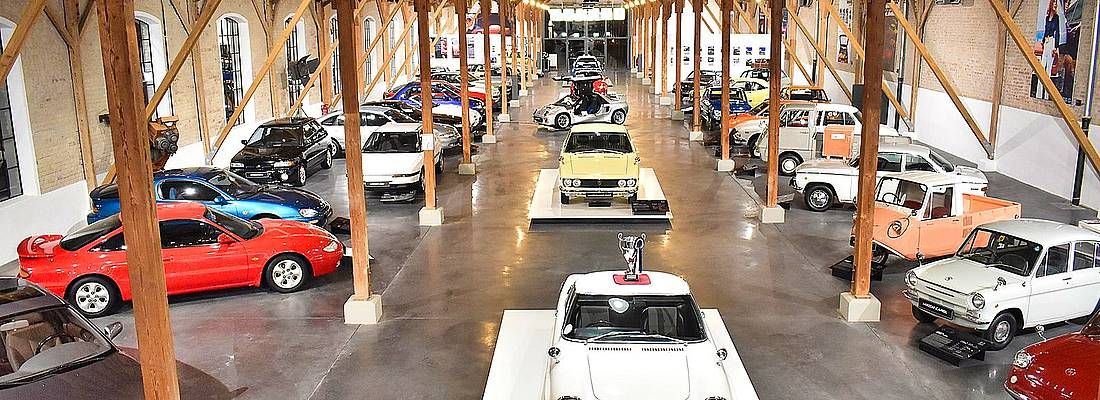
Mazda Museum
Mazda was founded in Hiroshima in 1920 and still has its headquarters in its hometown. Inside the plant there’s a museum where a free guided tour in English takes you through the company’s history.
Mazda has always played a major role in Hiroshima’s economy. It isn’t Japan’s biggest carmaker by volume, but it still builds more than a million cars a year and remains an innovative company.
Visiting the museum is a unique opportunity, and not just for car fans. It’s a way to see a different side of the Japanese economy and get inside one of the country’s most important companies.
Contents
How to visit the Mazda Museum
You can only see the exhibition areas and the factory on a guided tour, so you’ll need to book your visit online.
From cork to cars
Few people know that Mazda didn’t start out as a carmaker. In 1920 it was called Toyo Cork Kogyo and it made cork products. It moved into machinery later, and only after that into vehicles.
In fact, the first vehicle on display in the museum isn’t a car but the 1931 Mazda-Go, a small three-wheeled truck that ran on Japan’s roads for years. The first real family car, the tiny R360 Coupé, didn’t arrive until 1960.
The name has an interesting story too. It’s a nod to Ahura Mazda, the ancient Persian god of wisdom, and also to the founder’s surname, Jujiro Matsuda.
The visit starts with a short video about the company, its history and its flagship products, some of which you’ll see later on the tour, from the very first car Mazda built to its latest high-tech models. One section of the museum is devoted to the rotary engine, Mazda’s pride and joy, which won the company the 24 Hours of Le Mans, one of the toughest races in the world. That was in 1991, and the car was the Mazda 787B. It gave Japan its first win at Le Mans, and it’s still the only rotary-engined car ever to win the race. You can see it up close in the museum and hear a recording of the roar of its engine played in the room. The Mazda Museum isn’t only about the company’s past, though. One exhibition room looks at the future and the new challenges in cutting CO2 emissions.
Once you’ve seen the lineup of models, the tour moves on to the heart of the company, the production plant, where you get to watch several types of cars being assembled right in front of you. What makes it special is that different models, even in different colors and versions, come down the same line one after another. Workers and robots move in perfect sync, and seeing this Japanese precision up close is one of the most fascinating parts of the visit.
The whole tour takes 90 minutes. At the end, before you leave the museum, you pass through the gift shop, where you can buy Mazda-themed items and souvenirs.
Mazda and Hiroshima’s rebirth
Mazda’s ties to the city go well beyond the economy. The plant stood a few kilometers from ground zero, and on August 6, 1945, the atomic bomb damaged it but didn’t destroy it. In the months that followed, it became an anchor for a city brought to its knees.
For a while the company’s buildings housed the prefectural government offices and other institutions, and when production of three-wheeled trucks restarted, that made a real difference in rebuilding Hiroshima.
That’s part of why people in Hiroshima see Mazda almost as a symbol of rebirth, and knowing this gives the visit extra meaning.
Getting There
From Hiroshima Station, take an eastbound JR local train (Sanyo or Kure Line). Mukainada is the second stop, just a few minutes away. From the south exit, it's about a 5-minute walk to Mazda headquarters.
The meeting point is the headquarters lobby, where a shuttle bus takes tour groups to the museum.
Useful Info
- Mukainada Station (JR Sanyo, JR Kure): south exit
Map
This place is on MarcoMaps
Mazda Museum
My map of Japan: over 4,000 places I've tried myself, each with photos, rating, and hours. Filter by category and rating, find veg-friendly spots and places near you with GPS. No sign-up, right from your phone.
- 4,000+ places
- Rating, photos, and hours
- Veg friendly
- Near me (GPS)
- Favorites without login
- Works offline

