Meiji Jingu Inner Garden
An enclosed garden inside the forest of Tokyo’s busiest shrine, in Harajuku, where you walk on dirt paths and there’s nothing built for show. The Meiji Jingu Inner Garden has a large pond with water lilies, an iris field that turns purple and white in mid-June and, at the very end, a spring-fed well, which is what draws the most people.
You come here to walk slowly and look at the water, not to see monuments. It’s the part of Meiji Jingu I recommend if you find the shrine too crowded, if you have a free hour between Harajuku and Yoyogi, or if you’re in Tokyo during iris season.
Contents
What you’ll see
There’s just one route, and it doesn’t wander around. You head down from the woods to the water, climb back up along the iris field and end up at the well. These are the spots where you’ll stop.
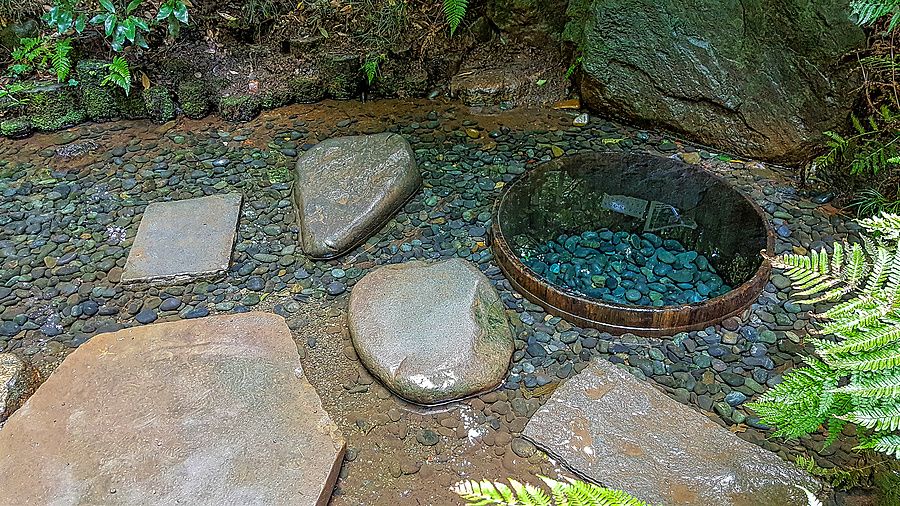
- The iris field: sixteen shallow flooded beds lined up along the bottom of the hollow, with 150 varieties planted together. In June you walk on narrow raised paths between the rows, with the flowers at knee height.
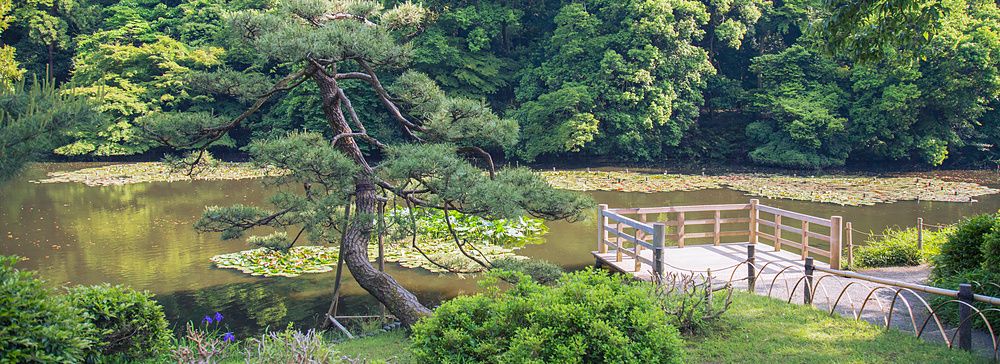
- The south pond: it takes up almost all of the lower part of the garden, with water lilies from June on, big carp coming up to the surface and herons standing still on the bank.
- The platform over the water: a wooden deck jutting out over the pond, where the empress used to come to fish. From there you see the whole pond, with the woods around it reflected in the water.
- Kiyomasa’s Well: a round stone basin at the far end of the garden. Clear spring water wells up in it and runs down toward the iris field. You reach it along a narrow path in the shade of the trees.
- The thatched pavilion: it sits up high above the iris field, with a wooden bench inside. This is where you look down over the whole field.
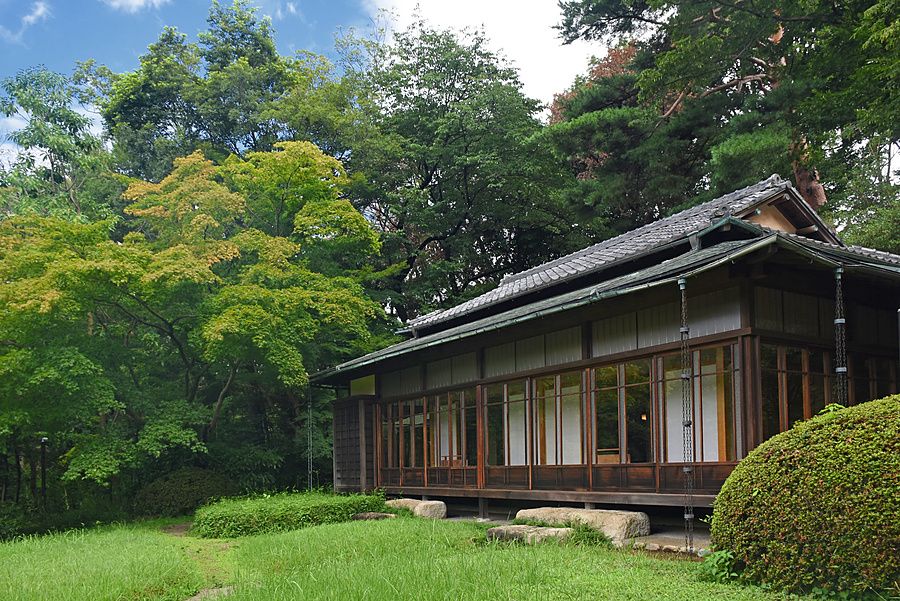
- The Kakuuntei teahouse: a low wooden building on the rise facing the pond. The original burned down during the war and this one was rebuilt afterward, but it stands in the same spot, with the whole pond spread out in front of it.
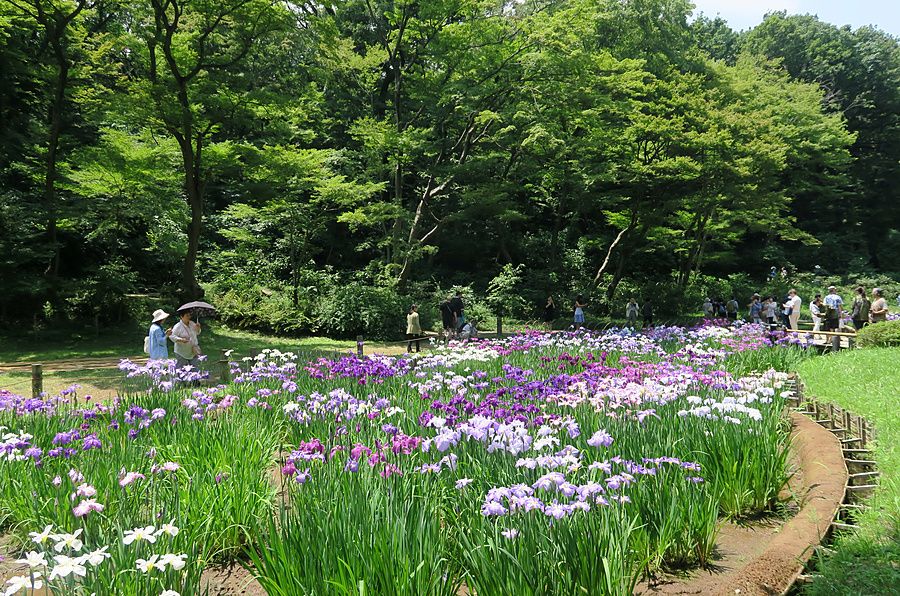
A word on the well, so you don’t show up with the wrong expectations: it’s a stone ring not much wider than a manhole, with clear water inside. There’s no building, no structure and nothing to read, just a hole in the ground with water rising up and the sound it makes as it flows away. It’s supposed to bring good luck, so people arrive in single file and each one stops just long enough to snap a photo on their phone. Japanese TV gave it that reputation by listing it as one of the so-called power spots, places said to recharge you with positive energy. Many Japanese people use a photo of the basin as their phone wallpaper, and that’s why you’ll see everyone photographing the water instead of looking at it.
You can see the teahouse only from outside. The path runs past it and below the rise, but you can’t go in.
From the raised paths you never see the whole iris field at once. The changes in level make you walk around it from three different sides, and each time you face a different band of color. If you only look out from the pavilion, take your photo and leave, you see the colors from a distance and miss the flowers up close.
Outside flower season the garden is just green, with maples, cypresses and water. That’s fine by me, but if you’re set on seeing something in bloom, in January you’ll find a few camellias and the ducks on the pond, and that’s it.
I come back mostly when I’m in the area and don’t feel like talking to anyone. I sit on the bench under the thatched roof above the iris field and watch the water move. It’s the only place in Tokyo where I can actually do that.
When to go
Early morning feels nothing like the rest of the day. The sun comes in low through the trees, there are only a handful of people on the paths, and at the pond all you hear are birds and carp breaking the surface. Around midday, especially on weekends, you shuffle along the iris field’s raised paths at a snail’s pace behind people stopping for photos, and the line for the well stretches back under the trees.
If you can choose, go on a weekday. You’ll feel the difference right away at the narrowest point of the route, the path to the well, where people pass one at a time.
Mid-June is spectacular, and I say that knowing it’s also the wettest time of the year. The irises open in stages, so there’s always something in bloom from early June to early July, but it’s the week in mid-June when the beds are packed with dark purple, light purple, blue, white and pink all at once. The water lilies on the pond open at the same time, which is a nice bit of luck: you get two different blooms on the same walk.
Light rain doesn’t spoil anything here. The leaves turn glossy, the green gets deeper and the crowds drop by half. In a real downpour, though, the dirt paths turn soft and slippery, and you’re better off skipping it.
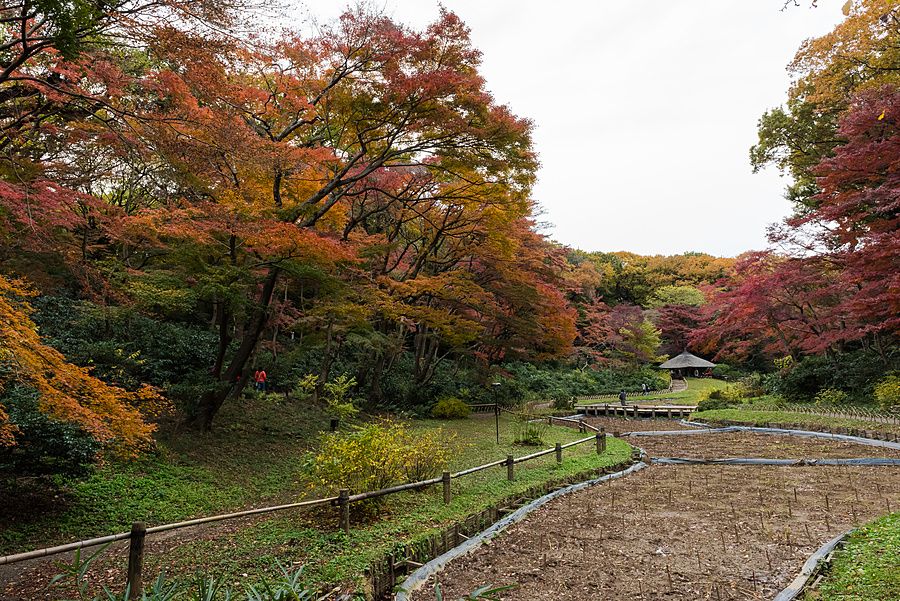
Late November is the other high point, when the maples inside the garden turn deep red and reflect in the pond. In summer the woods keep the whole garden shaded, and it’s far more comfortable than the shrine’s main path, which is wide and has no shade.
In winter you get the ducks, the still water and the bare branches, with very few people and no line at the well.
What it’s like inside
You notice the change within ten steps. Outside the gate is the shrine’s gravel path, wide and open to the sky, with a steady stream of people coming and going. Inside, the path narrows, the trees close in overhead and the city noise disappears. You’re left with the sound of water, the crows, the cicadas in August and a few low voices.
Along the path, set into the ground among the greenery, there are wooden lanterns with white paper that completely change the feel of the place at the end of the day.
As for how tiring it is: you walk on packed dirt and gravel, not smooth paving, and the route keeps going up and down because the garden sits in a hollow. There are steps, slopes and a few spots where the ground is uneven.
It’s hard going with a stroller, and don’t even try it with a wheelchair. If you have bad knees, the last stretch to the well will take some effort. Otherwise it’s an ordinary walk, not a real climb, and there are plenty of benches to sit on.
Let’s be honest: small kids get bored here. There’s nothing to touch and nothing to climb, and the fun lasts as long as there are carp to watch from the platform. Older kids do better, since they can at least go looking for the herons and the turtles on the logs.
There are only a few signs in English and they don’t explain much, but the route is so clear that you can’t take a wrong turn.
The garden’s history
The garden is older than the shrine. In the Edo period this land was part of a country estate belonging to the family of Kato Kiyomasa, the general the well is named after, and it later passed to the Ii clan. After the Meiji Restoration it became imperial family property.
Emperor Meiji had the irises planted for Empress Shoken, who came here to stroll and to fish from the platform on the pond. The water running down from the well still feeds the field today.
When the emperor and empress died, the shrine dedicated to them was built on the surrounding land, and the garden stayed within its grounds just as it was. That’s why it feels more like a private park than a garden made for visitors.
The best photos
The spot to shoot from is the wooden platform on the pond. Only a few people fit on it at a time, it reaches almost to the middle of the water, and you can frame the whole pond with the woods behind and the water lilies in the foreground. In the morning the light slants in from behind the trees and the water lights up in patches.
The second spot is the bench under the thatched roof. From up there you can take in the whole iris field in bands of color, with the people walking on the raised paths giving a sense of scale.
At the well, on the other hand, don’t get your hopes up. It sits in deep shade, the water is dark and reflective, and phones struggle. The shot you see everywhere, with turquoise water and a pebbly bottom, only works when the sun manages to break through the trees and hit the basin.
For the red maples, the best place to stand is the edge of the pond on the teahouse side, where the red is reflected in the water.
Quick take
- Highlights: the sixteen iris beds in June and the pond seen from the wooden platform.
- When to go: early morning, mid-June for the flowers and late November for the maples. Avoid weekends.
- Best for: people in Harajuku who want a break from the shrine crowds, slow walkers, and anyone who photographs flowers and waterbirds.
- Atmosphere: dense trees overhead, dirt and gravel underfoot, a few people talking quietly.
Final thoughts
What makes this place worth it isn’t what’s in it. Taken one by one, those things don’t amount to much: a little well, a platform, a thatched pavilion, a teahouse you can’t go into. What matters is that two hundred meters from the busiest walkway in Tokyo you find yourself on a dirt path in the middle of the woods, with nothing in front of you but water and flowers, and nowhere else in the city offers that combination. It’s worth the detour for the iris field in June and for the pond in any season.
But if you’re looking for buildings to admire, pagodas or neatly groomed Japanese gardens with raked gravel, you won’t find them here and you’ll be disappointed. In that case you might as well stop at the shrine and save the garden for another time.