Mifuneyama Rakuen
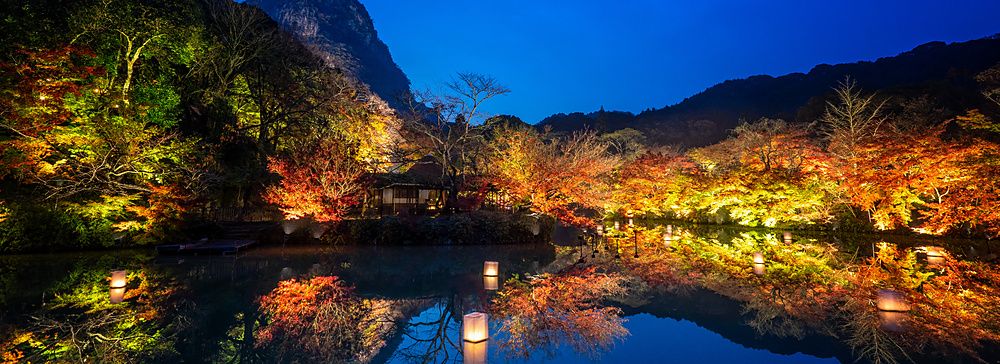
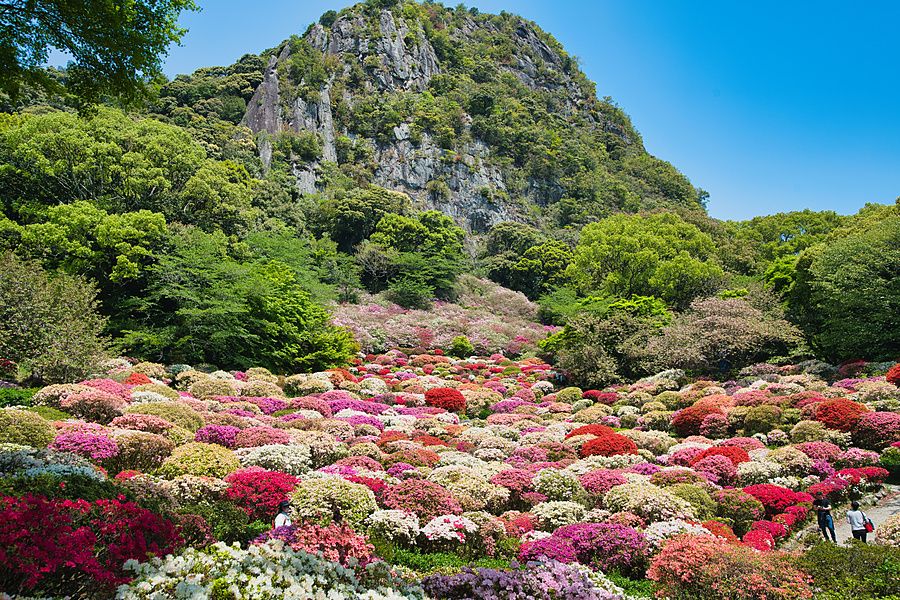
A huge Japanese garden in Takeo, Saga Prefecture, where a rock face about a hundred meters high rises behind the azaleas and maples and looms over you for almost the whole walk. Mifuneyama Rakuen is famous for two seasons. In spring a whole valley turns pink, red and white with azaleas, and in fall the red leaves are lit up in the evening.
There’s a lot more to it, though: a pond, a thatched-roof tea house, very old trees and a patch of woods with stone statues. It’s the right place if you’re traveling around Kyushu, you’re up for some walking and you want to see a garden that looks completely different from one season to the next.
What you’ll see
You walk in, circle the pond and head up toward the mountain, and at some point you realize the garden has ended and you’re walking in the woods. Nothing marks where one ends and the other begins, and that’s one of the best things about this place.
- The gourd-shaped pond: it’s the first thing you come to after the entrance, ringed by pines, cherry trees and maples, with the mountain reflected in it when the water is still.
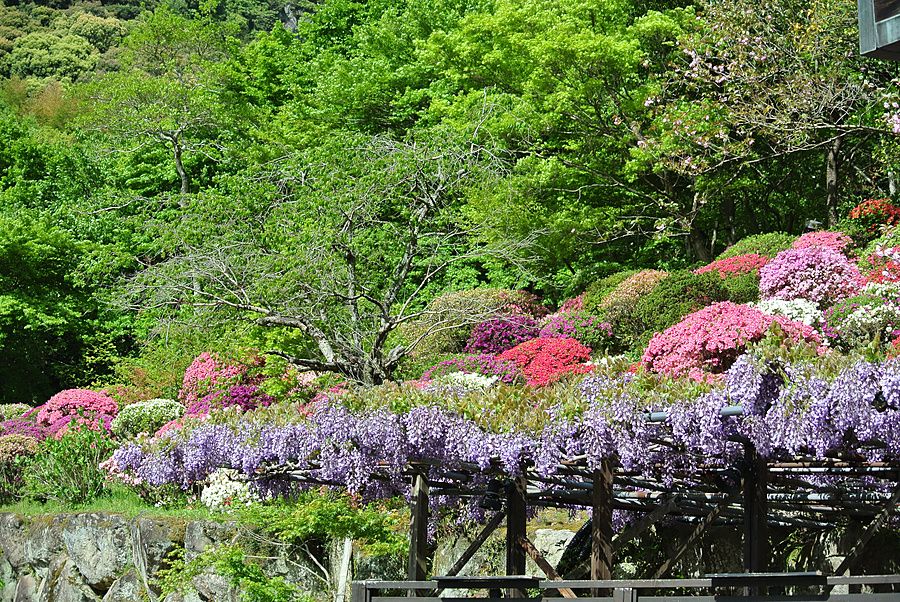
- Haginoo tea house: a small thatched-roof house at the water’s edge. Next to it grows a wisteria vine almost two centuries old that hangs like a purple curtain in late April.
- The azalea valley: a bowl-shaped hollow a little higher up than the pond, covered by about 200,000 azalea bushes clipped into rounded mounds, with the mountain’s rock face right behind it.
- The maple slope: an uphill stretch lined with hundreds of maples that turn deep red in fall. The oldest maple in the garden stands nearby, with low, very wide branches.
- The giant camphor tree: in the middle of the garden there’s a camphor tree about 300 years old, with a trunk so thick that three people together can’t get their arms around it.
- The shrine and the cave: farther up, toward the woods, there’s a small Inari shrine squeezed between huge boulders, and a cave with Buddha figures carved straight into the rock and statues of the 500 disciples, the rakan.
Almost everyone stays down at the bottom, between the pond and the tea house. The strangest and most beautiful things are up top, though. The shrine among the boulders and the cave with the carved Buddhas are the two things I’d tell you not to skip, even if you’re sweaty by the time you get there.
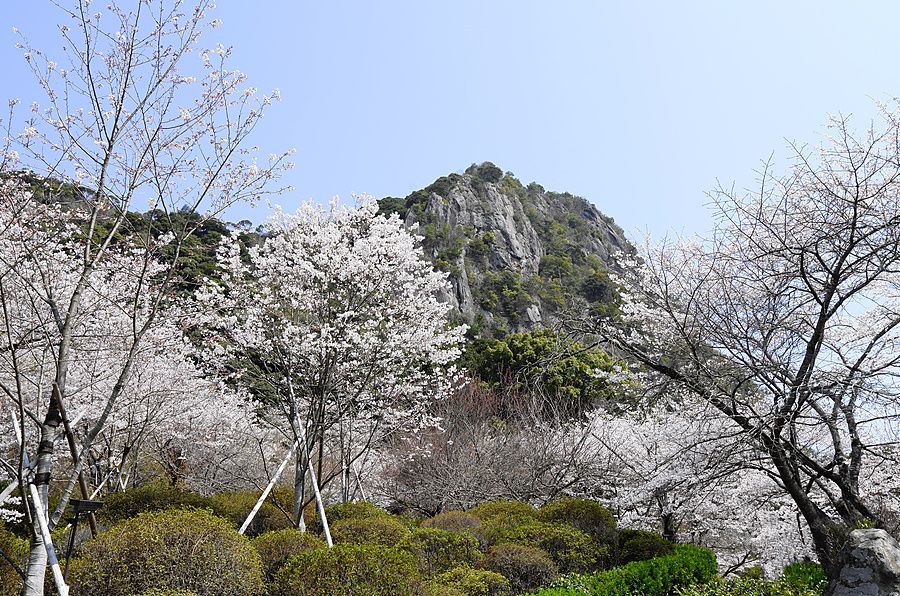
The rock face is what really defines this garden. From below it looks like a vertical wall of gray and green closing off the view, and its color changes with the light. It’s the reason photos taken here look different from photos of any other garden.
Outside azalea season and fall foliage season, the big valley is just a sea of round green bushes. The shapes are nice to look at, but it’s not the scene you’ve seen in all the photos.
If you want a raked-gravel zen garden to sit and look at, this isn’t the place. Here you walk, climb up, come back down and get a little lost.
I come back every time I’m in northern Kyushu, because the same valley looks like two different places in April and in November. The cave with the Buddhas in the middle of the woods also gets me every time. You step into the cool air, all you can hear is water dripping, and you forget all about the packed parking lot at the entrance. It’s one of the very few gardens I’d take someone to see just for the mountain behind it.
Who built it
Mifuneyama Rakuen was the private villa of Nabeshima Shigeyoshi, the lord of Takeo, who had it built at the foot of the mountain in 1845. The work took about three years.
Before construction started, he brought in a Kano school painter from Kyoto (the Kano were the shogun’s official painters) and had him draw what the garden should look like. That’s why it feels less like a garden for strolling and more like a painting, with the rock face as the backdrop.
The tea house by the pond is all that’s left of the villa. The cave with the Buddhas is much older than the garden: according to tradition, the figures were carved by the monk Gyoki about 1,300 years ago.
When to go
The best-known time is from mid-April to early May, when the azaleas are in bloom and the valley becomes a carpet of color all the way to the foot of the rock. The wisteria by the tea house flowers at the same time, and the cherry trees, about 2,000 of them, bloom a few weeks earlier.
In fall, from mid-November to early December, the leaves turn red and the garden is lit up in the evening. It’s one of the biggest fall maple illuminations in Japan, with the whole scene reflected in the pond.
These two periods are also exactly when the crowds come. The parking lot fills up even on weekdays, and on illumination nights you walk in a line around the pond, on a one-way route, at a crawl.
My advice is to get there first thing in the morning, right when it opens. That’s when the sun hits the rock face and the only people on the paths are photographers with tripods and a few local men. To see the illumination, go midweek and not on a Saturday.
Out of season it’s a much quieter place. In June the hydrangeas are out and the maples are still green. Summer is hot, with the damp air of the woods, while in winter the trees are bare, and when it snows the rock turns black and white.
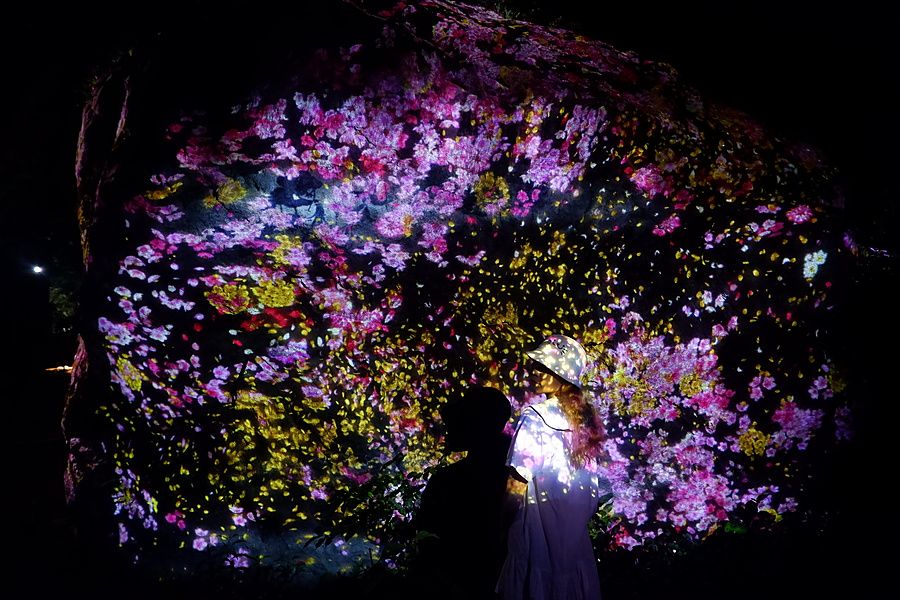
At certain times of year there’s also an evening teamLab exhibition, with projections and lights among the trees, around the pond and at the cave. Check whether it’s running before you go, and if you happen to catch it, it’s a completely different way to see the garden.
Slopes and footwear
The garden isn’t flat. From the pond to the azalea valley there’s a fair amount of climbing, and from there up to the shrine and the cave the paths get steeper, with uneven steps and stretches of rough paving.
The climbs are harder than you’d expect in a garden. Dress shoes or sandals make it a struggle, but a pair of sneakers is all you need.
With a stroller you can get around the lower part by the pond, but the upper part gets tricky. The same goes for anyone who has trouble walking: the area near the entrance is easy enough, the rest less so.
In summer, bring water. There’s not much shade in the open valley, and you’ll feel the climb.
At a glance
- The highlight: the azalea valley with the rock face behind it, plus the cave with the Buddhas in the woods.
- When to go: late April for the azaleas, mid-November for the fall colors, always early in the morning; on peak evenings, go on a weekday.
- Best for: people traveling around northern Kyushu who are fit enough for the climbs, and people who want to see a garden that’s also part of a mountain.
- Atmosphere: uphill paths, forest air, and a pond at the bottom that’s packed during the flower weeks and almost empty the rest of the year.
Bottom line
What makes Mifuneyama Rakuen special is the combination of a beautifully kept Japanese garden and a real mountain rising right over it, plus woods with Buddhas carved into the rock. During the azalea weeks or the fall colors it’s worth the trip to Takeo on its own, as long as you’re ready for crowds and some effort.
If you want a garden to sit and look at, without any climbing, or you’re passing through in a hurry in midsummer, you’ll only get to enjoy the lower part and you’ll miss the best of it.