
Mizonokuchi
Mizonokuchi is one of the best-connected areas southwest of Tokyo, and it’s also one of the areas where the old city hasn’t been wiped out. It’s actually in Kawasaki, in Kanagawa Prefecture, just over the Tokyo border, and from Shibuya you’ll get here in about fifteen minutes.
I’ll say it up front: this is not a tourist destination, and you don’t come here for famous landmarks. You come because a ten-minute walk takes you from a shiny shopping mall to a narrow alley of shacks hung with red lanterns, and because a canal dug in the Edo period still runs between the buildings. I like it precisely because of these constant shifts.
Contents
Restaurants


Nearby neighborhoods
Jiyugaoka
Chofu
Two stations side by side
There are two stations here, right next to each other and with almost the same name. Mizonokuchi serves the private Tokyu lines, and Musashi-Mizonokuchi serves the JR Nanbu Line. An elevated pedestrian walkway lined with shops links the two, so you can get from one to the other in a couple of minutes without going down to the street.
The mall side has Noctie Plaza and Marui Family, which means department stores, chains, a floor of restaurants and the usual basement food halls. The other side is where the Mizonokuchi I’d recommend seeing begins.
The postwar arcade
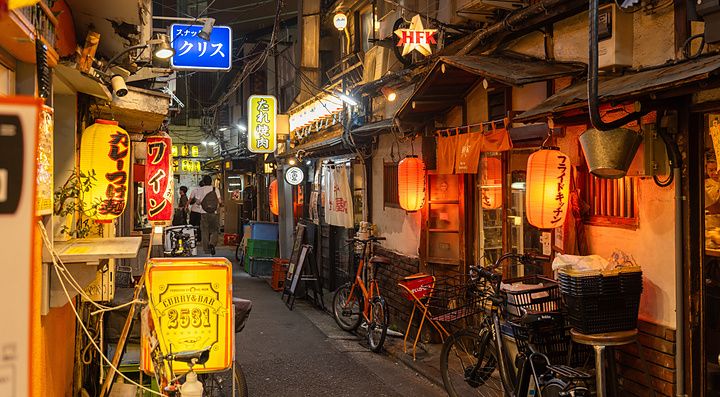
Right outside the JR station, on the side away from the department stores, there’s a block of low shacks. This is the Nishiguchi Shotengai. It started out as a black market after the war and has stayed pretty much as it was, with sheet metal, makeshift awnings, a passage as narrow as a tunnel and a wall of signs at the entrance.
During the day half the shutters are down and the place looks dead. From late afternoon on, the lanterns come on, tables spill out into the passage and the mood changes. Grilled skewers and glasses of shochu cost next to nothing, even by Japanese standards, and quite a few places have just six or seven seats.
You’ll find almost no English menus, and the noise keeps building as the night goes on. My advice is to walk the whole alley once before you choose, instead of ducking into the first place with an open door.
Upstream along the canal
Mizonokuchi didn’t grow up around the railway. It was a post town on the Oyama Kaido, the road that took pilgrims from Akasaka to the shrine on Mount Oyama, out toward Isehara. Tea, tobacco and dried fish also traveled along it on their way to Edo. Today the old road is just an ordinary street, but seven minutes from the station there’s a small city museum about the route, with artifacts and maps, and admission is free.
My favorite part is the water. The Nikaryo Yosui is an Edo-era irrigation canal that runs through the area. A path follows the bank, and in spring the cherry trees along it turn into a tunnel of blossoms. If you follow it upstream for a kilometer and a half, about twenty minutes, you reach the Kuji Entobunsui. This concrete disk, sixteen meters across, was built in the 1940s to divide the water among the villages in exact proportions, and it still works. Koizumi Jidayu, a Tokugawa official, had the canal dug in the early 1600s, and its name comes from the two domains it ran through, Kawasaki and Inage. The disk solved a problem that went back centuries. Until then the villages fought over the water, sometimes violently, and once the water was split precisely, the disputes stopped.
If you have only half a day, here’s what I’d do: see the canal and the old road while it’s light, then the alleys once the lanterns come on. And if you happen to be here when there’s a concert on, the music college nearby has a hall with more than 1,000 seats that’s modeled on Vienna’s Musikverein. Students often give concerts there that are free to attend.
Getting There
From Shibuya, take an express on the Den-en-toshi Line and you'll be at Mizonokuchi in about fifteen minutes. From Jiyugaoka or Futako-Tamagawa you can take the Oimachi Line. It ends here, so you'll almost always get a seat on the way back.
An elevated walkway links the two stations. For the alleys of the Nishiguchi Shotengai, take the west exit of the JR station. The Oyama Kaido museum and the canal are a 7-10 minute walk away.
Useful Info
Name: Mizonokuchi
Time needed: Half a day: a couple of hours along the canal and the old road, then the evening in the alleys
Tips: If you can, come in the late afternoon. Walk up the Nikaryo Yosui to the Kuji Entobunsui disc while it's still light, then head into the Nishiguchi Shotengai on the way back, just as the lanterns come on. Before you sit down, walk the whole alley once, because many places have only six or seven seats.
Getting there:
- Mizonokuchi Station (Tokyu Den-en-toshi, Tokyu Oimachi)
- Musashi-Mizonokuchi Station (JR Nanbu): west exit for the Nishiguchi Shotengai
Map
MarcoMaps100% free
This place is on MarcoMaps
Mizonokuchi
My map of Japan: over 4,000 places I've tried myself, each with photos, rating, and hours. Filter by category and rating, find veg-friendly spots and places near you with GPS. No sign-up, right from your phone.
- 4,000+ places
- Rating, photos, and hours
- Veg friendly
- Near me (GPS)
- Favorites without login
- Works offline

