Monzen-Nakacho
Monzen-Nakacho is one of those Tokyo neighborhoods where the city slows down and feels human again. Locals call it Monnaka, and the nickname suits it. It’s a slice of shitamachi east of central Tokyo, with two major places of worship side by side and rows of small bars that light up at night.
People don’t come here for skyscrapers or shopping. They come to walk slowly, eat well without spending much and get a feel for old Tokyo without going far. I’ll tell you how to get around, what changes after dark and why those two places of worship shaped the history of the area.
Contents
Nearby neighborhoods

Yaesu
Kiba
Getting around on foot
In Monnaka you can walk everywhere. Fukagawa Fudo and Tomioka Hachimangu are a few minutes apart, so in less than half an hour you’ve seen the heart of the neighborhood. The fun starts afterward, when you begin ducking into the side streets with nowhere in particular to go.
I’d suggest going beyond Monnaka, though, and making the most of the location, because several nearby areas pair well with a morning in Monnaka.
- Tsukishima: just one subway stop away, and the place to try monjayaki, the savory pancake you cook yourself at the table.
- Kiyosumi-shirakawa: right nearby, with its traditional garden and coffee roasters scattered among the old warehouses.
- Toward Ginza: if you’d like to end the day somewhere more elegant.
The fire ritual at Fukagawa Fudo
Fukagawa Fudo is the Tokyo branch of the great Naritasan temple, and one look at the new building tells you so. Its outer walls are covered in black Sanskrit characters on white, the mantra of Fudo Myoo repeated over and over until it becomes decoration.
Inside, the monks perform the goma ritual, a fire ceremony, every day. It opens with the sound of a conch shell, then the drums and the monks’ chanting come in, and flames rise in front of the statue. You can walk in, sit down and watch, even if you don’t understand a word. It’s something you feel in your gut more than in your head.
In the hall behind the main hall there’s also the prayer corridor, lined with almost ten thousand small crystal stupas, all lit up side by side. It’s the exact opposite of the dark wood you expect from a temple, and it’s what stays with me every time I go.
Evening drinks in Monnaka
At night the neighborhood becomes a different place. The daytime shops pull down their shutters, and the signs come on over izakaya and standing bars, often packed with locals just back from work.
You won’t find spots designed for tourists here. These places are tiny, sometimes just four stools and a single cook behind the counter. A beer or a glass of sake doesn’t cost much, and the food is what it’s always been.
The dish to look for is Fukagawa meshi, rice with asari clams and scallions, which started out as a quick meal for the fishermen of old Fukagawa. It comes two ways: with miso broth poured over the rice, or with everything cooked together with the rice. Either way, you’ll spend very little. I’d check out a couple of alleys before sitting down. There’s plenty to choose from, and half the fun is wandering until you find the right counter.
Sumo and festivals
Tomioka Hachimangu isn’t just any shrine. Professional sumo was born here in the Edo period, and on the grounds you’ll still find large engraved stones bearing the names of the champions, the yokozuna. Knowing this changes how you see the area: what looks like a quiet shrine is one of the birthplaces of the sport.
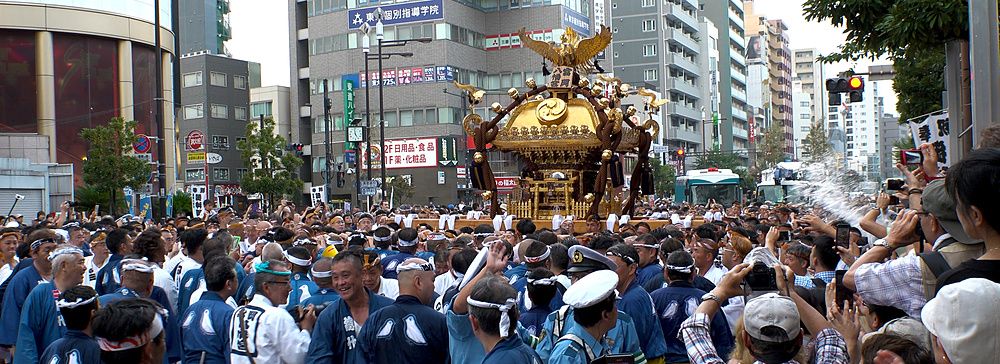
The other time Monnaka is at its best is during the Fukagawa Matsuri, one of Edo’s three great festivals. The full festival comes around once every three years, when dozens of mikoshi go through the streets on people’s shoulders while the crowd throws water on the bearers to cool them down. Even when there’s no festival, you can see Japan’s largest golden mikoshi on the grounds. It stands over four meters tall and weighs four and a half metric tons including its poles, and the phoenix on its roof is set with diamonds and rubies. It’s so heavy that it never goes out on anyone’s shoulders. A smaller one goes out into the streets in its place, while this one stays put all year behind glass.
The festival is loud, wet and beautiful, and if you’re in town at the right time it’s worth the trip out here. The rest of the year Monnaka is a quiet neighborhood to explore without rushing, and having both sides is what makes it one of my favorite corners east of central Tokyo.
Getting There
Monzen-Nakacho Station drops you right in the middle of the neighborhood. Take exit 1 and you're already on Eitai-dori, at the start of the street lined with stalls that gets you to Fukagawa Fudo in two minutes. Tomioka Hachimangu is a little farther along the same road, under five minutes from the ticket gates.
It's a quick ride from central Tokyo: on the Tozai line you're three stops from Otemachi, and the Oedo line brings you here with no transfers from Shinjuku and Roppongi.
Useful Info
Name: Monzen-Nakacho
Time needed: Half an hour is enough for the two places of worship, but plan on half a day if you also want to eat, explore the back alleys and stay into the evening
Tips: If you can choose your day, go on the 1st, 15th or 28th of the month. Those are the Fukagawa Fudo ennichi days, when the temple street fills up with stalls and street food. On most Sundays there's also an antique market in front of Tomioka Hachimangu, which wraps up in the early afternoon.
Getting there:
- Monzen-Nakacho Station (Tokyo Metro Tozai, Toei Oedo): exit 1 for the temples
- Kiyosumi-shirakawa Station (Toei Oedo, Tokyo Metro Hanzomon): one stop north, then a 15-minute walk
- Several city bus lines also run along Eitai-dori
Map
MarcoMaps100% free
This place is on MarcoMaps
Monzen-Nakacho
My map of Japan: over 4,000 places I've tried myself, each with photos, rating, and hours. Filter by category and rating, find veg-friendly spots and places near you with GPS. No sign-up, right from your phone.
- 4,000+ places
- Rating, photos, and hours
- Veg friendly
- Near me (GPS)
- Favorites without login
- Works offline

