Mount Koya
Mount Koya is one of the most fascinating places in Japan. Once you leave the city’s lights and noise behind, you understand why Kobo Daishi chose this plateau south of Osaka twelve centuries ago to found his monastery and the headquarters of Shingon Buddhism. It’s a couple of hours from the city, but it feels like another planet.
More than a hundred temples stand in a cedar forest, along with the huge Okunoin cemetery and Kobo Daishi’s mausoleum, and you can sleep in a temple, eat what the monks eat and wake up to their prayers.
Contents
What to see
Twelve centuries have passed since Kobo Daishi arrived, but this place hasn’t lost its mystical, magical spell. The tall, dense trees are like old guardians watching over sacred treasures. Besides the temple complex there are pagodas, prayer halls, Buddhist statues, a memorial to soldiers killed in wars and a huge cemetery with some famous names, including the samurai Toyotomi Hideyoshi.
Over the centuries the temple has become one with the forest and the mountain. The atmosphere is almost solemn and gives you a sense of eternity, as if the trees were guarding a thousand-year-old story, the kind you could once hear only if you were willing to climb all the way up the mountain to the plateau where the temple stands.
Today a cable car and a bus take visitors to the top in a few minutes, but many pilgrims still walk up the slopes, because Mount Koya is first and foremost one of the main pilgrimage destinations and a religious center devoted to the study of Buddhism. It started out as a single monastery, and now it’s a small town with a university for Buddhist studies and 120 temples, many of which offer lodging to pilgrims and tourists.
If you want to stay overnight, keep in mind that there are no hotels. The only option is a room inside one of the monasteries, where you eat what the monks eat, which means vegetarian food, and you get up early. It’s definitely an unusual experience, but these days it draws a lot of people who want to get away from the noise and pace of the city, even if only for a day.
Weather and when to go
Mount Koya is a perfect destination at any time of year, because its natural setting puts on a beautiful show in every season. Spring is the tourists’ favorite season, when the cherry trees in the area bloom and wash the whole place in a romantic pale pink. The altitude shifts the timing of the blossoms: at the top it’s always five or six degrees Celsius colder than in the valley, so the flowers open a couple of weeks later, and the first cherry blossoms usually show up between late April and early May.
As summer gets closer, the cherry blossoms give way to beautiful rhododendrons that brighten up the mountain for the season’s many visitors. Among them are lots of Japanese school groups, who come to Mount Koya during their school vacation. July and August are the high season here, so that’s when you’ll find it at its liveliest. Besides the students, there are foreign tourists and Japanese people escaping the heat: it’s cooler on the mountain, so plenty of people come up here for relief in the summer months.
Fall comes a little early. By mid-August temperatures are already dropping and the landscape slowly starts to change, with the colors getting warmer and warmer until, by October, the paths are covered in leaves. It’s one of photographers’ favorite times of year. The first snow already falls in November, but you have to wait until mid-December to see Mount Koya under a white blanket of snow. It looks like something out of a fairy tale, and this period, which lasts until mid-February, is ideal if you love snowy mountain scenery or you’re looking for peace and quiet, because the town sinks into a magical silence.
Staying in the monasteries
If you can, I recommend spending at least one night on Mount Koya. The trip from Osaka takes about two hours, so doing it as a day trip can be tiring, but more importantly, sleeping here is a big part of the visit and makes the whole experience richer. This place has been taking in pilgrims and visitors since it was founded, so even though you’re staying in a monastery, the rooms are simply furnished in a traditional style but still fairly spacious and nice.
Dinner is served early, either on lacquered trays brought to your room or in a shared dining hall, and you sleep on a futon laid out on the tatami, behind paper sliding doors that let every sound through. The bathrooms are almost always shared and Japanese-style, since rooms rarely have their own.
In the morning the monks call the guests to the service in the main hall, and at several temples it’s followed by goma, the fire ritual where wooden tablets with prayers written on them are burned in the flames.
A bit of history
Around the year 800, the Buddhist monk Kukai, who later also became known as Kobo Daishi, had spent years studying in China and Japan when he got permission from Emperor Saga to build a monastery on Koyasan (Mount Koya), where he could practice and teach Esoteric Buddhism. With the help of his followers, he started building what would later become the headquarters of the Shingon school.
From then on the complex kept growing and gaining importance, and over the years it became one of the main centers for practicing and studying Shingon Buddhism. In 2004 the Mount Koya complex was added to the list of UNESCO World Heritage Sites.
The Nyonindo and the women kept off the mountain
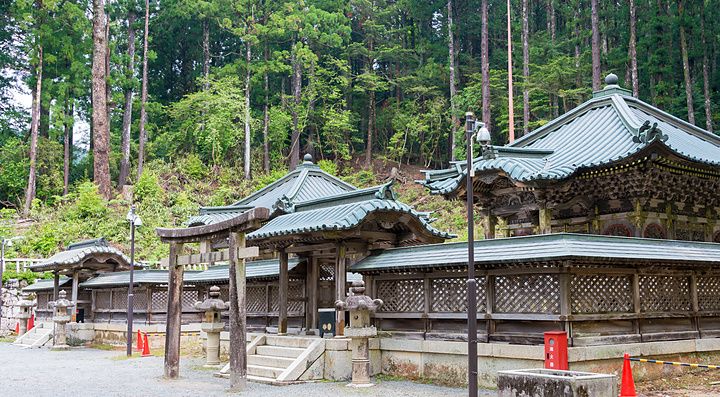
For more than a thousand years Mount Koya was off-limits to women. They could come as far as the gates of the sacred precinct, but they couldn’t go in. Seven halls, the nyonindo, were built for them, one at each of the mountain’s old entrances, and that’s where women pilgrims prayed and spent the night.
The ban ended in 1872, and only one of the seven halls is still standing, at the Fudozaka entrance on the road that leads down into town. It’s a small building, a bit out of the way, and hardly anyone visits it, but it may be the place that tells Koyasan’s story best. The Nyonin Michi still starts here: it’s the trail women used to walk around the mountain, from one entrance to the next. Today it’s a loop along the ridges that you can do in a day, with views down over the temple roofs that you’d never imagine from down in town.
Walking up the Choishimichi
If you want to arrive the way pilgrims used to, the old route is still there. It’s called the Choishimichi, and it starts at Jison-in temple in Kudoyama and climbs to the Daimon gate, then enters the Garan. The route is just over twenty kilometers long and takes seven or eight hours, and you’ll feel the climb, especially in the first part.
The name comes from the 180 stone pillars along the way, one every 109 meters. They’ve stood there since the Middle Ages and they still work as distance markers, because each one tells you how far you have left to go. The trail is well marked and runs mostly through the woods, so you don’t need to be an experienced hiker. You do need proper shoes and an early start, though: walking the last stretches in the dark isn’t fun.
If you don’t feel up to the whole thing, you can walk just the last part, from Yatate up, and still reach the Daimon on foot.
Visiting Mount Koya
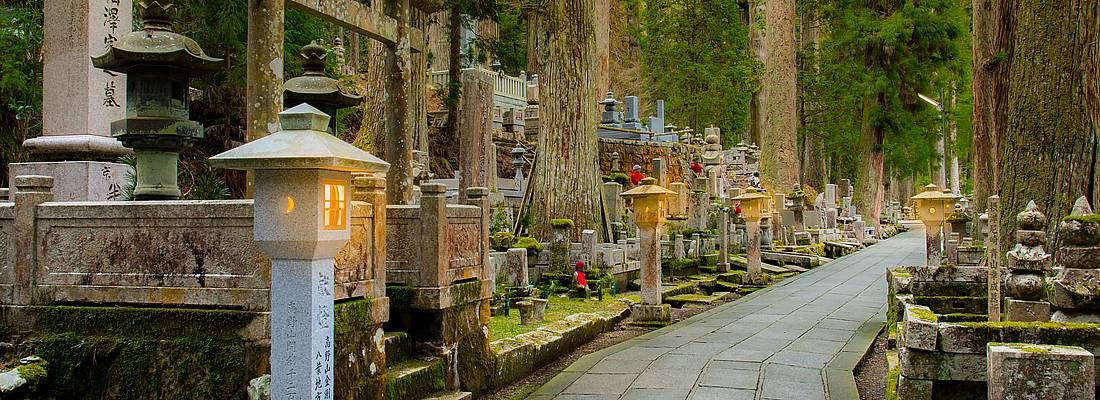
Mount Koya is full of buildings and places worth seeing, but the most important one is without a doubt Kongobu-ji, the head temple of Shingon Buddhism. Toyotomi Hideyoshi built it in 1593, and it later became the administrative heart of the whole complex. Inside you’ll find paintings and religious objects, plus a beautiful rock garden that’s one of the largest in Japan. The temple precinct at the heart of Koyasan is called Danjo Garan and holds many buildings. The one that stands out is the Konpon Daito, a white and orange pagoda that houses a large Buddha statue and represents the central point of the mandala, a kind of essence or center of the universe. Inside the Danjo Garan you can also visit the Kondo, Mount Koya’s main hall. Then there’s Kobo Daishi’s mausoleum (Okunoin). It’s surrounded by a vast cemetery, the largest in Japan, and you reach the mausoleum on a path through the beautiful cedar forest.
Okunoin and Kobo Daishi
To believers, Kobo Daishi isn’t dead. Since 835 he has been resting in his mausoleum in eternal meditation, waiting for the Buddha of the future. It’s not a minor detail, because it explains everything you see around you. There are more than 200,000 graves lining the path, and everything along it, from the graves of the most famous samurai to the monuments put up by Japanese companies, is there because someone wanted to rest next to him.
Every day the monks bring two meals to the mausoleum in a small procession you can watch go by on the path. It’s one of the oldest rituals in Japan, and it has never been interrupted. In front of the mausoleum stands the Torodo, the Hall of Lanterns, where more than ten thousand lanterns donated by worshippers are kept burning, some of them for centuries.
Once you cross Gobyobashi, the last bridge before the mausoleum, you’re in the most sacred area. You can’t take photos here, or eat or drink, and custom calls for a small bow before you cross the bridge.
Getting to know Buddhism
If you’d like to get closer to Buddhism and understand it better, there are several activities and ceremonies you can take part in here.
You can attend a Buddhist religious ceremony, for example. Every temple holds one each morning, usually starting at 6:00, when the monks chant prayers in the main hall.
At the Daishi Kyokai center you can try sutra copying. The most important text in Shingon Buddhism is the Hannya-Shingyo Sutra, known in English as the Heart Sutra (shin means heart). In Buddhism, copying the scriptures by hand is considered a very important “healing” ritual, because people believe that while you do it all your pain and problems are swept away and you heal in body and mind.
Another path to “healing” is Ajikan, a form of meditation typical of Shingon Buddhism that visitors can try at some temples.
On certain dates during the year you can also take part in a ritual called Kechien Kanjo, which aims to create a bond with the Buddha. It starts with the monks reciting a prayer. The participant is then blindfolded, given a flower to hold and led to the center of a mandala painted with various Buddhas, where they drop the flower onto the mandala. The Buddha it lands on is the one they form a bond with. At the end of the ritual, one of the monks pours water over the participant in a kind of purification ceremony meant to ease suffering and help anyone who feels lost “find their way again.”
Vegetarian temple food
If you stay at a temple, you’ll have to follow the Buddhist diet, which forbids eating meat. The dishes are very delicate and wholesome, made with seasonal ingredients according to the “rule of five”: five flavors, five cooking methods and five colors. Even if you love meat and might struggle a bit with these new flavors, I recommend trying this cuisine. Every temple serves it, and it includes specialties like Goma-dofu (sesame tofu) and Koya-dofu (freeze-dried tofu), both packed with protein. Some dishes also include edible wild plants and herbs from the area, which give them a unique, distinctive flavor.
Some specialties are also made and packaged so you can buy them as souvenirs or snacks for the trip. At the temple you can also buy other gifts, like good-luck charms, prayer beads and wooden tablets for writing sutras.
Getting There
From Osaka, you leave from Namba Station on the Nankai Koya Line. The Koya limited express gets to Gokurakubashi in about 80 minutes, while on express trains you change at Hashimoto and the whole trip takes just under two hours.
At Gokurakubashi you continue on the cable car, five minutes up to Koyasan Station, and from there you take the bus, because pedestrians aren't allowed on that road. Ten minutes later you're at Senjuinbashi, in the center of town.
From Kyoto and Nara it's best to go through Osaka Namba, or take JR trains to Hashimoto and switch to the Nankai line there. Once you're in town, you get around on foot or on the local buses.
Useful Info
Name: Mount Koya
Cost per person: Okunoin: free - Danjo Garan: free to enter the grounds, 500 yen per person each for the Kondo and the Konpon Daito - Kongobu-ji: 1,000 yen - Combined ticket: 2,500 yen, also includes the Reihokan museum
Time needed: I recommend at least 6-8 hours for the main sites like Okunoin, but I suggest staying a full day and spending the night at a temple so you can experience the morning rituals.
Booking: Temple stays need to be booked in advance, especially in spring and fall. You can go through the official website of the Koyasan shukubo association, which passes your request on to the individual temples, or book directly with some of them. Without a reservation it's hard to find a room.
Tips: Enter Okunoin from the Ichinohashi bridge, not from the stop closest to the mausoleum. Otherwise you miss two kilometers of gravestones and centuries-old cedars, and almost everyone does. If you're staying at a temple, go back after dinner, when only the stone lanterns are still lit.
Getting there:
- Gokurakubashi Station (Nankai Koya): end of the line at the foot of the mountain, with a direct connection to the cable car
- Koyasan Station (cable car): from here you can only continue by bus
- Senjuinbashi and Okunoin-mae stops: center of town and entrance to the cemetery
Address: Koyasan, Koya, Ito District, Wakayama 648-0211, Japan
Open in Google MapsMap
MarcoMaps100% free
This place is on MarcoMaps
Mount Koya
My map of Japan: over 4,000 places I've tried myself, each with photos, rating, and hours. Filter by category and rating, find veg-friendly spots and places near you with GPS. No sign-up, right from your phone.
- 4,000+ places
- Rating, photos, and hours
- Veg friendly
- Near me (GPS)
- Favorites without login
- Works offline

