Mount Nokogiri
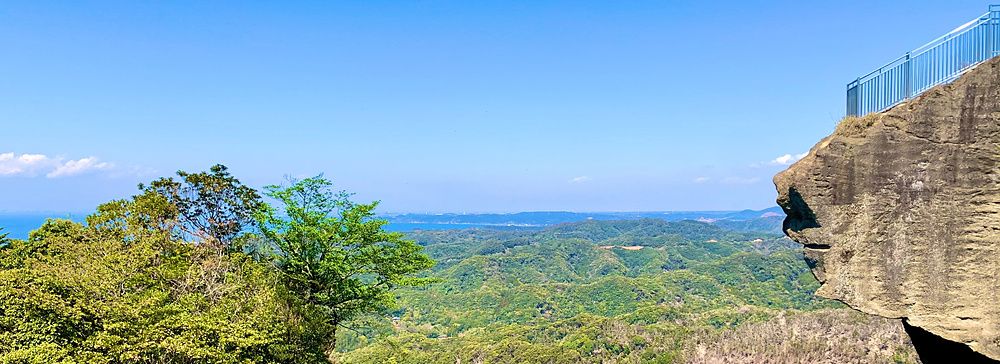
A low mountain on the Chiba side of Tokyo Bay, where an abandoned stone quarry and a huge temple have merged until you can’t tell one from the other. You get around Mount Nokogiri entirely on foot, on stone steps cut into the hillside, and there’s plenty to see: a Buddha carved out of the rock face, hundreds of statues tucked into niches, sheer walls as tall as apartment buildings and a spot where you lean out over the drop with the sea in front of you.
It’s the right place if you have a free day away from Tokyo, want to walk and don’t mind stairs. For me it’s one of the most striking places anywhere around Tokyo.
Contents
What you’ll see
The temple grounds, called Nihonji, cover the entire south side of the mountain, while the side facing the port is full of disused quarries. These are the parts worth your time:
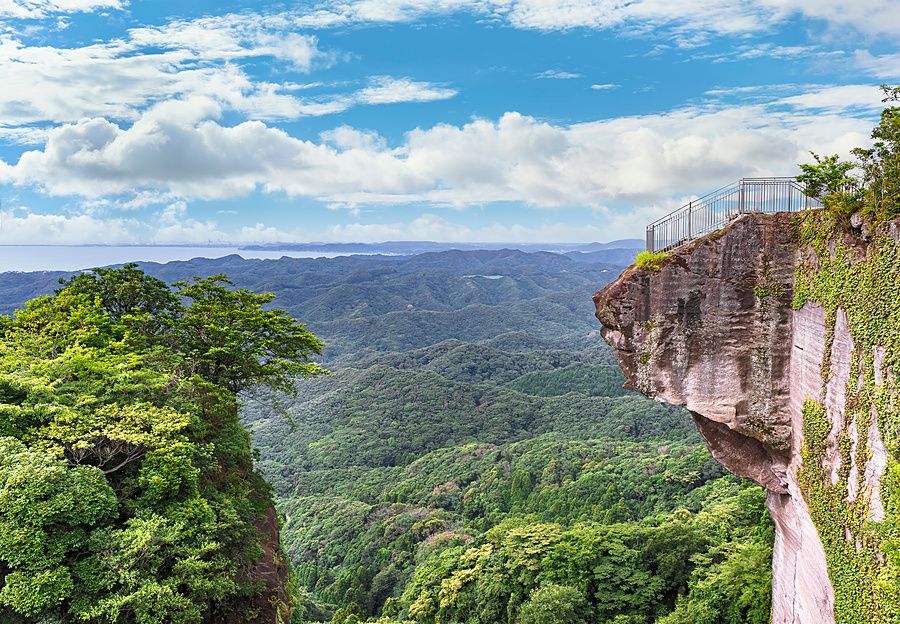
- Jigoku nozoki, or “a peek into hell”: a slab of rock jutting out over a quarry cut about a hundred meters deep. From the tip you can see the bay, the Miura Peninsula across the water and, when the air is clear, Mount Fuji.
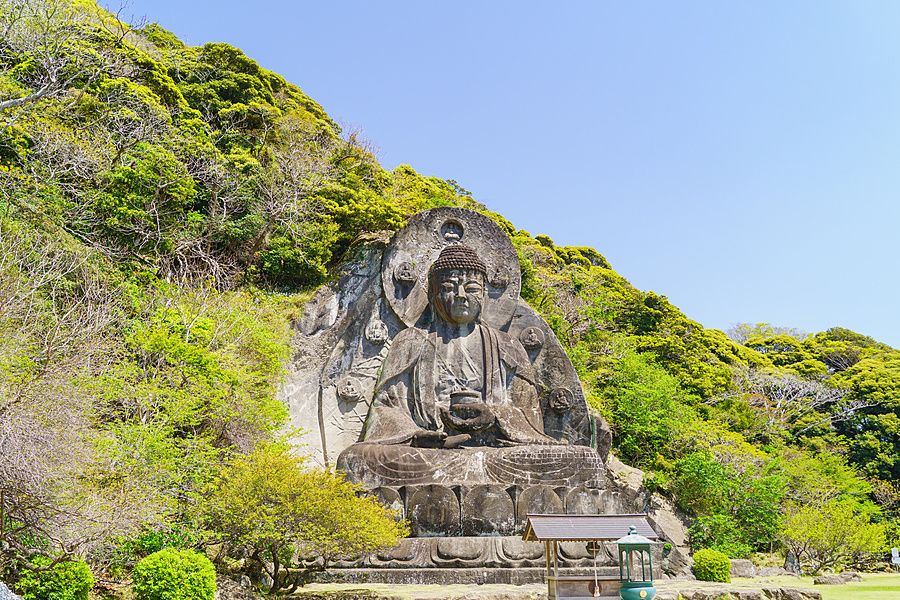
- The big Buddha, carved straight into the rock face: just over thirty meters tall including the base, the tallest of its kind in Japan. The ones in Nara and Kamakura would only come up to its belly.
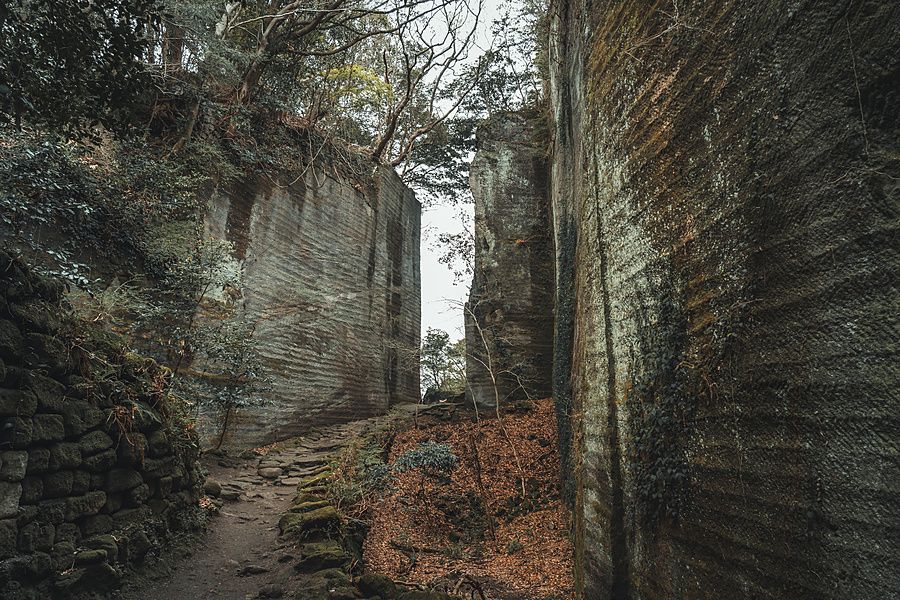
- The Hundred-Foot Kannon, a figure about thirty meters tall carved at the end of a quarry corridor: you walk between two sheer, knife-cut walls, the passage opens up and suddenly there it is, right in front of you.
- Statues of the disciples, more than fifteen hundred of them, set along the trail inside caves, cracks and hollows in the rock. Every face is different, and many of the statues are missing their heads.
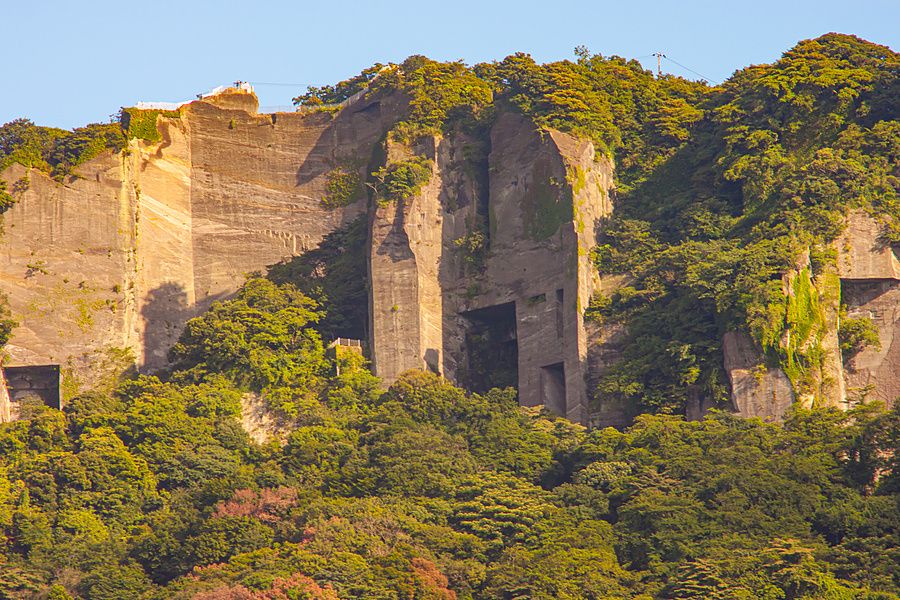
- The actual quarries on the port side, outside the temple grounds: smooth walls still covered in chisel marks, moss, ivy hanging down from above and passages cut through the stone where the air stays cold even in August.
The rock ledge you lean out from is shorter than it looks in photos and only fits a few people at a time, so there’s a line. On busy days the wait gets seriously long, and when your turn comes you get a handful of seconds up there with twenty people waiting behind you. There is a low railing, so how scary it feels comes down to whether you have the stomach for it.
The Buddha is much lower down than the viewpoint, and that’s the detail that trips everyone up: going down is easy, but climbing back up means twenty or thirty minutes on the stairs, and when you’re already tired they wear you down. If you have to choose, the upper part with the Kannon and the quarries is the more rewarding one.
The headless statues didn’t end up that way by accident. In the early years of the Meiji era, when the state separated Shinto from Buddhism, temples and Buddhist statues across much of Japan were destroyed or looted, and here the statues were beheaded by the hundreds. Some of the heads were put back on later, but many weren’t. Walking among them, with moss growing on them and water dripping off the rock, is the part of the walk where people stop talking.
I keep coming back mostly for the corridors cut into the quarry, not for the temple. I like standing there looking at the lines the chisels left on the stone, every single one made by hand, and thinking that half the stonework around the bay came out of that hole. That’s why, when someone asks me for a day trip out of Tokyo, this is the first one I suggest. The stone here is a soft tuff that’s easy to work, and for centuries it went into walls, wharves and foundations in Tokyo and Yokohama; the quarries stayed in use until 1985. Carts hauled the blocks down to the port on a trail paved with the same stone, and you can still walk it today.
The place promises a view and a ledge over the drop, and it delivers on both. What you don’t realize before you go is that the best part isn’t the one famous spot but everything else put together: the mountain eaten away by the quarries, the statues in the caves, the greenery reclaiming the stone. You need some stamina, but the payoff is huge.
When to go
Early in the morning it feels like a different place from midday. The line for the ledge is short or nonexistent, you don’t run into anyone on the steps, and the sea still looks milky.
From late morning on, especially on weekends, it’s another story: you walk in single file through the narrow passages, and at the jutting rock you wait your turn among people taking photos of their friends. Weekdays are much calmer, except when school groups show up, and you can hear those from far off.
Fall is the best season, with the leaves turning red from the end of October into early December. They cling to the gray stone walls, and the contrast stands out from far away. In June there are thousands of hydrangeas along the entrance path.
In winter the air is clear and you can see Mount Fuji well from the top, which rarely happens the rest of the year. Summer, on the other hand, is tough: the stone steps throw the heat right back at you, there’s shade only here and there and you’ll need more water than you think.
If it’s raining, skip it. It’s not just that the view disappears into the fog. The wet, mossy stone gets as slippery as soap, especially on the way down.
The stairs
If you do the whole thing on foot, you’ll climb and descend more than 2,600 steps in total. Even if you skip the lower part it’s still a lot: the spot where you lean out over the drop can only be reached on foot, and from the highest point you can get to without any effort there’s still a good twenty minutes on the stairs.
The stone steps are uneven, each one a different height from the next, and in some stretches there’s no handrail. Wear closed-toe shoes with sturdy soles, not sandals. It’s the most obvious advice in the world, and every time I’m there I see someone who wishes they’d followed it.
A stroller just won’t work here, so plan on a baby carrier or kids who can walk on their own. If you have bad knees, going down is harder than going up.
There’s nothing to buy along the way and there are restrooms in only a couple of spots, so bring your own water and something to eat. If your idea of a day out is seeing a couple of things and then sitting down, this isn’t the place, because here all you do is walk.
Getting the best photo
You won’t get a good shot standing on the jutting rock, because all you see is the drop and your own shoes. The photo that actually shows what that spot is like is the one you take from below and off to the side, with the full height of the vertical quarry cut in the frame and the people on top as tiny as ants.
The other shot I recommend is from the corridor just before the giant Kannon, where the two walls close in tight to frame the scene and the carved figure fills the far end.
On the quarry side, the walls with hanging ivy look best in mid-morning, when the light comes in at an angle and you can see every chisel line. At noon, with the sun high, everything looks flat.
In short
- The highlight: the rock jutting out over the old quarry’s drop, with Tokyo Bay in front of you.
- When to go: early morning to avoid the line, fall for the colors, winter for clear air; avoid weekends.
- Best for: anyone with a free day outside Tokyo who enjoys walking and isn’t put off by steps.
- Atmosphere: cut stone, moss, statues inside caves, silence in the corridors and chatter only at the famous spots.
Final thoughts
What makes this place worth it isn’t a single attraction to check off. It’s the fact that a mountain gutted by human hands has become something beautiful to look at, and that you can walk through it from the summit all the way down to the Buddha’s feet. If you like walking, go, because there’s nothing like it within a couple of hours of Tokyo. If stairs are a problem for you, know before you set off that you’ll miss half the walk, and think about going somewhere else; with a stroller, don’t even try.
Getting There
From Hama-Kanaya Station (JR Uchibo Line), walk about 8 minutes to the ropeway's base station. The ropeway takes you to the top in a few minutes, a short walk from the west entrance of the temple grounds.
If you're coming from Yokosuka or the Miura Peninsula, the easiest option is the ferry from Kurihama, which crosses the bay to Kanaya Port, a few minutes' walk from the ropeway.
You can reach the south side, where the Buddha is, by car along the mountain's scenic road, with parking a few minutes from the plaza in front of the Buddha.
Useful Info
Ropeway: closes at 17:00 (16:00 in winter) and doesn't run in strong winds or on maintenance inspection days.
- Hama-Kanaya Station (JR Uchibo): 8 minutes on foot from the ropeway
- Kanaya Port (Tokyo Wan Ferry from Kurihama): a few minutes on foot from the ropeway
- On the south side there's also Hota Station (JR Uchibo)
Map
This place is on MarcoMaps
Mount Nokogiri
My map of Japan: over 4,000 places I've tried myself, each with photos, rating, and hours. Filter by category and rating, find veg-friendly spots and places near you with GPS. No sign-up, right from your phone.
- 4,000+ places
- Rating, photos, and hours
- Veg friendly
- Near me (GPS)
- Favorites without login
- Works offline

