Mozu Tombs
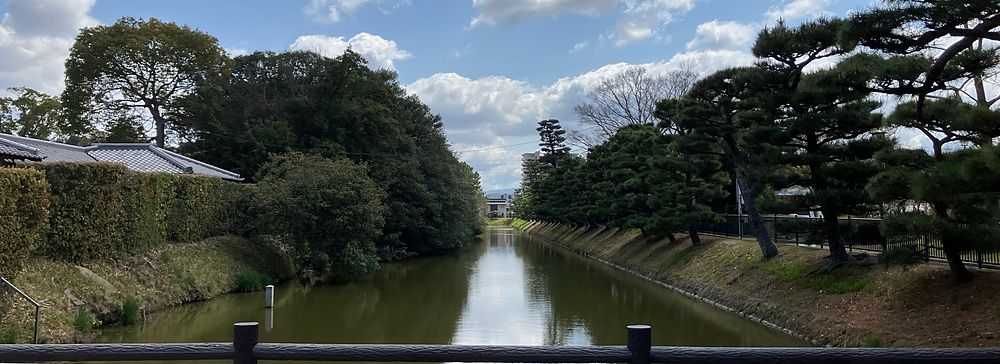
A cluster of ancient tombs in Sakai, the city right on Osaka’s southern edge, where small tree-covered hills hide the largest tombs in Japan. Forty-four Mozu Tombs survive, scattered among the streets and residential neighborhoods, and they’re on the UNESCO World Heritage list.
The biggest one is attributed to Emperor Nintoku. At the entrance you’ll see a water-filled moat and a forest, but from the ground you can’t see the famous keyhole shape at all. It’s the right place if you have a free day around Osaka and feel like walking, and much less so if you want a monument to frame in a photo before moving on.
What you’ll see
The sights are spread over an area of roughly four by four kilometers, and these are the ones that really matter:
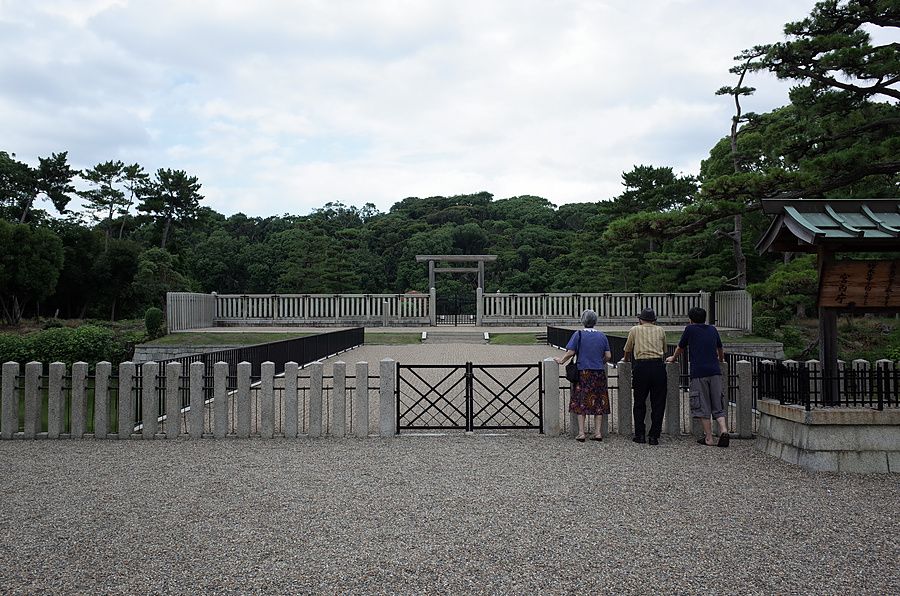
- The worship area in front of Nintoku’s tomb: gravel, a wooden gate, the green water of the moat and a wall of trees behind it. It’s the only spot where you face the mound head-on.
- The outer loop along the water: 2.8 kilometers of flat road, with Sakai’s houses coming right up to the edge of the moat and herons standing motionless on the bank.
- The visitor center next to the entrance, where they project aerial footage of the mounds onto the walls and floor. It also has Lego models of the tombs and replicas of the terracotta figures that were once set into the ground on top of the mounds.
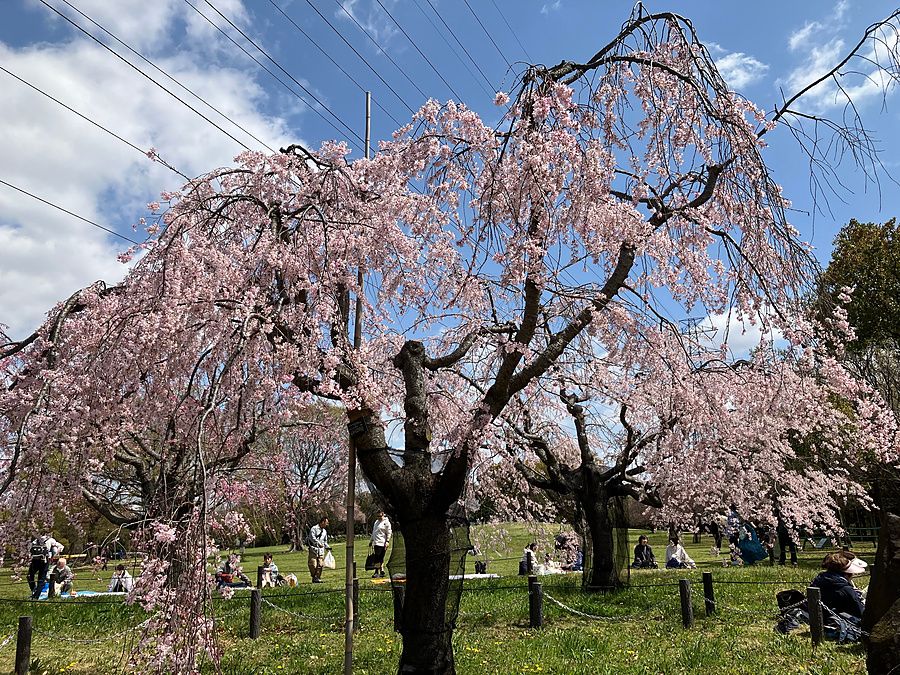
- Daisen Park, between the two largest tombs: a lawn that goes on and on, about a thousand cherry trees, a walled Japanese garden, the Sakai City Museum, and several small mounds that look like shrubs until you read the sign. In the southeast corner there’s a terrace over the moat of Richu’s tomb, where you can look across the water at the mound with no fence in the way.
- Itasuke, one of the mid-sized mounds: a concrete bridge sits in the moat, broken off halfway, left over from a plan to level the whole mound and take its soil. Tanuki live on that bridge.
- Nisanzai, to the east: the most beautiful moat of them all, extremely wide, with the trees reflected in the water.
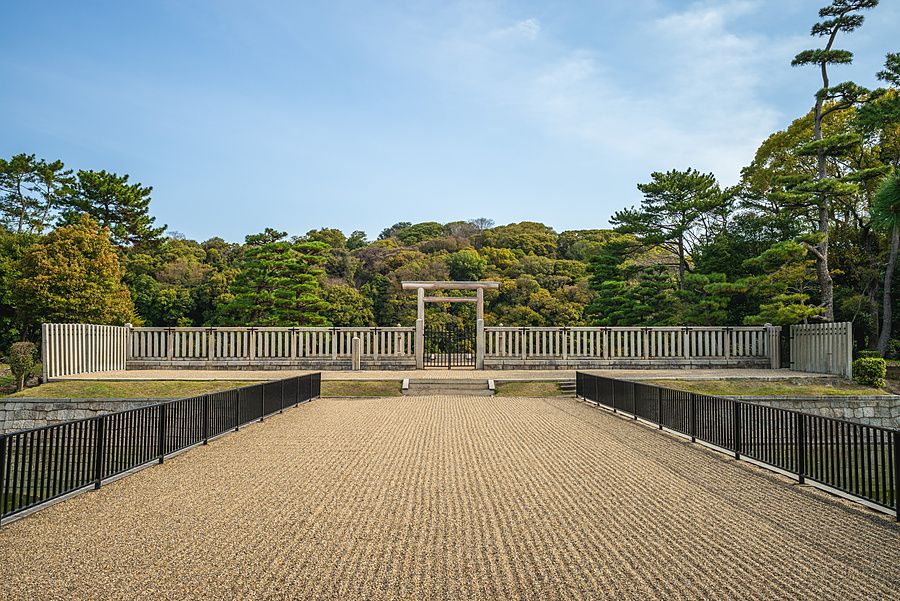
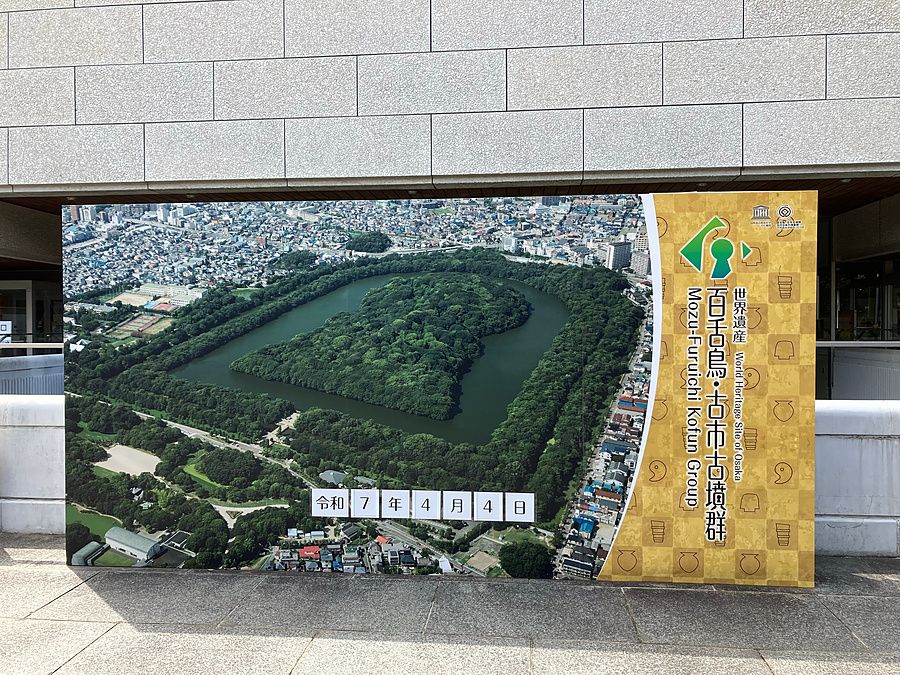
Make your peace with it now: you won’t see the keyhole shape. From Sakai City Hall, 80 meters up, you can make out a dense patch of green among the rooftops and nothing else, and anyone who goes up expecting the drawing from their school textbook is back down in three minutes. You only get the real outline from a plane, or from the tethered balloon that rises about a hundred meters above the park.
The worship area itself doesn’t take long: gravel under your shoes, a bow, a couple of photos of the forest. What matters is outside, along the moat and in the streets behind it, where you come across an imperial tomb sitting between a parking lot and a four-story apartment building.
It’s all closed off because the Imperial Household Agency manages these mounds as tombs of the imperial family’s ancestors, and excavation is banned. That’s why nobody knows for sure who’s actually buried inside, and many archaeologists prefer to call the largest one Daisen Kofun, after the area, rather than Nintoku’s tomb.
At the gate you’ll find Sakai’s volunteer guides, older gentlemen in jackets and yellow caps who explain the site to anyone who stops and point out where to look. Ask them, because they know the best angle for everything.
I come back here when I want to walk without having to decide anything. I start at the gate and do the whole loop around the water, which on the far side turns into a road where you hardly see anyone, and halfway around your legs tell you how big this place is in a way no photo can. Whenever someone visits me and says you can’t see the kofun anyway, this is the walk I ask them to do.
When to go
Early morning is by far the best time: flat light on the water, men from the neighborhood jogging along the moat, someone walking a dog, and traffic noise you only notice when you pass the main road again. On weekends tour bus groups show up at the gate and you wait your turn to photograph the mound, while on weekdays there are five or six people in total at the worship area.
In the late afternoon the moat changes color and Itasuke’s tanuki come out onto the broken bridge, so that’s when you want to be over on that side.
In spring the park turns into one big party, with cherry blossoms and families out on the lawn, but it gets packed. For me autumn is the season to go, because you can do the long loop without breaking a sweat and the colors on the water still look good.
Summer here is brutal. The outer loop is all asphalt, there’s shade only in patches, and on an August afternoon those kilometers turn into an endurance test. In heavy rain, forget it: everything here is outdoors and there’s nowhere to take cover.
Getting around
You see everything from the outside. You can’t climb the mounds, you can’t go inside, and nobody will let you past the gate. On the plus side, there are no stairs and no uphill stretches anywhere on the route, so strollers and wheelchairs have no trouble on the loop or in the park.
It’s a big area, though, and seeing three or four different mounds means a lot of walking on ordinary suburban streets. Plenty of people get around by bike, and they’re right to, because that way you can also reach Nisanzai and Gobyoyama without wearing yourself out on foot.
Kids do better here than you’d expect, just not in front of the moat. The lawn in Daisen Park, where they can run around and you can grab a bite, will keep them busy for a whole afternoon. The other thing I recommend, before you set off on foot, is a stop at the visitor center: seeing the mounds from above, projected on the floor, completely changes how you read what’s in front of you later, when all you can see is a wall of trees.
There are few benches and very few cafés along the water, so bring your own water.
At a glance
- Highlight: the walk along the moat of Nintoku’s tomb, with the neighborhood’s houses right at the water’s edge.
- When to go: early morning or late afternoon, ideally in autumn; spring is beautiful but crowded, summer is exhausting.
- Best for: people who’ve already seen Osaka and Kyoto and want to spend a day walking somewhere different, families bringing kids to the park, archaeology fans.
- Atmosphere: still water, herons, locals out jogging, small quiet groups at the gate.
Final thoughts
You don’t come here to see a monument, because there’s no monument to look at. You come to walk for a long time around a tomb you’d mistake for a natural hill from the ground, and to take in the strange sight of an imperial tomb right next to someone’s garage. It’s worth the detour from Osaka, no question in my mind, but only if you’re willing to walk and to imagine what you can’t see. If you’re short on time and want temples, gardens and things to photograph, you’ll walk away from this loop feeling like you’ve seen a fenced-in forest.
Useful Info
Map
This place is on MarcoMaps
Mozu Tombs
My map of Japan: over 4,000 places I've tried myself, each with photos, rating, and hours. Filter by category and rating, find veg-friendly spots and places near you with GPS. No sign-up, right from your phone.
- 4,000+ places
- Rating, photos, and hours
- Veg friendly
- Near me (GPS)
- Favorites without login
- Works offline

