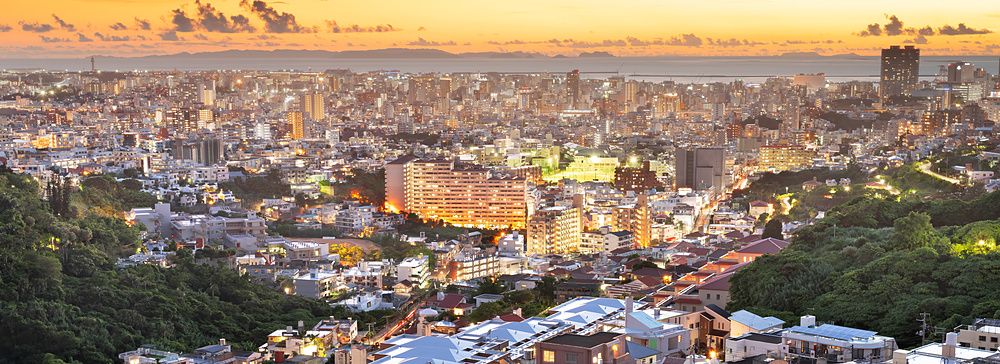
Naha
Naha is the gateway to Okinawa, but it often gets treated as just a stopover on the way to the beaches. Writing it off like that is a mistake.
It’s a hot, low-rise city that feels different from the rest of Japan. You’re not on the main islands anymore but in what was once the Ryukyu Kingdom, with its own language, its own food and its own pace.
Most travelers fly in, hop on the monorail and are downtown within half an hour, among the covered arcades and souvenir shops. I’d give the city at least one full day before rushing off to the sea, because this is the place to understand what makes Okinawa feel so far from Tokyo.
Contents
Restaurants

Shops

Village Vanguard
Kokusai-dori at night
Kokusai-dori is the backbone of downtown, just over a kilometer and a half of shops, izakaya and colorful signs. During the day it’s packed with people and pretty hot, with all the island’s humidity rising off the asphalt.
What I’d do is duck into the covered side streets like Heiwa-dori and the market arcades. That’s where you’ll find ceramic shisa lion-dogs, local salt and cane sugar, stalls selling tropical fruit and the strong smell of the fish market.
Walk ten minutes and everything changes. The shop windows give way to low houses and little places where you can eat Okinawa soba and drink awamori.
Evening is when the street comes into its own. The heat lets up a little, the lights come on, and you’ll often hear live music drifting out of the places along the street, with someone playing the sanshin, the three-stringed instrument whose sound box is covered in snakeskin. That’s why, honestly, I wouldn’t limit Naha to your daytime plans. At night it’s a different place.
The Miracle Mile
If Naha strikes you as a city without an old town, there’s a reason. In 1945 the Battle of Okinawa leveled it, and everything you see today was built from scratch after the war.
Before the war, Kokusai-dori was little more than a road through the fields. It takes its name from the Ernie Pyle International Theater, a movie theater that opened halfway along the street in 1948, and the speed at which shops and bars sprang up around it earned the street the nickname Miracle Mile.
Knowing this changes how you see the street. What looks like just a row of souvenir shops by day is the part of the city that Okinawans chose to rebuild first.
A base for the island
Naha makes the most sense as a base camp, but the monorail doesn’t go to the beaches or to the north of the island. For those you’ll need something else.
Within the city, public transportation is all you need, but once you want to see the rest of Okinawa, your practical options come down to a few:
- Rent a car: still the most convenient way to reach the beaches and the villages far from downtown.
- Rely on long-distance buses: slower and less intuitive, but fine if you don’t drive.
- Keep Naha as your base: take day trips and stay near the main street every night.
I’d set aside one day for Shuri. The castle was the heart of the Ryukyu Kingdom, which was founded in the 15th century, back when these islands were an independent kingdom trading with China and much of Asia.
It has been destroyed and rebuilt several times, and right now work is underway again, so before you head all the way up there, check what’s open when you plan to go. The hill on its own, with its curved stone walls and the view of the city sloping down to the sea, goes a long way toward explaining why Okinawa has always seen itself as a place apart. Below the castle, a stretch of the old royal road survives too: the Kinjocho stone-paved road, a couple of hundred meters of worn stone between low walls and houses, with six huge akagi trees giving shade halfway down. It’s all that’s left of the 16th-century road between Shuri and the port, almost all of which was wiped out in the war. Walking it is the closest you’ll get to feeling the kingdom under your feet.
Pottery in Tsuboya
A short walk from the shop windows of Kokusai-dori is Yachimun-dori, the pottery street: a few hundred meters of stone paving and low stone walls, with about twenty shops and workshops.
In 1682 the kingdom had the island’s kilns brought together here, and potters have worked the same dark clay ever since. The best pieces are the simplest ones: awamori cups, heavy plates glazed in blue and brown, and handmade shisa that cost more than the ones in souvenir shops, though one look tells you why.
It’s worth going in even if you’re only looking, because many of these are working studios, with the potter’s wheel at the back of the room. In the uphill lanes, a few old wood-fired kilns still survive, the long multi-chamber kind that nobody fires up in the city anymore.
Getting There
The Yui Rail monorail leaves right from the Naha Airport terminal and gets you downtown in just under 15 minutes. Get off at Kencho-mae for the start of Kokusai-dori, or at Makishi for the other end of the street and the market arcades.
The trick is to use both stops: get off at one end, walk the whole street and get back on at the other, without doubling back.
For the castle, stay on the same line to Shuri Station, then allow for a 15-minute uphill walk to Shureimon Gate.
Useful Info
Name: Naha
Time needed: At least one full day, or two if you want to take your time with Shuri, the market arcades and an evening on Kokusai-dori.
Closed: Makishi Public Market, the heart of the covered arcades, closes on the fourth Sunday of the month (in December it's open every day) and over New Year and Obon. The fish stalls also close on some other Sundays of the month.
Tips: At Makishi Public Market, don't just look at the stalls. You pick your fish on the ground floor and take it upstairs, where they'll cook it for you for a small extra charge. It's the most direct way to taste Okinawa's tropical fish.
Getting there:
- Kencho-mae (Yui Rail): south end of Kokusai-dori
- Makishi (Yui Rail): north end, market and covered arcades
- Shuri (Yui Rail): for the castle and the hill
- Yui Rail one-day pass: 800 yen, pays for itself quickly if you get on and off several times
Map
MarcoMaps100% free
This place is on MarcoMaps
Naha
My map of Japan: over 4,000 places I've tried myself, each with photos, rating, and hours. Filter by category and rating, find veg-friendly spots and places near you with GPS. No sign-up, right from your phone.
- 4,000+ places
- Rating, photos, and hours
- Veg friendly
- Near me (GPS)
- Favorites without login
- Works offline

