Nakasendo
Walking the Nakasendo is like traveling back in time. In the Edo period (1603-1868), this old post road was one of the five Gokaido, the main roads leading out of Edo, today’s Tokyo. Only the Nakasendo and the Tokaido went all the way to Kyoto, while the Nikko Kaido, Oshu Kaido and Koshu Kaido headed elsewhere.
The Tokugawa shogunate wanted these roads so officials, daimyo and merchants could travel more easily, and so it could keep the feudal lords in check. Plenty of other people used them too: wanderers, samurai, street performers and monks. On the long journey they stopped at the post towns, small villages where travelers could find a bed and a meal.
Contents
The route
The Nakasendo ran for about 500 km inland, through Japan’s mountains and valleys. The name says as much, since it literally means “road through the central mountains.” Back then it was a popular choice because it was mostly safe and better developed than other roads, where some stretches meant wading across rivers. The busiest road, though, was the Tokaido, which followed the Pacific coast. It was less developed, but it was largely flat and more direct. Today the Tokaido Shinkansen and National Route 1, both linking Tokyo and Osaka by way of Kyoto, follow that old road.
Most of the Nakasendo’s 500 kilometers is paved over today, but in the wooded stretches of the Kiso Valley time seems to stand still. Here you can still walk on the original road, following in the footsteps of travelers from centuries ago and coming across old villages that still have the feel of the past. The sections you can still walk draw lots of people who love hiking and history, and they get to see Japan’s oldest, most rural side at a slow pace, surrounded by beautiful countryside.
The Nakasendo then and now
The road was developed in the Edo period, but its origins actually go back to the Nara period in the 8th century. That period has left traces of a road called the Tosando, meaning “eastern mountain road,” which was modeled on Chinese roads.
In the early Edo period, the Nakasendo covered 534 km from Sanjo Bridge in Kyoto to Nihonbashi in Edo, today’s Tokyo, crossing what are now the prefectures of Kyoto, Shiga, Gifu, Nagano, Gunma and Saitama. Along the way there were 69 post towns where travelers could find a bed and a meal. Some of them were major stops, and they still keep much of their old look and feel, which has turned them into a big draw for visitors. The towns of the Kiso Valley in particular, like Magome and Tsumago, are stops on many hikes and trips for people looking for the legendary Japan of samurai and feudal lords.
Walking the Nakasendo
Very few people walk the whole Nakasendo from Tokyo to Kyoto these days, but a lot of them want to explore its best parts, the ones running through the well-known Kiso Valley. There are several guided tours lasting one or more days that take you along the Nakasendo and through its historic villages, but you can also do it on your own. You reach the Nakasendo from Nagoya Station, where you take a JR Chuo Line train either to Nakatsugawa, the most convenient station for Magome, or to Nagiso, the closest one to Tsumago.
The most popular stretch
The most popular stretch runs from Magome to Tsumago, and some keep going to Nagiso. Buses from Nakatsugawa Station get you to Magome easily, and once you’re there you can take a look around the village before setting off for Tsumago. This part of the old post road climbs to the Magome-toge pass and then heads back down past waterfalls and farmland. Depending on the season, you’ll see mountain peaks, rice paddies stretching out in front of you, bright shades of green or the deep, warm colors of fall. It’s a pleasant walk of about 2 hours, and if you want, another hour and a half on foot gets you to Nagiso, where you can take the train back to Nagoya. Almost everyone walks it in this direction, and they’re right to. You start at 600 meters in Magome, climb to just under 800 at the pass and then it’s downhill all the way to Tsumago at 420 meters. Going the other way, you really feel the climb. Just past the pass there’s an old teahouse run by volunteers, where they serve hot or cold tea depending on the season. Along the trail you’ll also see brass bells hanging from posts. Ring them as you go by: they’re there to let the bears in the woods know you’re coming.
The trail is well marked, so you won’t have trouble finding your way, and the villages have luggage forwarding services that take your bags and have them waiting for you at your destination. The path winds around a bit, but walking the nearly 8 km between Magome and Tsumago is a one-of-a-kind chance to be out in spectacular mountain scenery, take in the smells and colors and meet the people who live here. On the way you’ll pass lots of stone statues of Jizo, a Buddhist deity seen as the protector of travelers, and a few replicas of “ichirizuka,” mounds of earth planted with trees that were built every ri, just under 4 km, to mark the distance from Nihonbashi Bridge. If you’d rather not walk or you’re short on time, buses run between the villages, so you can get around easily and still enjoy the scenery from the window.
Other sections you can walk
If you fall for the Nakasendo, the stretch between Magome and Tsumago isn’t the only one you can still walk. The most beautiful of the others is the trail from Yabuhara to Narai over the Torii pass, which at 1,197 meters is the highest pass in the Kiso area. It’s about six kilometers through thick forest, with the ruins of an old shrine on the way up and, on clear days, a view of the sacred Mount Ontake.
The trail ends in Narai, which in its day was the richest post town on the road and today is the longest, stretching for a kilometer with wooden houses that are nearly all historic. Compared with the southern Kiso, the big plus here is that you’ll be walking with far fewer people around.
There are also short sections that connect to the classic one. From Nakatsugawa you can walk up to Magome instead of taking the bus, and from Tsumago you can carry on to Nagiso along the valley floor. Put them together and you can make the walk longer without ever leaving the old road.
Visiting the post towns
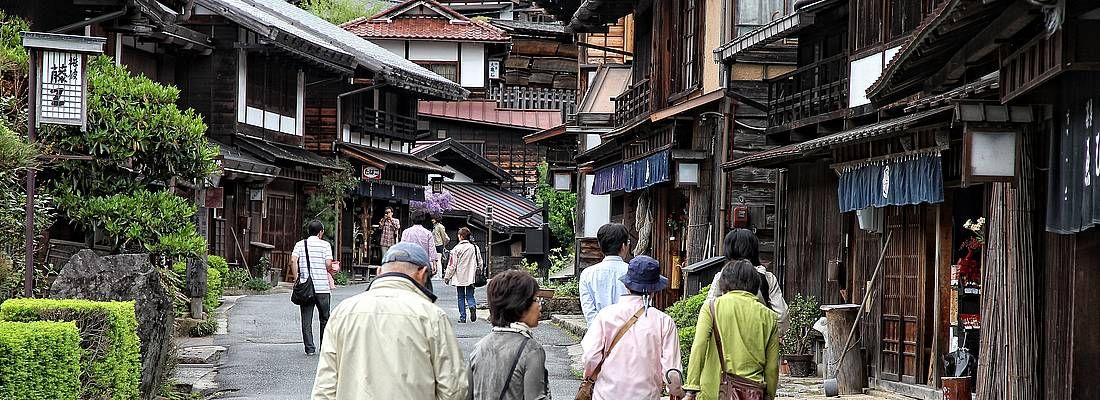
Walking the Nakasendo is also a great way to see the villages of the Kiso Valley, with their winding cobbled lanes, traditional wooden houses, mills and green countryside all around. In Tsumago the effect is even stronger, because the power lines were buried underground and the vending machines, mailboxes and modern signs are hidden behind wooden panels. When you look up, you see no sign of the present day. In the middle of the day cars are kept off the main street, so you walk right down the middle of the road the way people used to.
In some villages, including Tsumago, you can see a few historic wooden buildings and go inside them, like the traditional inns called honjin and waki-honjin, where the upper classes of the time, such as daimyo and high-ranking officials, stayed.
In the villages you’ll also come across seki, a kind of forerunner of today’s customs checkpoints, where the authorities checked incoming travelers and goods, and kosatsuba, small wooden towers hung with wooden boards that told travelers the rules and laws of the village.
The post towns also have small souvenir and local craft shops where you can buy handmade wooden goods and food specialties from the area. If you’re in the Kiso Valley in November, don’t miss Tsumago’s Fuzoku Emaki procession, which follows the old road with participants dressed in period costume.
Staying overnight in a Nakasendo village
If you have the time, the best way to experience the Kiso Valley is to stay the night in one of the villages. Tsumago and Magome empty out once the day-trippers leave, and the lanes are only dimly lit. That sudden quiet may be the best moment of the whole walk.
Most places to stay are family-run minshuku, wooden houses with just a few rooms, futons on tatami and dinner cooked by the owners, often served around the irori, the hearth sunk into the floor. All of this still exists in Tsumago because the residents signed a now-famous pact summed up in three rules: don’t sell, don’t rent, don’t tear down. Spend a night there and you’ll understand that the village isn’t a stage set but a place where people still live.