Nanzoin Temple
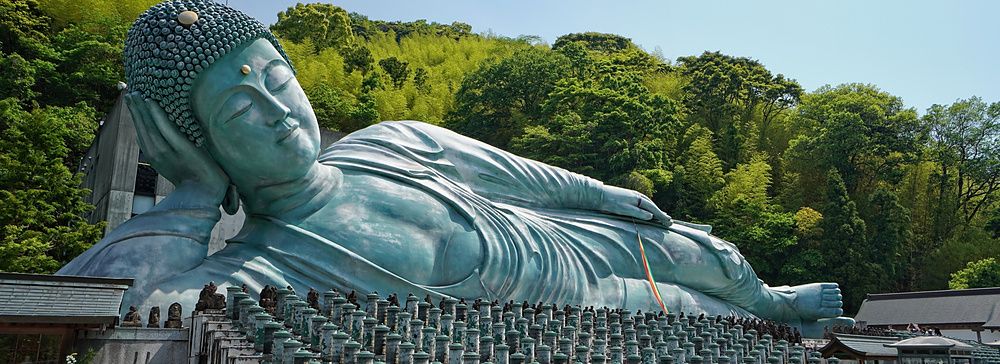
A mountain temple in the woods of Sasaguri, the town just outside Fukuoka, with the world’s largest bronze reclining Buddha inside its grounds: forty-one meters of statue stretched out along the side of the valley.
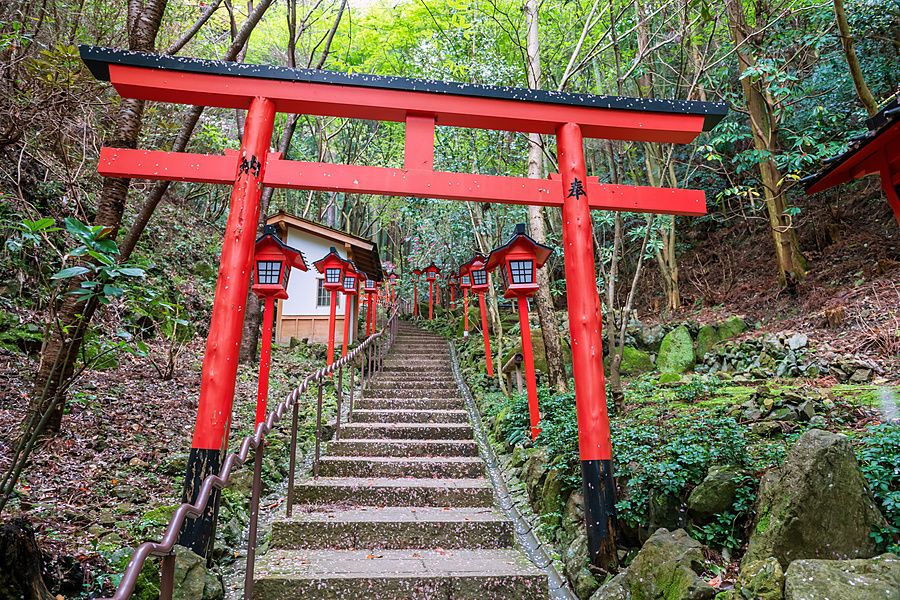
There’s more to Nanzoin than that, though. The path climbs past rows of small stone statues and runs through a tunnel. Along the way there’s the main hall, a Fudo Myoo with flames behind his back, and a waterfall where people stand under the cold water as an ascetic practice.
If you’re near Fukuoka and want to spend a morning out of the city, this is the place. It’s also worth it for anyone who’s never seen a statue that size up close, because seeing it in person is nothing like the photos.
What you’ll see
- The reclining Buddha: forty-one meters long, eleven meters high, three hundred metric tons of bronze. It lies stretched out in the greenery, and you approach it from the feet, which is where everyone stops.
- The five colored bands: they run from the statue’s left hand down to the area where people pray, and you hold them tight while you pray, which links you to the reclining figure. Everyone does it, and it’s nicer than it sounds on paper.
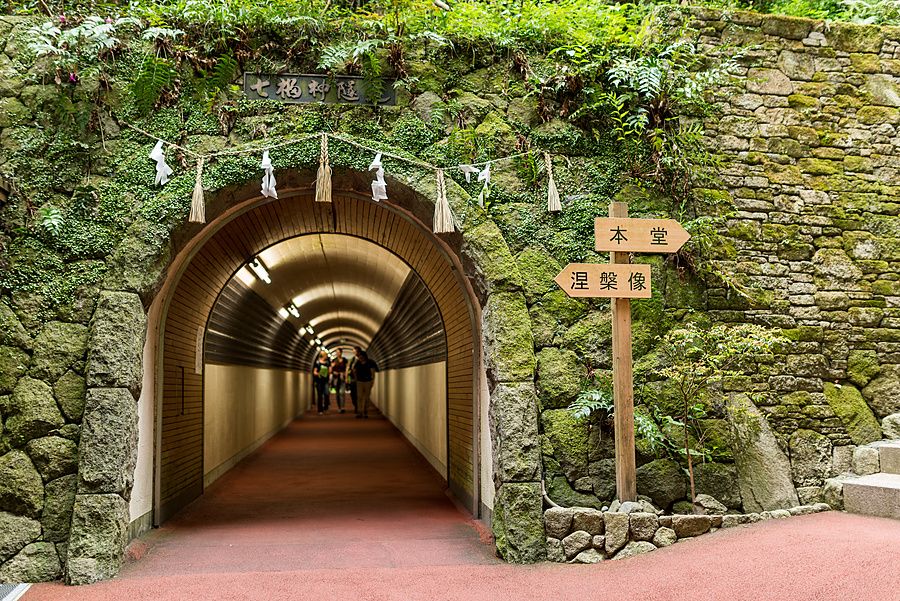
- The Seven Lucky Gods tunnel: about fifty meters of tunnel linking the lower part of the temple to the area around the Buddha, with the seven figures set along the walls and pairs of small statues left by pilgrims.
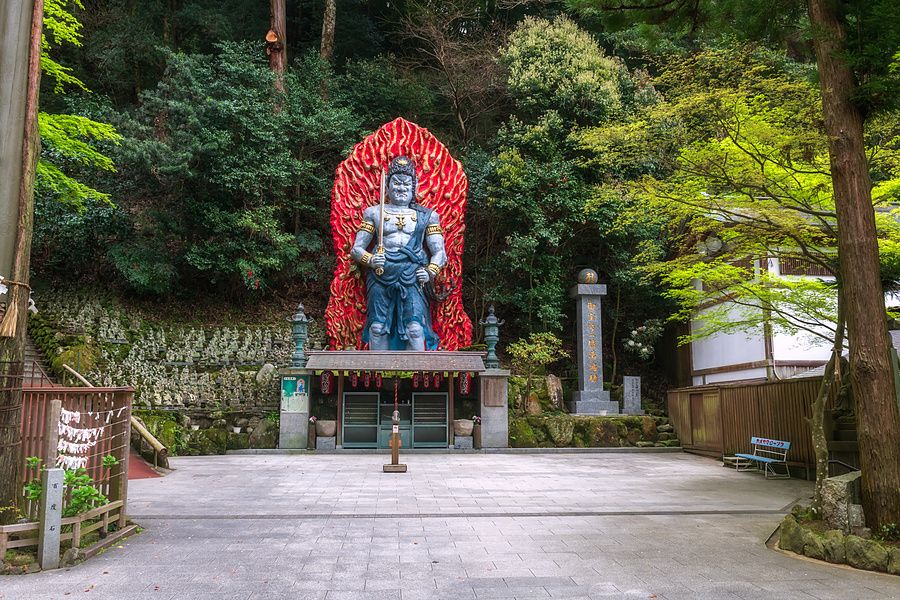
- The big Fudo Myoo: a sword in one hand, a rope in the other, and a wall of carved flames behind him. He stands higher up the slope, and far fewer people make it there than gather in front of the reclining statue.
- The waterfall and the water grotto: spring water and a waterfall used for ascetic practice, the kind where you stand under the falling water. Up there, the sound of the water alone drowns out everything else.
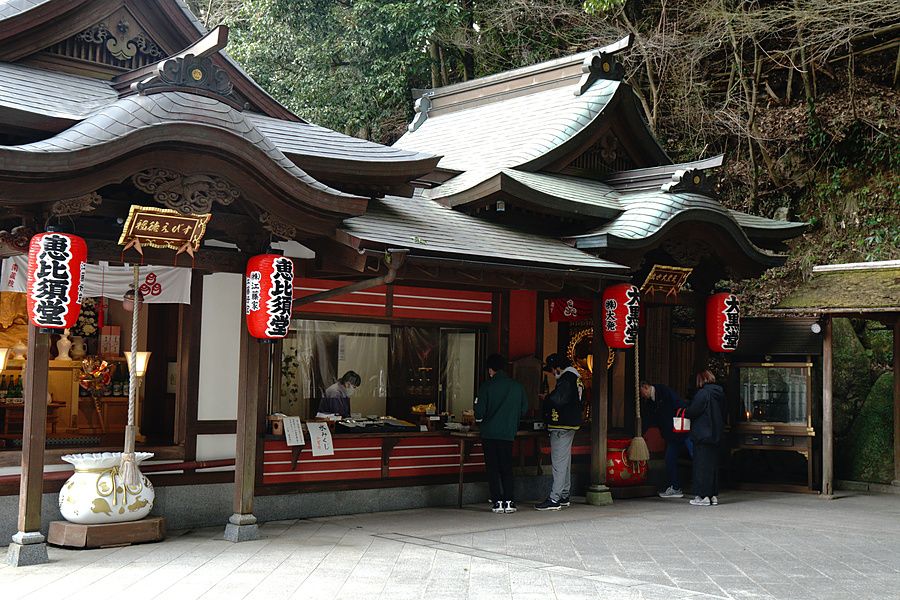
- The nakamise and the main hall: the nakamise is a row of stalls selling sweets made for the temple, candles, incense sticks and lucky cats. A little farther on is the main hall, with a spot where you can have a bowl of udon or soba.
The statue won’t fit in a single photo, and anyone who tries from the feet goes home with two giant toes and nothing else. The best spot comes earlier, on the uphill path, where the head appears through the branches and you can tell where the body ends. From there you can fit the whole thing in the frame.
The feet and the tunnel are the two bottlenecks where everyone bunches up, while the upper area around the Fudo Myoo and the water stays almost empty even when it’s packed below. If you have some time to spare, spend it up there.
This isn’t a theme park with a bronze giant in it. It’s a working temple with an ossuary, and there’s always someone among the visitors who has come to pray for a person they’ve lost. You’re asked not to walk around with bare shoulders or bare legs, and it’s a serious request, not a formality.
If you have trouble walking, or you’re with someone who does, you’ll struggle here. There’s no shorter version of the route that still gets you to the statue.
Nanzoin promises a huge statue, and on that front it delivers, no question. But what stays with me every time isn’t the world record. It’s the way you get there: the climb through the trees with small stone statues on both sides, the sound of the water, the steps, and then the valley opening up.
I go back whenever I have friends visiting Fukuoka and a free morning, because it’s the only place around here where I see people stop talking for a few seconds as soon as they turn the corner. It happens with everyone, even people who couldn’t care less about temples.
When to go
Early in the morning it’s a different temple. Pilgrims in white move from one statue to the next, incense smoke rises straight up through the trees, and you can have the Buddha’s feet to yourself for a few minutes.
From mid-morning to mid-afternoon the tour buses roll in with their groups, and the Seven Lucky Gods tunnel turns into a single-file line. By late afternoon the crowds thin out again and you can breathe.
On weekdays you can stroll; on weekends you can’t. If you get to choose, the times to avoid are the New Year holidays, the spring holiday week, the mid-August holiday week, and the fall foliage weeks from late October to mid-November.
That said, fall is the best season here. The maples in front of the main hall turn red, and the climb up to the statue changes color from one day to the next. In spring there are cherry blossoms, and in summer everything is green and it stays cool under the trees.
If the weather’s bad, go anyway. Gray days and light rain are when you’ll find fewer people, and the statue wet with rain, with mist rising from the valley, looks better than it does under a blazing sun. The one thing to watch is your footing: the stone steps and the downhill ramps get slippery, so wear sturdy shoes, nothing with smooth soles.
Inside the statue
You can go inside the reclining Buddha, and it isn’t a gimmick. There’s a hall with relics that came from Burma, and a route where you walk over sand taken from the eighty-eight temples of the Shikoku pilgrimage, with small statues lined up along the walls.
The light is low, people keep their voices down, and within a few steps you go from the noise outside to a corridor where all you hear is the shuffle of feet on the floor. The relics are also the reason the statue exists. Burmese monks gave them to the temple to thank it for the medical aid it sent to children in Myanmar and Nepal, and the reclining Buddha was built specifically to house them and inaugurated in 1995. It’s less a giant put there for show than a huge reliquary.
The Shikoku sand underfoot isn’t there by chance either. Nanzoin is the main temple of the Sasaguri pilgrimage, a circuit of eighty-eight temples scattered over the town’s hills and modeled on the one in Shikoku, and that’s why you see pilgrims dressed in white going by.
You come out near the soles of the feet, which are carved with Buddhist symbols, gold designs set inside panels. People leave coins in the hollows and run their hands over the soles.
From there you also see the head from below, with curls the size of soccer balls. That’s where you really measure the statue against your own body, far more than when you look at it from a distance.
Getting around
From the entrance to the statue it’s uphill all the way, and it’s a real climb: ramps, stone steps, and flat stretches that soon start going up again. Once you’re inside the grounds you keep going up and down from one building to the next, because the temple is spread across the mountainside and the things to see sit at different levels.
With a stroller it’s a battle, and in a wheelchair there are stretches you simply can’t get through. For kids who can walk, on the other hand, it’s perfect, because between the tunnel, the water, the statues and the candy stalls there’s always something around the next bend.
Bring water, and expect some stretches with no shade. The rest of the route runs under the trees, and in summer you really feel the difference.
There are two rules for photos: tripods and selfie sticks are banned, and if you’re shooting for work, you need to get permission in advance. If you’re just using your phone, nobody will say anything.
Oh, and if you see people buying amulets with real conviction in front of the small Daikoku hall, there’s a reason. The temple’s head priest won the lottery, and since then Nanzoin has had a reputation as the place to pray for luck with money. Whether you buy it or not, it explains half the focused faces you’ll see around.
At a glance
- The highlight: the bronze reclining Buddha, forty-one meters long and stretched out in the valley, with colored bands to hold while you pray.
- When to go: early morning on a weekday, or fall for the red maples. Around midday on weekends there are lines everywhere.
- Best for: anyone passing through Fukuoka with a free morning, families with kids who can walk, and anyone who wants to see a statue that’s completely off the scale.
- Atmosphere: mountain woods, running water, incense, pilgrims in white mixed in with the tourists, and a climb that leaves everyone quiet.
Final thoughts
Nanzoin is worth the detour even if you’ve already seen twenty temples, because you don’t come here for the architecture or a garden. You come for one enormous thing, on a scale no photo prepares you for, and for the walk that brings you face to face with it.
If you’re expecting an old wooden temple with a gravel garden, you’ll be caught off guard. Here it’s almost all bronze and concrete on a mountainside, and some corners feel more like a park full of votive statues than a historic site.
If climbs are hard for you, bear in mind that the best part is at the top and there’s no other way to reach it. For everyone else, it’s one of the best mornings you can spend around Fukuoka.