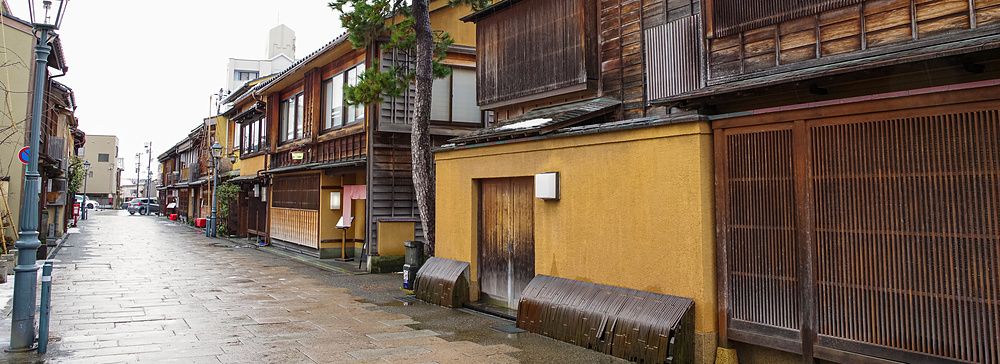
Nishi Chaya
A street of teahouses in Kanazawa, on the Teramachi side of the Sai River, where geisha still work and, as evening comes on, you can hear a shamisen being played behind the wooden lattices. Nishi Chaya is the smallest of the city’s three geisha districts: about a hundred meters of dark red facades, a museum housed in an old teahouse and a couple of shops selling some of the best Japanese sweets in Kanazawa.
Come here if Higashi Chaya, the best known of the three, was too crowded for you and you’d like to walk a street like this at your own pace, maybe with a visit to the temples just behind it.
What you’ll see
The teahouses are two-story wooden buildings with tightly spaced lattices on the ground floor, and inside, geisha entertain guests with music, dancing and games. In Kanazawa geisha are called geiko, and Nishi Chaya is the district that has the most of them.
- The main street: a single straight street with teahouses packed wall to wall, low streetlamps and spotless paving. It’s the main reason to come.
- The Nishi Chaya Shiryokan museum: it’s on the site of the teahouse where the writer Shimada Seijiro grew up. The ground floor has displays about him, and upstairs there’s a reconstructed banquet room with red walls, shamisen, drums and braziers.
- The kenban office: a pale, Western-style building with European-style windows, where the district’s geisha rehearse and their work is organized. Surrounded by all that dark wood, you’ll spot it right away.
- Amanatto Kawamura: a shop selling candied red, white and black beans mixed with walnuts, chestnuts or sweet potato. The most popular packs sell out early.
- Moroeya’s tearoom: an old rakugan shop. Rakugan are small dry sweets made of sugar and flour pressed into molds, and here you can try them with matcha while looking out at the street.
- Teramachi just behind: the temple district starts right behind the street, including Myoryuji, the ninja temple full of trapdoors, hidden staircases and secret passages.
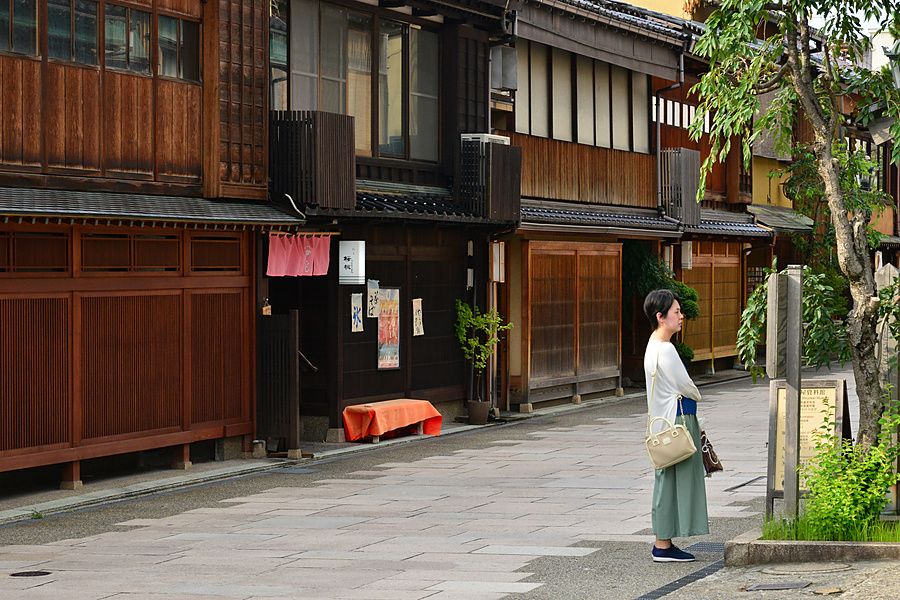
From one end of the street you can see all of it without taking a step. There are no side streets to explore and no alleys branching off. It’s one street, and that’s it.
You can’t go inside the teahouses. The doors stay shut, people really do work in there, and the only house you’ll get into is the museum.
At the museum, head straight upstairs. The red-walled room is what gives you a sense of what an evening at a teahouse was like, while the ground-floor exhibit on the writer is one you can skip if you don’t know who he is. At the entrance you’ll find the district’s volunteer guides, older men and women who are happy to tell you who lived in the houses along the street.
Of the shops, Kawamura is the one with a line. At Moroeya you can almost always get a seat without waiting.
Compared with Higashi Chaya there are fewer buildings to see here, but the street is still very much alive. The geisha name plates beside the doors are kept up to date, people live in the houses, and in the evening taxis pull up out front to drop off guests.
When I take people to Kanazawa, I bring them through here around sunset. It’s the only place in the city where you can walk a geisha street without weaving through crowds, and if you’re lucky, the sound of a shamisen drifts down from a second-floor window as you go.
How the street began
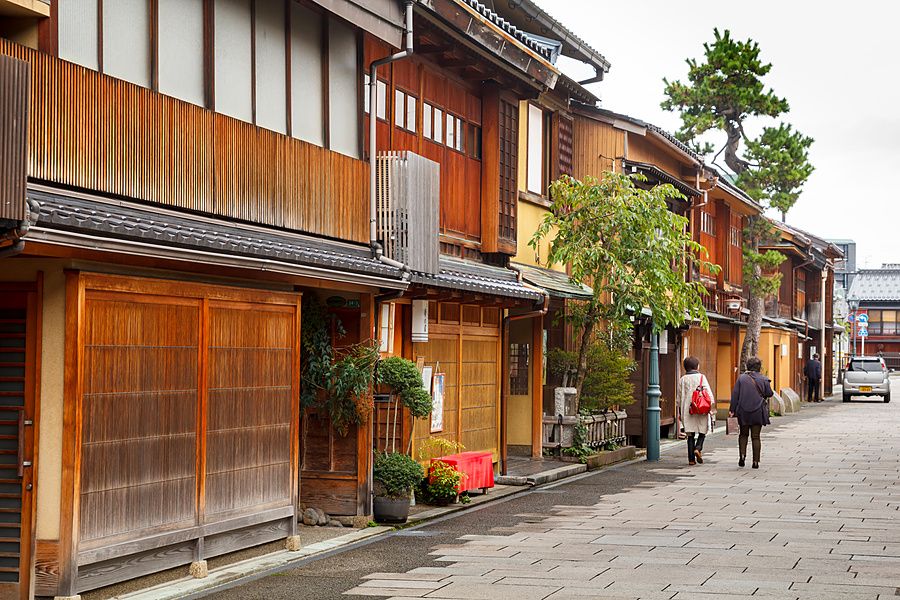
Nishi Chaya dates back to 1820. That year the Kaga domain decided to gather the teahouses, until then scattered around town, into two dedicated districts on the edge of the city center. One was Higashi Chaya to the east; the other was this one, west across the river. That’s where the names come from: the east chaya and the west chaya.
Today’s street is what’s left of that district, which is why you can walk it in just a few minutes.
Shimada Seijiro, the writer the museum is dedicated to, grew up here in the early 1900s. His novel Chijo was a huge hit in the 1920s, but he was soon forgotten, and part of the museum’s purpose is to keep his name alive.
The kenban building, the pale Western-style one, dates from 1922 and is still in use: the district’s geisha still rehearse there.
When to go
The best time to come is late afternoon, when the streetlamps come on and the geisha start arriving. That’s when the facades turn from dark red to a warm brown, yellow light spills out through the lattices, and the sounds of rehearsals drift out into the street.
In the morning the street is empty, with just residents sweeping in front of their doors and a few photographers. You can see it clearly, but without the lights and the music it feels like a different street.
On weekends you’ll notice the difference at Kawamura, where the line spills onto the sidewalk, and at Moroeya, where the tables fill up. The street itself stays easy to walk even on a Saturday afternoon, which is more than you can say for Higashi Chaya on a weekend.
I wouldn’t skip it in the rain. The wet paving stones reflect the glow of the streetlamps, and with an umbrella you can still walk the street just fine.
Photos and etiquette
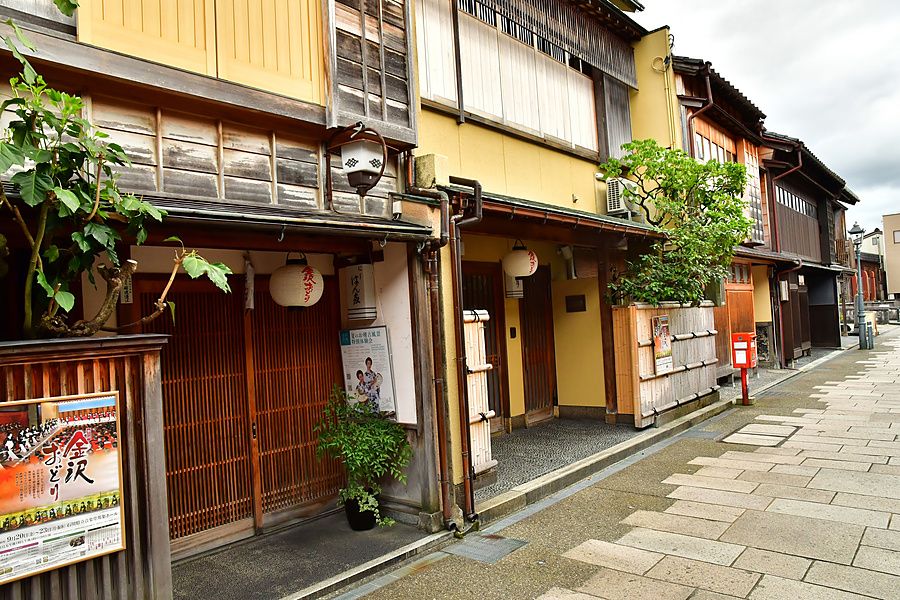
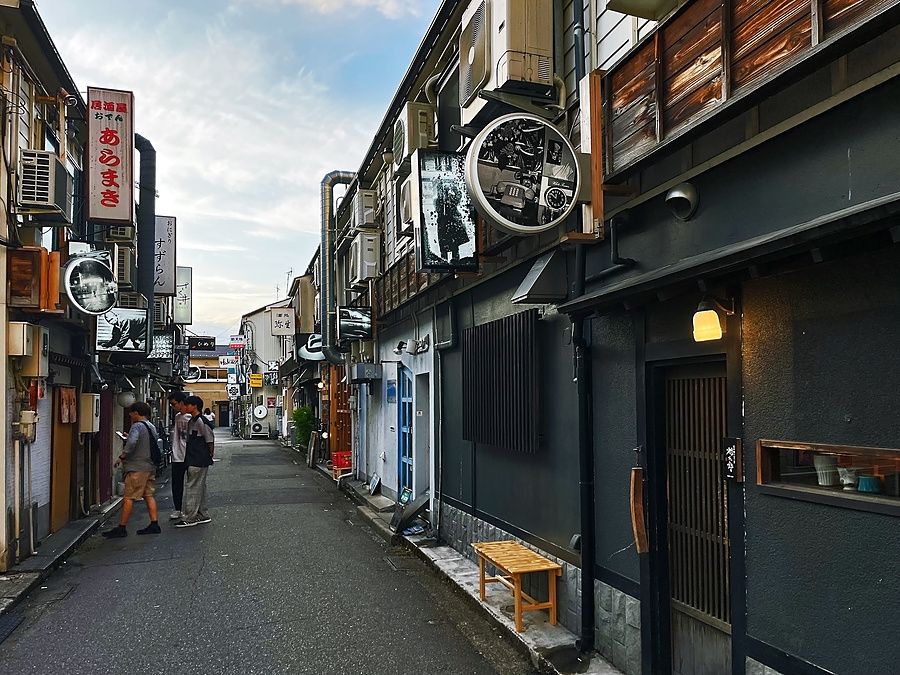
The best shot is from either end of the street, with the whole row of lattices receding into the distance. It looks best at dusk, with the streetlamps on and the sky still blue, and you won’t have to wait your turn the way you do in other geisha districts.
If a geisha walks by, let her pass. Geisha here are on their way to work and don’t stop for photos, and chasing them with your phone is what most annoys the people who live here. Don’t knock on doors, and don’t peek in through the lattices.
The street is flat, with no steps and smooth paving, so it’s fine for strollers and for anyone who has trouble walking. The only steep stairs are at the museum, the ones up to the red room.
Small kids get bored quickly, but a bag of candied beans or some soy milk ice cream from a local tofu shop will fix that.
At a glance
- The highlight: the teahouse street at dusk, with shamisen music coming through the lattices.
- When to go: late afternoon, just as the streetlamps come on; mornings are empty and lifeless.
- Best for: anyone who found Higashi Chaya too crowded, or who wants to pair a visit here with the Teramachi temples.
- Atmosphere: dark wood, yellow light, few people around and the occasional taxi pulling up.
Final thoughts
You don’t come to Nishi Chaya for landmarks. Apart from the museum, the street is lined with closed doors. You come for one street, seen at the right time of day, and for a piece of Kanazawa that’s still in use in the evening.
If you’re in Kanazawa, it’s worth stopping by at sunset, along with a walk around the temples and a stop for sweets. If you’re after museums, shops and streets to explore for hours, though, you’ll be disappointed after a hundred meters. That’s what Higashi Chaya is for, crowds included.